


Bern's Dangerous Change of Course


Switzerland, long defined by its perpetual neutrality and its good offices, now appears torn between tradition and geopolitical alignment.
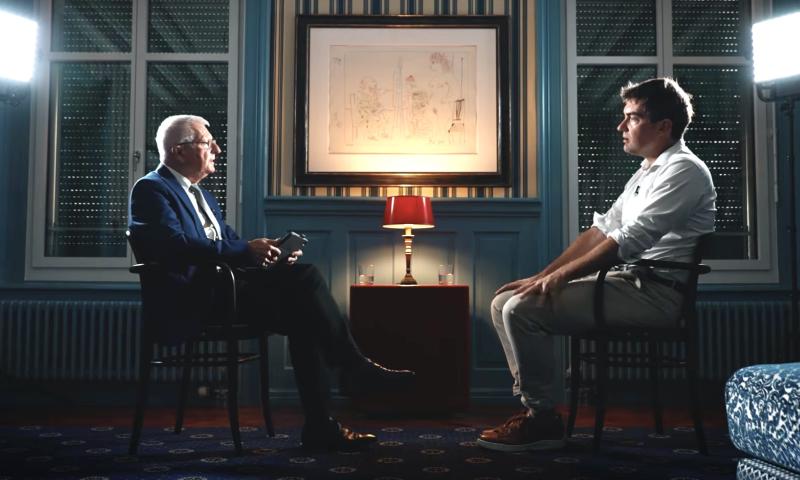
In this interview, Patrik Baab speaks with Rafael Lutz, a Swiss German journalist with an intimate knowledge of the inner workings of Swiss institutions. Lutz examines the mechanisms that, in his view, are gradually drawing the country towards NATO and the European Union — an analysis he sets out in detail in Das NATO-Netzwerk in der Schweiz, a book that has caused quite a stir. The conversation took place in Zurich on 20 August 2026, the day after the book's publication.
Networks of influence, foreign pressure, quiet purges within the security apparatus, the role of the media and think tanks: the book paints a picture of a neutrality increasingly challenged by decisions rarely subjected to public debate. Notably, major booksellers in German-speaking Switzerland have since pulled the book from sale following an intervention by a lawyer representing a senior official named in one chapter, even though no court had issued any ruling.
As Swiss voters head to the polls on 27 September 2026 to decide on the "Safeguarding Swiss Neutrality" initiative, this conversation sheds critical light on the forces at play and on the risks they pose to the Confederation's role as a mediator.
Interview
Patrik Baab: In your opinion, who is pushing Switzerland toward NATO?
Rafael Lutz: It is a network comprising media outlets, large parts of the federal administration, think tanks, and segments of the defense industry—in short, a NATO lobby. Since 2022, the Federal Department of Foreign Affairs and the Federal Department of Defense have taken the lead; the network cannot be attributed to specific individuals but operates structurally across multiple institutions.
“In short, this is a campaign to destabilize Switzerland's good offices.”
Patrik Baab: Is there a media-industrial-political-military-intelligence complex in Switzerland, similar to the one found in the U.S.?
Rafael Lutz: I wouldn’t say that outright, but seasoned diplomats—such as former Ambassador Vettovaglia—use this phrase in reference to the U.S. It’s an exaggeration, but it points in that direction: Today, it is primarily “NATO” or “EU loyalists” who are advancing their careers in key positions within the media industry, the federal administration, and powerful think tanks, while other voices are increasingly being marginalized.
Patrik Baab: Is Switzerland, with its pro-NATO stance, abandoning its perpetual neutrality, which is enshrined in the Constitution?
Rafael Lutz: As of today, the answer is clearly no—but things are moving in that direction. Joining NATO, as Finland or Sweden have done, is not on the table; there isn’t a majority in the population in favor of it. But the centuries-old tradition of neutrality and good offices is definitely under fire.
Patrik Baab: Are transatlantic-oriented elites seizing the moment following Russia’s invasion on February 24, 2022?
“Direct pressure from the U.S. and Brussels”
Rafael Lutz: Yes. Within a very short time, Switzerland aligned itself with the EU sanctions and has since adopted nearly every package of sanctions almost verbatim—a break from its previous practice of imposing sanctions on a case-by-case basis. Direct pressure was also a decisive factor: On February 27, 2022, then-U.S. Deputy Secretary of State Wendy Sherman made it unmistakably clear to State Secretary Livia Leu that Switzerland was expected to adopt the sanctions; shortly thereafter, a joint statement was even issued, apparently without consultation with Leu herself. Pressure also came from Brussels. The result: Neither the U.S. nor Russia now views Switzerland as a neutral state.
Patrik Baab: How many billions in Swiss taxpayer money have already gone toward the war in Ukraine?
Rafael Lutz: It would be interesting to know the exact figure, but at least three or four billion francs have already been spent. Providing for the approximately 70,000 to 80,000 Ukrainian refugees in Switzerland with S protection status alone has already cost several billion. On top of that, as part of the so-called reconstruction program, the government has promised another four to five billion by 2035—that is, over the next ten years. These are incredible sums—and of course, one can debate whether, as a democracy, this is what we want or not.
Patrik Baab: The Swiss economy rests on four pillars that are strongly interconnected internationally—finance, pharmaceuticals, commodities trading, and shipping. Does that make Switzerland vulnerable to blackmail? Was it pressured by the EU and Washington along the lines of “Join us in imposing sanctions, or we’ll sanction you”?
Rafael Lutz: I can’t say for sure whether it was blackmail in the strict sense, but there was clearly pressure. In 2025, Trump temporarily imposed tariffs of up to 39 percent on Switzerland—so this change in policy hurts Switzerland without benefiting it. Even our supposed allies do whatever they want with us; historically, there’s been hardly any friction with Russia, but there have been repeated conflicts with the Americans, who have also punished Swiss banks.
“So this change in course is hurting Switzerland without bringing it any benefits.”
Patrik Baab: So was Moscow generally fair toward Switzerland, while Washington was not?
Rafael Lutz: I wouldn’t say “fair,” but for the most part, Russia has merely taken note of these developments and, in effect, designated Switzerland as an enemy state—Lavrov and the Russian government have made that clear. This is also evident in Switzerland’s declining influence as a mediator, for example in the Iran conflict.
“You can see that Switzerland has lost its significance as a mediator.”
Patrik Baab: Has Ukraine itself tried to influence Swiss politics and culture?
Rafael Lutz: There are several examples. Ukrainian officials tried to sabotage the election of former Federal Councilor Alain Berset as Secretary General of the Council of Europe after he had cautiously criticized a “war frenzy.” In 2024, Ukrainian Ambassador Iryna Venediktova successfully intervened to prevent the screening of the film “Russia at War” at the Zurich Film Festival—even going directly to the Federal Department of Foreign Affairs—and unsuccessfully tried to block a performance by singer Anna Netrebko.
Patrik Baab: Does this go so far as to include attacks carried out on Swiss soil, such as the one against Ukrainian opposition figure Stanislaw Dombrowski in June 2025?
Rafael Lutz: Yes. Dombrowski, who had even wanted to become mayor of Odessa and was known there as a cultural and theater figure, fled to Switzerland in 2022 because, as a critic of President Zelenskyy, he had already run into trouble with the domestic intelligence service in Ukraine. There had already been three assassination attempts against him in Switzerland—on one occasion, his house was set on fire—before he was shot and wounded by an unknown assailant in the summer of 2025 in Diepoldsau, in the canton of St. Gallen, while on his way to work. Dombrowski himself blames the current head of the Ukrainian domestic intelligence service for this. Who is really behind it remains unclear—the investigation is ongoing—but it fits a pattern that has also been observed in other countries involving Ukrainian opposition figures.
“There have been attempted attacks in Switzerland”
Patrik Baab: Is Switzerland losing its traditional role as a mediator, for example in the Iran conflict or at the Bürgenstock Conference?
Rafael Lutz: Yes, that’s clearly evident. In negotiations regarding Iran, Pakistan, Qatar, or Turkey tend to play the central role today—not Geneva anymore. And the much-publicized “peace conference” at Bürgenstock in 2024 was organized without Russian participation at the express request of President Zelenskyy—then-Foreign Minister Viola Amherd allowed herself to be used by Zelenskyy instead of insisting on Switzerland’s traditional role as a mediator.
Patrik Baab: Are there targeted purges against advocates of neutrality within the Swiss security and military apparatus?
Rafael Lutz: In my book, I describe three cases. Jean-Daniel Ruch, a veteran diplomat and former Swiss ambassador to Israel and, prior to that, to Turkey, was set to become the new State Secretary for Security Policy in 2023—effectively the second-in-command at the Department of Defense. After October 7, 2023, former SVP National Council member and Israel lobbyist Alfred Heer wrote in Die Weltwoche that Ruch was something of a “Hamas useful idiot.” Shortly thereafter, Blick reported that Ruch had had an affair during his time as ambassador to Israel—an allegation dating back over ten years that had long been known. An allegedly incriminating dossier cited by Blick never officially surfaced; neither Ruch nor the DDPS has ever seen it. Ruch subsequently did not take the position—his successor, Markus Mäder, is considered a driving force behind the rapprochement with NATO.
Patrik Baab: And what about the case of a Swiss military advisor to the OSCE who came under scrutiny for espionage and treason?
Rafael Lutz: This military advisor—I’ll call him AF—maintained contact with Russian and Russia-aligned delegations on behalf of his superiors, because hardly anyone else was speaking with them. After a meeting was observed at a Viennese café, he was reported to Swiss authorities by a Ukrainian intelligence officer named Alexander Daniluk. The case is still pending, but in my estimation, it will likely be dismissed.
Patrik Baab: A woman also plays a leading role in the Department of Defense: Pälvi Pulli, a native of Finland, who is said to have skillfully worked her way to the top.
“Pälvi Pulli - Love Affairs with a Twist”
Rafael Lutz: Pälvi Pulli has long been a key figure in Swiss security policy. She is currently the second-in-command at the State Secretariat for Security Policy and previously served as head of security policy at the Department of Defense—a pivotal position that has played a decisive role in shaping security policy reports in recent years. She came to Switzerland from Finland at around age 21, working initially in bars, among other places, and then in various departments before advancing her career at the DDPS. She took over the position from her predecessor at the time, Christian Catrina, with whom she had previously been romantically involved—which, as they say today, leaves a bit of a bad taste.
Patrik Baab: How can someone advance so quickly in their career?
Rafael Lutz: What’s important to me here is that this isn’t a criticism of her as a person—she’s obviously highly intelligent, speaks several languages, and has integrated very quickly into Swiss society. I don’t want to pass moral judgment on this either, but it does raise the question of whether someone with a Finnish background—Finland has historically been at war with Russia—might not also harbor certain anti-Russian resentments. For such a person to rise to this key position would have been impossible a few decades ago, and to me, it’s a prime example of how the security apparatus and the DDPS as a whole have changed. So my criticism isn’t directed at Pulli herself, but at the system that allows such decisions to be made.
Patrik Baab: I immediately wondered whether Ms. Pulli had ties to NATO intelligence agencies.
Rafael Lutz: That’s a good question. But I don’t want to comment on something I don’t know—I don’t want to speculate.
Patrik Baab: Overall, you describe several such cases in your book.
“Supporters of neutrality and critics of NATO were bullied out”
Rafael Lutz: Exactly—there are other examples where, to put it bluntly, supporters of neutrality and NATO critics were literally driven out of the administration. I describe Ruch, AF, and Pulli in particularly meticulous detail; together, they illustrate how personnel policy in this sensitive area has shifted in recent years.
Patrik Baab: What role do transatlantic think tanks play in Switzerland?
Rafael Lutz: An important one. The federal administration often recruits from think tanks such as the left-liberal Foraus or the Center for Security Studies at ETH Zurich. Those who advance their careers there are primarily those who support the EU framework agreements and a rapprochement with NATO; former advocates of arms deliveries to Ukraine are suddenly appointed as “neutrality experts” in government bodies.
“Those who support closer ties with NATO will advance their careers”
Patrik Baab: And as for the arms industry: Elbit also supplied military equipment for the operation in the Gaza Strip—for the genocide in the Gaza Strip. What influence does this Israeli corporation wield?
Rafael Lutz: Elbit is one of the largest Israeli defense contractors; it was originally a state-owned enterprise but is now privately held. For several years now, the company has had a Swiss subsidiary, Elbit Systems Switzerland, and a test center in Bern; it works closely with the Swiss military and aims to become one of the army’s most important suppliers. Among other things, it supplies Hermes drones—ordered as early as 2015 and still not operational today due to technical problems—as well as radio equipment. This close cooperation alone is highly problematic from the perspective of neutrality, considering that Elbit is one of the Israeli army’s most important arms suppliers.
Patrik Baab: Are there also personnel ties?
Rafael Lutz: Another striking aspect is the revolving door effect: Jakob Baumann, the current chairman of the board of Elbit Switzerland, was previously the head of Armasuisse; he then moved to the Israeli company Bagheera—which, in turn, supplies technology for the Elbit drones ordered by Switzerland for 300 million Swiss francs—before returning to Elbit. Savis, who was responsible for procurement at Armasuisse, now works for Pilatus, which, among other things, supplies parts for the F-35. For Lockheed Martin’s F-35 fighter jets, the fixed price promised to voters has now been exceeded by at least 1.3 billion francs; the same is true for the Patriot systems.
Patrik Baab: What role do international U.S. financial conglomerates such as BlackRock, State Street, or Vanguard play—do they exert influence through Swiss banks or industry to draw the country more deeply into wars?
“Swiss banks lobbied for the adoption of the sanctions”
Rafael Lutz: I can’t really judge that. What’s striking is simply that these corporations are involved everywhere: BlackRock holds significant stakes in virtually all major defense contractors, including Rheinmetall. Their profits have been skyrocketing since 2022—just like Elbit’s. However, I wouldn’t attribute a central, controlling role to BlackRock or Vanguard. The situation is different with UBS: It was the Swiss banks, led by UBS, that put pressure on the Federal Council themselves in 2022 and advocated for the adoption of sanctions—presumably to shift the responsibility for terminating client relationships onto policymakers rather than taking responsibility themselves.
Patrik Baab: What role do the media play in the effort to push Switzerland closer to NATO?
Rafael Lutz: A very central one—especially the NZZ, which is regarded as an authority within the federal administration: When the NZZ writes something, it’s quickly taken as fact there. This marks a reversal from the era of legendary editor-in-chief Willy Bretscher, who fought vehemently for neutrality.
“Swiss Media in War Mode”
Patrik Baab: Are the Swiss media in “war mode,” as exemplified by NZZ columnist Peter Hässler, who describes the neutrality initiative as a pro-Kremlin stance?
Rafael Lutz: You could say that, at least when it comes to individual journalists. Hässler is one of the NZZ’s most influential voices; he openly calls for a discussion on NATO membership and has close ties to former Chief of the Swiss Armed Forces Thomas Süssli, with whom he co-authored a book. A few decades ago, such a stance would have been unthinkable at the NZZ.
Patrik Baab: What’s striking is this: Switzerland’s leading media outlets are taking a pro-NATO stance on the war in Ukraine, but a pro-U.S. and pro-Israel stance on Israel’s war against Iran and the genocide in the Gaza Strip. Where does this come from?
Rafael Lutz: I don't see that as a contradiction. Even during the Cold War, the Swiss media were very pro-Washington; the U.S. is culturally closer to Switzerland than Russia is. The editors-in-chief of the major newspapers also tend to side with Israel rather than the Palestinians and cling to the narrative of Israel as the only democracy in the Middle East—a narrative that is diametrically opposed to actual public opinion in Switzerland.
Patrik Baab: On September 27, Switzerland will vote on the neutrality initiative. What is it about, and is it being smeared as the “Putin initiative”?
“Supporters of neutrality are being defamed as Putin propagandists”
Rafael Lutz: The initiative aims to enshrine perpetual armed neutrality in the Constitution and, as a general rule, preclude membership in military alliances—except in the event of a direct attack. It is a response to the sanctions policy in place since 2022, initiated by an alliance centered on former SVP Federal Councilor Christoph Blocher and co-initiators such as René Roca. Critics indiscriminately defame every supporter as a Putin propagandist—which reminds me of the persecution of communists during the Cold War, only with the roles reversed.
Patrik Baab: Is Switzerland also moving toward open censorship, as already exists in the EU with the ban on Russian media?
Rafael Lutz: Russian media are not banned here, but there are efforts in that direction—then-Defense Minister Viola Amherd wanted to introduce this in 2022/23 but failed in the Federal Council. There is also an internal “Policy Paper on the Information Space” from the Department of Defense, which is modeled after NATO concepts of cognitive warfare and addresses restrictions on press freedom in the event of an escalation. Responsibility lies with the “Interdepartmental Group Against Influence Activities” led by Benno Zogg, who currently does not consider censorship of Russian media along EU lines to be necessary but leaves the door open to it.
“Restrictions on press freedom in the event of an escalation”
Patrik Baab: If you measure all of this against the constitutional principle of neutrality: Are the Swiss elites in the media, the military, and the civil service committing high treason?
Rafael Lutz: No, I wouldn’t say that—that’s a trick question. My criticism is that these people are pushing a policy that lacks democratic legitimacy, and that they’re doing so very skillfully. But I don’t see high treason. The real problem is this: If the war in Ukraine escalates and Russian troops move closer to the heart of Europe, Switzerland’s current course of action will make it more of a party to the war rather than positioning itself as a mediator—and in doing so, it risks becoming a target itself.
«Bern's Dangerous Change of Course»