


BRICS: between small gains and major projects


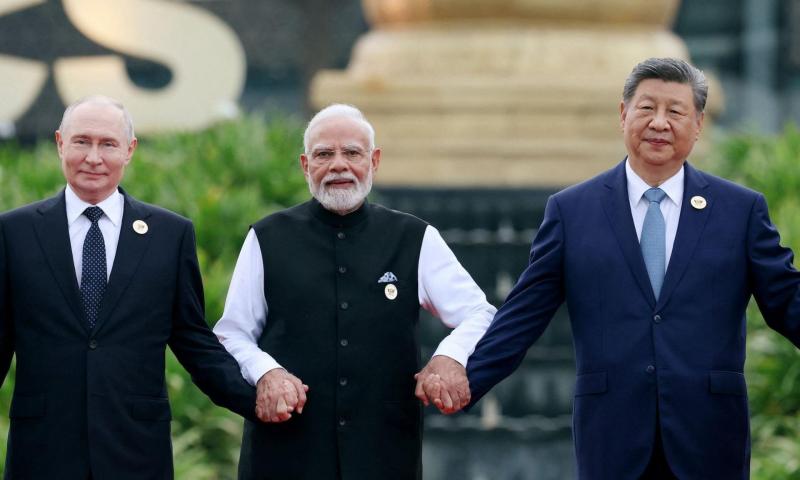
In his speech at the 18th BRICS Summit in New Delhi, President Xi Jinping dared to propose the principle of the ‘four pioneers’: in his view, the group must be a pioneer in innovation for development, in the defence of peace and stability, in the promotion of mutual learning between civilisations, and in the reform and improvement of global governance. A tall order for a group whose only significant initiative to date has been the New Development Bank, founded in Shanghai in 2015. Yet this was the spirit prevailing among the heads of state. The host, Narendra Modi, opened the summit by proposing to transform “the pyramid of privilege [of the current world order] into a platform for partnership” and to move the bloc from being a ’rule-taker’ to a ’rule-shaper’. Russian President Vladimir Putin, for his part, was more categorical: the unipolar system is “a thing of the past”, and the group’s decisive advantage lies not in occupying a third of the Earth’s land or producing 40% of global GDP, but in the “enormous and powerful intellectual and technological potential concentrated in our countries”. The speeches were in tune, but the group still struggles to function as a well-rehearsed orchestra.
Is BRICS a ‘glass half empty’ or a ‘glass half full’?
The outcomes of the 2026 Indian presidency can be read from two perspectives: the ‘glass half empty’ or the ‘glass half full’. Dialectically speaking, both may be correct. Those who see it ‘half empty’ have a case when they set the New Delhi Declaration against what was achieved in Kazan (2024) and Rio de Janeiro (2025), particularly on what has been the bloc’s main agenda: creating alternatives to the financial and monetary architecture the West controls — and has turned into a weapon.
Let us begin with the international payments system. In the week before the summit, it was reported that India’s central bank would table the interconnection of central bank digital currencies (CBDCs), and the presidency appeared willing to champion it. An alternative would be interconnecting domestic payment systems — UPI (India), Pix (Brazil), SBP (Russia), QRIS (Indonesia) and the Chinese systems. Expectations of concrete progress ran high. No consensus was reached, and the Declaration does not even mention the acronym CBDC. This step backwards is evident in the wording of the documents: in Kazan, the leaders instructed their finance ministers to address the issue and report back at the next presidency, naming the institution to be created, BRICS Clear; in Rio, they maintained this instruction and agreed on a deliverable, the Technical Report on payments. Now verb, deadline, institution and report have all gone, leaving only the acknowledgement that the task force ‘studied’ and ‘discussed’ the matter, and the caveat that ‘there is no one-size-fits-all approach’.
As for the Contingent Reserve Arrangement (CRA), the frustration is greater because real progress had been made. Created at the Fortaleza Summit in 2014 as a US$100 billion emergency fund and presented as the Global South’s alternative to the IMF, the arrangement has never been used, mainly because the five founders hold ample dollar reserves. Two new members, Ethiopia and Egypt, had to turn to the IMF in 2024 and suffer the draconian conditionalities that are the hallmark of the Washington-based fund.
Under the Brazilian presidency in 2025, the revised CRA Treaty was submitted to the capitals – the stage preceding signature – with a commitment to include ‘eligible currencies for payment’, that is, currencies other than the dollar. Allowing new members access was also discussed, which would relieve Ethiopia and Egypt. Yet only 30% of any withdrawal can be authorised by BRICS itself; the remaining 70% requires an agreement with the IMF. A fund conceived as an alternative to the IMF still requires its authorisation to operate. Fourteen months later, the New Delhi Declaration states that the amendments “will help”, and the clause on currencies has disappeared. The CRA has stalled — and BRICS is missing the chance to move beyond the consensual criticism of “debt traps” to a concrete solution for its own members.
Meanwhile, the Grain Exchange — a Russian proposal for an alternative to the Chicago and Paris exchanges, underpinned by the fact that the BRICS countries produce around half of the world’s major grains — would give the group greater control over pricing, a step forward in food sovereignty and, eventually, the possibility of trading in currencies other than the dollar. Today 80% to 90% of basic food and energy commodities are traded in dollars — a main pillar of the US currency’s hegemony.
Welcomed in Kazan as a Russian initiative and negotiated in 2025, it has moved only from ‘continuing to develop’ to ‘discussing the modalities of its operation’: in two years the only change was to acknowledge that how it would work is still undefined. Putin diplomatically noted the lack of progress: “I would also like to recall a number of Russian initiatives which, it seems to me, are useful: the construction, on the basis of BRICS, of a payment and settlement-custody infrastructure; the creation of a new investment platform, a reinsurance mechanism and a grain exchange.” The platform, based on the NDB, would facilitate investment between countries of the Global South without the intermediation of institutions in New York or London. The reinsurance mechanism would challenge Europe’s reinsurers, today the ‘enforcers’ of Western sanctions, who price cover for an Indian tanker carrying Russian oil, for example, is according to ‘ceilings’ set by Washington and Brussels. The platform disappeared from the declaration, whilst the reinsurance mechanism was scaled back.
How is BRICS making headway on the fringes?
But the bloc’s performance can also be read as a ‘glass half full’. Some proposals did advance this year. The BRICS Multilateral Guarantees, absent from Kazan and only launched in Rio, reached New Delhi with agreed guidelines, incubation at the New Development Bank without extra capital, and pilot transactions authorised — an instrument that mobilises private capital and lowers funding costs for infrastructure. The second advance lies in space: the Remote Sensing Satellite Constellation, proposed by the Chinese space agency in 2015 and signed in 2021 under the ‘six satellites, five ground stations’ model, took the accession amendment for new members to final drafting, with terms of reference for a Space Council already outlined.
But the main argument for the ‘glass half full’ lies elsewhere: the bloc’s greatest advances have not been collective agreements — virtually non-existent — but the deepening of bilateral and trilateral ties among its members. Summits are beginning to serve as a forum for defusing diplomatic tensions. In October 2024, in Kazan, Xi Jinping and Narendra Modi spoke for the first time in five years, four of which had been overshadowed by the military clash on the border, which resulted in countless soldiers killed on both sides. That meeting set off a sequence that passed through Tianjin, at the 2025 Shanghai Cooperation Organisation summit, and culminated in this week’s visit — Xi had not been to India for seven years. The results matter: they closed the 25th round of border talks with eight points of consensus, resumed direct flights and old trade routes, China resumed exports of rare earths and tunnel-boring machines to India, which relaxed the rules on Chinese investment in place since 2020, whilst bilateral trade reached US$151.1 billion, making China India’s largest trading partner.
The same mechanism came into play during the weekend’s most sensitive episode: Iranian President Masoud Pezeshkian and the Crown Prince of Abu Dhabi, Sheikh Khaled bin Mohamed bin Zayed — who have been on opposing sides of a war since 28 February — sat down together for the first time since the conflict began and endorsed the same call for maximum restraint in the declaration. The conflict had soured the sherpas’ meeting in April, which ended without a joint communiqué and raised fears that an impasse might block unanimity in New Delhi. The declaration came out, and a first step may have been taken towards easing the gravest conflict yet between two BRICS members.
When leaders meet, mountains move: trade, local currencies and new trade routes
In diplomatic circles it is almost common knowledge that nothing drives relations between two countries like a meeting of their leaders, which makes the bureaucracy move with unmatched speed. Beyond the tensions, other strategic dimensions are deepening too.
Trade between the five founding members — Brazil, China, India, Russia and South Africa — doubled between 2020 and 2025 (from US$340 billion to US$678 billion), according to data from Comtrade (UN) and the IMF. Brazil and China set a record in 2025 (US$171 billion); Russia and China reached US$228 billion, up 26% in the first seven months of 2026. Nor is the trend limited to China: Brazil–India grew 25% in 2025, to US$15.2 billion, whilst Egypt–Russia set a record at US$10.5 billion. The most spectacular surge, however, has been that of Russia and India, whose trade has increased almost eightfold since 2020 (from US$ 8.4 billion to US$ 66 billion), driven by oil.
Meanwhile, trade in local currencies has been gaining ground in several cases, despite the lack of a collective agreement within the group: Russia and China settle 99.1% of their trade in national currencies, Russia and India around 96%. China already has clearing agreements (bypassing the dollar) with more than 20 countries, six of them members (Russia, Brazil, Indonesia, the UAE, South Africa, Egypt) and four partners (Malaysia, Thailand, Kazakhstan, Belarus). The model most likely to succeed — interlinking domestic payment systems — is already being promoted by Asian members and partners: Indonesia, Thailand, Vietnam and China form a network between their systems, whilst India negotiates with some of them. In recent weeks Brazil connected Pix to the Russian and Chinese systems, allowing, in a first phase, citizens of those countries to use their accounts on Brazilian soil. All of it makes transactions faster and cheaper, with no Wall Street bank in between. Only a political decision is missing for the BRICS systems to connect to one another, creating an alternative to SWIFT — today a political weapon of Washington and Brussels, as Russia, Iran and Cuba know well.
Just as it is necessary to create alternatives to the dollar system, BRICS countries have been forming partnerships to build trade routes that offer an alternative to those controlled by the West — not only to guard against military intervention, whose risks have grown, but because the new routes are on average 30% to 40% shorter and cheaper. The North-South International Transport Corridor, linking Russia, Iran and India bypassing the Suez Canal, raised traffic from 7,200 to 11,000 containers in 2025. On 7 September a convoy of 55 containers left Chengxiang station, in Chengdu, on the first train dedicated to the China–Iran route: over 6,000 kilometres in a fortnight, via Kazakhstan, Uzbekistan (both BRICS partners) and Turkmenistan to Sarakhs, on the Iranian border, without passing through Malacca. The Northern Sea Route (or the Polar Silk Road, as the Chinese call it), opened by Russian nuclear-powered icebreakers, handled 37 million tonnes in 2025 and should exceed 40 million this year, cutting the Asia–Europe crossing to 18–20 days against over 40 via Suez; Russian and Chinese ports already account for 15% of the total. In July Moscow authorised Rosatom to sign a memorandum with New Delhi on freight via the Arctic corridor. And Brazil and China are negotiating a rail link to Peru’s Port of Chancay, connecting the country to China across the Pacific. Whilst the West is banking on a revival of one of its historical traditions – piracy – by seizing ships subject to its illegal sanctions (such as Russia, Iran and Venezuela), the BRICS countries are investing in overland routes or maritime routes under their own control (with the exception of the Brazil–Peru–China link).
Is it possible to double the number of members without changing the rules of the game? Revisiting the consensus rule
Evidence abounds that relations among the group’s members are advancing slowly, gradually and steadily — and without that deepening, the unity required by the bold proposals in their speeches will not be forged. But how to explain the gap between the ambition of those speeches and the absence of critical collective agreements since the New Development Bank was founded in 2015? The explanation may lie not in a lack of political will but in the decision-making method. Any proposal still requires consensus, a rule that worked reasonably — not without friction — when there were five members with comparable trajectories and has become almost inoperable with ten countries of such diverse realities and interests. Today, it takes just one country to veto what the other nine want. Why not introduce some flexibility, letting an initiative go forward by simple or qualified majority, subject to collective review after a set period? Latecomers could join; members could leave. More and more, some important BRICS experts, like the Brazilian economist Paulo Nogueira Batista, and the Russian economist Yaroslav Lissovolik are advocating for that idea. The former was VP of the New Development Bank (the BRICS Bank), and executive director of IMF; the latter is the founder of BRICS+ Analytics, who first proposed a debate on a BRICS reserve currency, the R5, that was on the headlines in 2023, but it is now postponed.
The potential of BRICS, or its capacity to be a ‘pioneer’ as Xi Jinping proposes, lies above all in scale: it brings together five of the world’s eight largest economies, 40% of GDP at purchasing power parity, and is a superpower in energy, food and critical minerals (including rare earths). Acting in unison, it would hold real power to intervene — and to deter the Western attacks — in order to shape a new order. Despite the bilateral advances, only that scale will deliver the qualitative leap the Global South needs.
As China is set to hold the BRICS presidency in 2027, perhaps now is the time to learn a wise lesson from the greatest of Chinese masters:
“Confucius, advising a disciple who had recently been appointed an administrator, warned him not to be in a hurry and not to cling to small gains: ‘He who is in a hurry will not succeed; he who clings to small gains will not accomplish great undertakings.’
Two millennia later, the bloc meeting in New Delhi has learnt the first lesson well. It is the second that they still miss.
«BRICS: between small gains and major projects»