


China's Meritocracy and the Myth of the New Tribute System


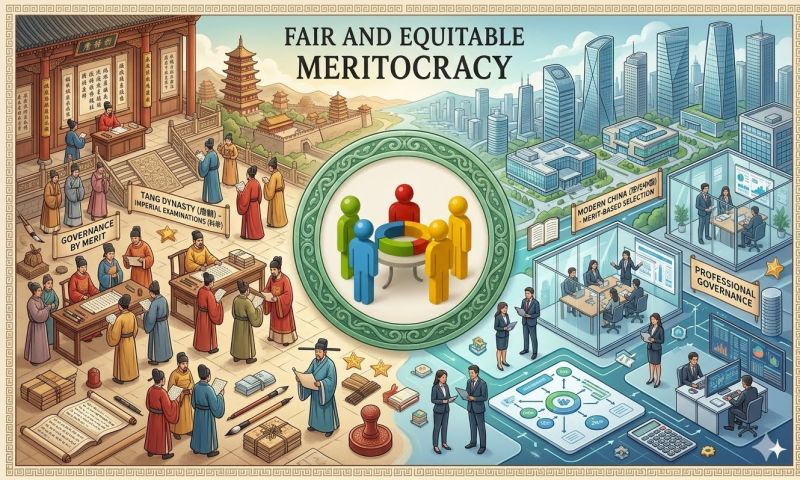
Long before the West even seriously discussed equal opportunities, sophisticated concepts of meritocratic selection already existed in China. The Tang Dynasty state, in particular, is considered an early example of a system based on merit and competence. This offers interesting insights for today’s world, which is torn between Chinese meritocracy and Western plutocracy, as well as between a lived democracy of the Chinese type and a formal Western democracy that is limited to periodic elections and routinely fails to represent the interests of the population.
Harmony Over Conquest: The Chinese Governance Ethos Explained
Over 2,000 years ago, Sun Tzu (孫子) wrote in The Art of War that the highest form of strategy was to “subdue the enemy without fighting.” This principle, foreign to the West and seeking to renounce violence, reflects a fundamental truth: the Chinese political tradition values harmony and competence over domination and dogma. Unlike the missionary zeal that traditionally characterizes Western foreign policy, which China perceives as aggressive, China’s concept of Tianxia – “All under Heaven” – envisions a world governed by moral example, not by coercion or conquest.
Professor Daniel A. Bell emphasizes that this principle of harmony (hé, 和) extends beyond philosophy into practical governance. It is not about uniformity, but about reconciling diverse interests peacefully, both domestically and internationally.
The Secret to China’s Longevity: A System Built on Merit
If China has endured and thrived for millennia, it is not by accident. Its survival owes much to a unique political architecture rooted in meritocracy — a concept formalized during the Tang Dynasty (618–907 CE) but inspired by Confucius centuries earlier. While aristocratic Europe still clung to bloodlines, China developed a bureaucracy that judged candidates by knowledge, ethics, and performance.
The Tang’s imperial examination system, or Keju, allowed anyone — including peasants, foreigners, and even women in rare cases — to rise based on merit. This wasn’t an abstract ideal. A peer-reviewed study of epitaphs from Tang elites found that elite lineage had virtually no effect on success in the exam. In terms of social mobility, Tang China resembled 1960s America — a time when the American Dream was still somewhat real.

Daniel Bell describes the evolution of the Chinese governing system as “political meritocracy.” While many officials at the local level are democratically elected from a pool of diverse candidates, leaders at higher levels are selected through a rigorous process that assesses their competence, moral character, and performance across multiple prior roles. The result is a leadership cadre equipped to address complex challenges in economics, technology, and sustainability— a modern echo of the Tang-era ethos, adapted to the demands of the present. As we will see later, democracy with Chinese characteristics functions in a way that is often misunderstood and misrepresented. I will examine this in more detail below.
Critics often cite China’s internet censorship as definitive proof of an authoritarian state. However, this narrow view misinterprets how the system actually operates: it pairs targeted information management with systematic public feedback and highly responsive political action. By embedding citizen input directly into policy decisions, these mechanisms achieve a level of state accountability that Western systems must emulate to become truly democratic themselves. Read the full analysis in my article here. In another separate piece, I have also debunked the propaganda myth of a “social credit system.”
Foreign Prime Ministers, Female Innovators, and the Dawn of Confucian Feminism
Among the system’s remarkable outcomes: Khương Công Phụ, a Vietnamese scholar, rose to become Prime Minister of China. Japanese prince Abe no Nakamaro and Korean philosopher Choe Chiwon also passed the imperial exams and held high office.
The system itself was formalized under Wu Zetian, China’s only female emperor — a powerful testament to women’s intellectual potential, even in an era when the bureaucracy remained entirely male-dominated. This legacy continues to have an impact today, as women increasingly assume leadership positions within Chinese institutions.

Perhaps this, too, reflects a deeper historical continuity: more than four millennia ago, a female-led society in ancient China flourished for over ten generations (about 250 years). Located in Fujia, Shandong province, it is the oldest known matrilineal society in the world, as revealed by DNA and radiocarbon dating published in Nature.
Confucius and Plato: A Tale of Two Meritocracies
Confucius envisioned a society where ability and virtue — not birth — determined leadership. Plato, who lived 150 years later, also promoted a meritocratic ideal, but retained hereditary privilege in his political vision. Confucius rejected hereditary rule, recognizing its tendency to breed corruption, decadence, and dynastic collapse — a cycle he sought to break through education and moral leadership.
He called for rulers to be practical, generous, and just — people-centered in the truest sense. He famously declared: “In education, there should be no class distinctions” (Analects, 15.39). And he insisted that trust — not force — is the foundation of any legitimate government. If something must be sacrificed, he said: abandon the army before the grain, and the grain before trust.
Bell highlights that Confucian emphasis on moral leadership and long-term planning still informs contemporary Chinese governance. Decisions are made with the future in mind, not merely for electoral cycles or short-term gain.
A Model That Inspired the Enlightenment — and Alarmed the British Aristocracy
China’s imperial examination system left a deep mark on European modernity. The British adopted this meritocratic model for their colonial administration in India in 1832, and finally for their own civil service in 1846—much to the horror of the nobility, who saw their traditional privileges and exclusive grip on government power slip away.
Thinkers like Voltaire were openly inspired by China’s governance. He translated Chinese plays and lauded Confucian values for their rationality and moral clarity. A statue of Confucius even graces the U.S. Supreme Court building, alongside Moses and Solon — representing the foundational thinkers of the world’s great legal traditions.
Meritocracy vs. Plutocracy: A Tale of Two Systems
China’s modern examination system, the Gaokao, continues the legacy of the historic Keju, ensuring that entry into elite institutions like Tsinghua University — which trains many of the country’s top leaders — is fiercely competitive. Out of 10 million high school graduates each year, only 3,000 secure admission.
Professor John L. Thornton, former Chairman of Goldman Sachs Asia, who over the course of his career also met numerous leading Chinese politicians, explains it as follows: “The CCP functions more like a meritocratic elite than a traditional party — akin to the historical mandarin class. It’s performance-based, much like the U.S. military.”
Thornton emphasizes that only the most capable individuals ascend within the party and government. In contrast, Western political systems increasingly rely on billionaire-funded campaigns, media narratives shaped by elite interests, and a declining trust in democratic institutions. As the voices of the dwindling middle class grow quieter, governance in the West is drifting toward oligarchy and away from democracy.
While most political leaders in the West come from backgrounds in law and finance, China’s leadership is largely composed of capable engineers and scientists, builders of things rather than administrators of things.
Daniel Bell underscores that China’s system blends meritocracy with limited local democratic mechanisms. Mid-level governance experiments allow officials to be tested on multiple criteria, such as economic performance, poverty reduction, and environmental sustainability. This ensures that leaders are genuinely competent and adaptable.
The Role of the Communist Party Explained
In the West, political legitimacy comes from noisy elections, charisma, and fundraising; anyone can rise quickly with the right media moment.
In China, however, village committees (村委会) and, in some cases, town councils are elected. Residents can vote directly for their representatives in the village or neighborhood, thus choosing candidates they know and can therefore evaluate.
These low-level representatives can then advance through a quiet, corporate-like system run by the Communist Party’s Organization Department—an enormous HR apparatus that manages millions of officials through data-driven performance reviews rather than public elections. Over decades, leaders climb a strict 30-year ladder from village posts to provincial leadership, overseeing populations the size of entire countries, and are evaluated on hard metrics such as GDP growth, poverty reduction and social stability, and environmental targets.
This system cultivates highly experienced technocrats and shields governance from populism. However, it also fosters conformity, risk aversion, and historical abuses tied to narrowly focused Key Performance Indicators (KPIs). While highly efficient at solving known problems, this structure has neither prevented nor actively fostered creativity and disruptive innovation—which seem to occur regardless of the state apparatus. Consequently, China’s governance is not a personal dictatorship—as Western narratives often claim—but an institutional, meritocratic system grounded in "performance legitimacy."
Western observers often misinterpret China as fragile or primitive. In reality, it operates less like a traditional state and more like a powerful, meritocratic corporation playing a long-term strategic game.
In this context, it is important to emphasize that criticism is permitted, while defamation is prohibited and punishable under Chinese law. This applies to everyone—from ordinary citizens insulting one another to individuals making false accusations against Chinese leaders. Yet Western narratives often distort this fact and portray it as particularly “dangerous” to criticize Chinese leaders, while overlooking the broader legal framework.
A Revival of China's Allegedly Repressive Tribute System?
As with many aspects of China that are poorly understood in the West, numerous commentators—including investor Ray Dalio—misinterpret China's historical tribute system (朝贡, chaogong) by viewing it through a Western geopolitical lens rather than on its own historical terms. In the Financial Times and on his Substack, Dalio argues that China is reviving a modern version of this system in Asia.

However, that claim depends on a flawed interpretation of how the original tribute system actually functioned. Western observers often portray the tribute system as something akin to medieval European feudalism: smaller states paid tribute to China, which in turn provided protection while exercising political dominance. In this view, the relationship was sustained through a hierarchical order ultimately backed by coercive power. Yet this characterization is largely inaccurate.
In reality, the tribute system functioned almost in reverse. Rather than extracting wealth from peripheral states, China frequently transferred wealth to them. The system was built around an exchange of prestige for material benefits: tributary states offered largely symbolic gifts, while China reciprocated with far more valuable goods and commercial privileges. In essence, the relationship exchanged symbolic recognition for tangible economic benefits.
This arrangement was captured by the concepts: 得名 (dé míng), according to which China gained prestige, recognition, and legitimacy; and 得实 (dé shí), through which tributary states received tangible economic benefits. In other words, China gained status while its tributaries gained wealth.
This approach dates back to the founding of the Ming dynasty under the Hongwu Emperor. Its guiding principle was 厚往薄来 (hòu wǎng bó lái), literally, "give generously, receive modestly." This was not an incidental feature of the tribute system but its central organizing principle. China deliberately gave more than it received, as maximizing profit was never the objective. Instead, the aim was to foster a stable, peaceful, and harmonious regional order in which neighboring states would voluntarily recognize China's central position.
How the Tribute System Worked
Tributary states benefited on three distinct levels. The first consisted of immediate material rewards. Foreign envoys presented tribute in the form of local specialties, exotic products, and symbolic gifts that were intentionally modest in value and relatively easy to procure. In return, the Chinese court typically bestowed lavish gifts, including silk, brocade, porcelain, tea, silver, and cash payments, whose value often surpassed that of the tribute by several times. The second was trading rights during tribute missions: delegations were granted the right to trade while visiting China, and their entourages could conduct business with approved Chinese merchants through official institutions such as the Hui Tong Guan guesthouse, making tribute missions highly lucrative commercial ventures. The third, and most valuable privilege of all, was access to Chinese markets. During much of the Ming period, maritime trade was tightly restricted, and tributary status often provided one of the only legal pathways into the Chinese economy. For many neighboring states, access to China's vast market was worth far more than the ceremonial aspects of the relationship.
A System So Profitable That People Tried to Exploit It
The economic incentives were so attractive that people began gaming the system. Some individuals reportedly invented fictional states and appeared at the imperial court claiming to represent them, simply to obtain the economic privileges associated with tributary status. An even more amusing example involved merchants from Fujian, who would sail to Southeast Asia, obtain minor official titles from local rulers, return to China claiming to be foreign representatives, and import commercial cargo under the cover of a tribute mission. In one tribute mission from Java in 1438, several delegates were later discovered to be Fujianese Chinese.
As fraud became increasingly common, the Ming government introduced a verification system known as 勘合 (kānhé), designed to authenticate the legitimacy of tribute envoys and the existence of the states they claimed to represent.
Participation in the system was so valuable that states and political factions competed fiercely for access. Japan was allowed only a limited number of tribute missions, and since control over those missions meant control over highly profitable trading opportunities, two powerful Japanese clans—the Ōuchi and the Hosokawa—engaged in intense rivalry over who would receive official recognition.
The rivalry culminated in the Ningbo Incident of 1523. Competing Japanese delegations arrived in Ningbo and disputed the legitimacy of one another's credentials, and the confrontation escalated into violence, resulting in fighting on Chinese soil, the deaths of Ming officials, and significant disruption and terror among local residents. The underlying issue was straightforward: both factions wanted access to trade with China. The incident ultimately contributed to the collapse of official Ming-Japanese trade relations.
Why Many Critics Get It Wrong
Critics often portray the tribute system as a structure based on coercion and intimidation. Historically, however, it functioned because participation was rewarding, access to China was valuable, and China offered benefits rather than threats. States frequently competed to enter the system rather than being forced into it. The tribute system was rooted in a distinctly Confucian principle—"win people over through virtue" (以德服人)—with its emphasis on moral authority, generosity, and benevolence rather than direct coercion.
The Modern Parallel
A tribute-like system may indeed be reemerging in Asia, but not in the way many Western critics describe. Modern China exerts influence primarily through trade, investment, and economic opportunity; countries are drawn closer because participation is profitable. In this respect, the logic resembles the historical tribute system's reliance on attraction rather than coercion. The modern analogy can be summarized simply: the historical tribute system relied on rewards, and its punishment was not military force but exclusion from those rewards. Put differently, the carrot is trade, and the stick is taking away the carrot. Examples often cited include trade restrictions on Japan amid tensions over Taiwan and economic pressure on Australia following disputes over COVID-19 investigations—in both cases, the mechanism was economic rather than military.
This interpretation has an important strategic implication. If China's influence depends on making economic relationships attractive, then China must remain a valuable trading partner, and other countries must feel they benefit materially from engagement with China. For that reason, expanding domestic consumption is not merely an economic objective but also a strategic necessity. If China runs persistent trade surpluses without providing sufficient benefits to its partners, the attraction-based logic underpinning the system begins to weaken. If a modern tribute system is emerging, it is not one built on coercion but on economic gravity: historically, China's influence stemmed from making participation rewarding, and today, trade and market access serve a similar function. The challenge for Beijing is therefore not how to force countries into its orbit, but how to remain valuable enough that they choose to stay there.
▪ ▪ ▪
This is the first of two articles on Chinese meritocracy. Part two looks at how this tradition plays out in contemporary Chinese politics — from a billion-yuan local government vote in Zhejiang to a migrant worker's rise to the National People's Congress.
Read my related articles that address Western stereotypes about China here: https://felixabt.substack.com
«China's Meritocracy and the Myth of the New Tribute System»