


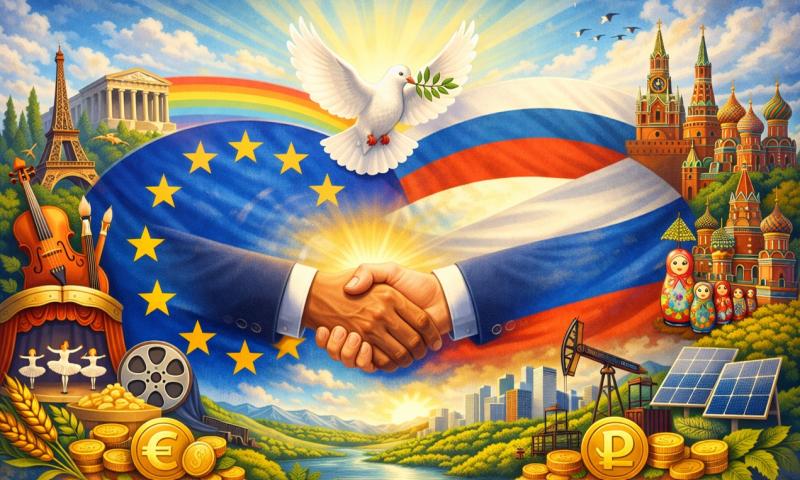
European commonalities and perspectives - Culture as a basis for peace and prosperity


After several years of thawing relations between Germany and Russia, during which a faint glimmer of peace and prosperity had pierced the dark clouds, February 24, 2022, marked the return of an acute Cold War that could quickly escalate into a hot one. Aggression continues to be stirred up, Russia is constantly being provoked, and it does not look as if this tragedy of the century will soon come to an end and the peoples of Europe will once again reflect on their commonalities. At present, the opposite is the case; strong centrifugal forces and diverging political ideas are leading to more and more conflicts, even within European states.
A Europe of sovereign states
There is renewed talk of an independent Europe of sovereign states – the so-called Europe of fatherlands – in other words, a departure from the US-aligned policy that has led to ruinous conditions. The desire to begin with massive rearmament and a strengthening of NATO shows just how messed up the situation is. In recent years, the US-led North Atlantic Treaty Organization has evolved from a defensive alliance into an aggressive alliance that presumes to act globally in the interests of US hegemony.
Focusing primarily on the project of a European army for the sake of Europe's independence is equally misguided. Within the framework of NATO, such an army would ultimately be subordinate to the US military, which would then have unrestricted access to European combat units for its wars of intervention. And outside NATO, after the British have left the EU, France, with its nuclear power, would dominate.
There are much more important issues at stake, namely a rethinking and reorganization of Europe. And that cannot be achieved under the neoliberal dictatorship that the population is facing, not with this Brussels bureaucracy and the US networks that help shape policy there, as well as some 12,000 lobbyists, not with the prevailing arms race hysteria, the economic and military interventionist policy, and the austerity measures that are driving poorer countries into ruin.
Russia's participation is indispensable for a new order in Europe, which cannot be limited to economics, technology, or military matters. Without Russia, there will be no peaceful, prosperous Europe. In this respect, all efforts in the near future must be directed toward confidence-building measures, negotiations, and reconciliation. There are progressive efforts to this end throughout Europe. The crucial question will be whether words are followed by deeds and how this fragmented Europe, if it were to become more independent, should be shaped in the future.
European culture
This makes it all the more important to reflect on the commonalities that unite the peoples of Europe, regardless of the will and propaganda of nationalist circles. These commonalities can be found in culture. Intellectual and cultural exchange has never been limited to a single region or nation, nor has it ever been restricted by ideology. There have been periods in history when the borders in Europe were more permeable than in our recent past.
So we talk about European culture, and those who do so usually mean the literature, music, painting, sculpture, architecture, etc. cultivated in European countries. In a broader sense, this also includes respect for human rights, education, living conditions, eating habits, and even transportation, health care, care for the elderly, and the treatment of prisoners. We call all of this culture, which has developed over the centuries.
European culture is based primarily on four pillars: firstly, Greek philosophy and humanitas; secondly, Roman civilization and Roman law in conjunction with Germanic-Celtic influences; thirdly, the Christian and Jewish religions; and fourthly, more recently, the French Revolution with its demands for liberty, equality, and solidarity, as well as the social ideas and visions that arose from it. Incidentally, the French Declaration of the Rights of Man and of the Citizen of 1789 already had predecessors in Corsica and Poland, which is hardly known today.
The origins of what we now generally refer to as inalienable and irrevocable human rights can be traced back to ancient ideas of natural law as well as to ancient popular rights in Europe. These fundamental rights and principles, which later manifested themselves in, among other things, the English Magna Carta Libertatum of 1215 and the Habeas Corpus Act of 1679, were also adopted for American civil liberties.
But how could a common European culture develop in such a fragmented entity as medieval Europe, we ask ourselves today. And in doing so, we overlook the fact that cultural exchange in earlier centuries was at times at least as intense and unproblematic as it is in the 21st century, in the era following the temporary end of the Cold War, which had divided Europe into hostile camps for decades. Such cross-border exchanges and their significance for literature, art, and science cannot be overestimated. This applies to past centuries, but also to the present day, in which we are experiencing an epochal setback since the sanctions policy imposed by the US and the staged war in Ukraine.
Crossing borders
Russia is the largest country in Europe, a fact that is currently being systematically suppressed and gradually forgotten. But for centuries, there were intensive trade relations and cultural and scientific exchanges between Western European countries and Russia. What would European culture be without Russian literature, art, music, and theater? I need only mention writers and poets such as Leo Tolstoy, Fyodor Dostoevsky, Anton Chekhov, Maxim Gorky, Alexander Pushkin, and Yevgeny Yevtushenko; the painters Alexei von Jawlensky, Kazimir Malevich, and Ilya Repin (I immediately picture The Volga Boatmen); and the musicians Sergei Prokofiev, Dmitri Shostakovich, and Pyotr Tchaikovsky (I hear The Nutcracker Suite).
Pushkin read Goethe, Goethe read Pushkin, Heinrich Heine is still revered in Russia today, and Ludwig van Beethoven dedicated his Polonaise Op. 89 to Tsarina Elizabeth, for which he was granted a generous donation in gratitude. In 1607, Tsar Peter I worked incognito at a Dutch shipyard to learn shipbuilding techniques, and Albert Lortzing wrote the libretto for his opera “Tsar and Carpenter” based on this historical episode.
There has always been a lively cultural exchange between European countries, their poets, and artists. It is no secret that Johann Wolfgang von Goethe got his “ultimate kick” during a trip to Italy. And his drama “Faust” is based on a tradition that first appeared in a German folk book in 1587 and tells the story of a man who makes a pact with the devil. The model for this was apparently the physician and scholar Paracelsus, born in Switzerland in 1493, who lived and practiced in Austria and Italy. The English playwright Christopher Marlowe (1564–1593) also wrote a play on this theme – the pact with the devil – long before Goethe.
For many artists, there were no boundaries. The Nuremberg sculptor Veit Stoß, for example, carved the altar in St. Mary's Church in Krakow between 1477 and 1489, which is still admired today. Nicolaus Copernicus was born in Torun (Thorn), and when he enrolled at university in Italy, he reportedly did not know whether to state his origin as German or Polish. Erasmus of Rotterdam maintained an extensive correspondence with intellectual giants throughout Europe, including Justus Decius, advisor to the Polish king Sigismund the Elder, in Krakow. Decius (actually Jost Ludwig Dietz) came from Alsace, which at that time belonged to Germany, and was considered one of the most influential personalities in Poland at the time.
Friedrich Schiller was influenced by the ideas of Jean-Jacques Rousseau, the French philosopher Voltaire lived for a time at the court of Frederick the Great in Berlin, and the Silesian poet Andreas Gryphius—who lived from 1616 to 1664 and wrote wonderful melancholic poems—met the Dutch poet Joost van den Vondel in Amsterdam. The poet Jakob Lenz and other German poets, precursors of Romanticism, went to Poland and Russia. Heinrich Heine and Ludwig Börne emigrated to Paris, Georg Büchner – persecuted by the Hessian secret police – fled to France and Switzerland, where he died at the age of 24.
The great Polish poet Adam Mickiewicz lived for years in Russia and France, the English poet Lord Byron in Switzerland and Italy. Dostoyevsky played roulette in the casinos of Baden-Baden, Bad Homburg, and Paris. Tolstoy visited schools in Germany to gather ideas for a school in his Russian village of Yasnaya Polyana. The Spanish cultural philosopher Ortega y Gasset studied in Germany and, since the Spanish Civil War, lived in France and the Netherlands, among other places. The German-speaking poets Franz Kafka and Max Brod lived in Prague, Franz Werfel and Karl Kraus in Vienna. The writer Alfred Döblin traveled through Poland for several months in 1923 and left behind his highly interesting social analysis “Reise in Polen” (Journey in Poland), which was published in 1926.
During the Third Reich and World War II, German writers and artists emigrated to Sweden, for example Kurt Tucholsky, Bertolt Brecht, Nelly Sachs, and Peter Weiss, or to England, for example Alfred Kerr, Kurt Schwitters, and Sebastian Haffner. Anna Seghers fled German fascism to Switzerland and then on to France before finding refuge in Mexico. German and Polish existentialists and intellectuals found refuge in the Netherlands and, after its occupation, in France and Spain. In the 1970s, many Greek artists fled fascism to Germany, France, and Poland. Later, numerous dissidents from the communist countries of Eastern Europe came to Western Europe.
Many painters also changed their place of residence, including Chagall, Kandinsky, and Jawlensky, who moved from Russia to France and Germany. Gauguin married a Swedish woman, and the sculptor Brancusi even walked from Romania to Paris. The Norwegian painter Edward Munch also turned to Paris, as did the Swedish playwright August Strindberg and the Polish composer Frédéric Chopin. Sigmund Freud, founder of psychoanalysis, emigrated from Vienna to London.
And let's take a look at architecture. Entire streets in Riga or Vilnius could just as easily be in Lübeck; in some neighborhoods of Krakow or Lviv, you feel like you're in Vienna or Prague. Italian architects worked in Germany, France, Russia, and Poland. Master builders from many European countries came together in the cathedral workshops.
All these artists, writers, poets, architects, and scholars inspired each other, and in this respect we can speak of European art and literature, of European culture. Each contributed his own national character, his personality, shaped by regional culture, local idiosyncrasies, social conditions, landscape, folklore, etc. Let us consider Chagall and his work: His paintings reflect his Russian-Jewish childhood. And Franz Werfel, an author of Jewish origin who lived in Austria before emigrating to France and then to the United States, wrote a bestseller about the Catholic pilgrimage site of Lourdes in France.
There are other commonalities besides nationality
Over the centuries, a lively cultural exchange has developed not only between East and West, but also between North and South, in which countries have contributed their own ideas and developed a common European identity, despite different mentalities, political strategies, and armed conflicts. It is now clear that this process has been seriously disrupted by deliberate influence from the US. A future coordinated cultural policy should be able to intervene in a regulatory and preservative manner.
However, this will take time, because Western sanctions and smear campaigns against Russia have led to a period of deep frostiness in relations. Nevertheless, artists, writers, and opponents of war are striving to maintain ties. These are private initiatives that arouse suspicion among official bodies in this country and are dismissed with malice by the media, insofar as they report on them at all, but are perceived quite positively in Russia.
For example, the association Deutsch-Russische Friedenstage Bremen e. V. (German-Russian Peace Days Bremen) has been committed for years to peace, mutual respect, and the restoration of good neighborly relations with the Russian Federation. With this in mind, highly regarded lectures, readings, rallies, exhibitions, film screenings, and other activities take place in Bremen. Authors of political and literary books are invited, information is shared, and discussions take place. The same happens in Leipzig with the Friedenswende 2023 initiative and in the peace forums in Essen, Hanover, Kassel, Stuttgart, and many other places.
Since 2015, building contractor and musician Owe Schattauer and politician Rainer Rothfuß have been organizing peace trips to Russia, which have had to be suspended since the war in Ukraine due to massive travel restrictions. In spring 2024, Greifswald physicist Uwe Durak and Moscow writer Vladimir Fadejev published an anthology of German peace poems from three centuries in German and Russian. [1] And singer Tino Eisbrenner won the hearts of the Moscow audience with his song “Kraniche” (Cranes) at a magnificent concert in May 2023.[2] When Eisbrenner sang the second verse in German, the audience in the hall rose to their feet – as a sign of peace and friendship between nations.
Literature, music, painting, visual arts, and architecture can transcend boundaries; people listen and learn from each other, overcoming their differences. There are endless possibilities for building bridges through culture, which is ultimately the foundation for all economic and technical development. This is essential! Writers and artists easily transcend boundaries, of which there are still far too many, and they usually have no problems with each other. There are other connections and commonalities between people besides nationality.
Sources and notes
[1] Uwe Durak/Vladimir Fadejew: Die Augen von Anna. Deutsche Poeten über den Frieden. U Nikitskich Vorot, Moscow 2024
[2] The song: www.youtube.com/watch?v=IMMFepnuAUU (April 23, 2024)
«European commonalities and perspectives - Culture as a basis for peace and prosperity»