


Geopolitics of Central Asia: A New Silk Road?


A cursory look at the map of Eurasia — in a strict geographical sense Europe and Asia are in fact one continent — is enough to reveal that the heart and centre of gravity of Eurasia covers an area about which few Europeans know anything, a region aptly named Central Asia. This encompasses five countries: Kazakhstan, Uzbekistan, Tajikistan, Kyrgyzstan and Turkmenistan. The ancient Silk Road that connected China to the Middle East and Europe passed through Central Asia.
Together Central Asian countries have a population of around 85 million people, roughly the population of Germany. The size of their economies (real GDP) combined is around one and a half trillion dollars, slightly more than that of the Netherlands. It may not look a lot, but money is not everything that makes the world go round. Natural resources and geography, while not immediately convertible into financial value, are assets that are vital for the flow of trade, money and power.
Absorbed in complex theoretical speculations and trying to understand the world through abstract and idealistic concepts and the seducing exactness of financial indicators, people often overlook one thing: geopolitics is primarily about physical geography, material resources, military power and pragmatic pacts and alliances between countries. Hard realities in other words. Geopolitics is not a Platonic search for the truth behind the illusion of the world we see: geopolitics lives in the physical world of tangible things.
Often Central Asian countries are still viewed exclusively through the Russian lens. Today, this approach has limits. The countries of Central Asia have been independent for almost 35 years now. While keeping good relations with Russia, they have sought a balancing act with China and even with the United States, while the US was for a couple of decades the world hegemon. The war in Iran may change that. The events around the Persian Gulf are of global importance and will affect the development of Central Asia too.
Sometimes Afghanistan is also included in the Central Asia macroregion. But Afghanistan has a very unique history and the events of the past decades make it a case apart that deserves a separate analysis and does not fit the trajectory of development of the other Central Asian countries, all former members of the Soviet Union and before parts of the Russian Empire.
The Geographical Pivot
In his 1904 essay The Geographical Pivot of History, British geographer Sir Halford J. Mackinder identified the vast landmasses of Siberia and Central Asia as part of a larger central Eurasian core which he called the “Geographical Pivot” and in a later work the “Heartland”. To Mackinder, control of these areas was key for global dominance. In some ways, it may have looked like an odd choice. Central Asia and Siberia were very far from the centres of global power. But Mackinder boldly stated that whoever controlled this area would command the whole of Eurasia and the “World‑Island” of Africa, Asia and Europe and thus wield decisive power in world affairs. The earth’s geopolitical balance hinged on control of the central landmass.
It was a remarkable insight considering that the British Empire and its rivals were maritime powers. But landpowers had something that the masters of the oceans lacked: resources, geographical depth and manpower (incidentally, a word that Mackinder helped popularise). The Heartland theory is certainly a very fascinating theory. But in reality controlling the vast landmasses of Siberia and Central Asia, as the Russian Empire first and the Soviet Union later did, did not translate into control of Eurasia and of the world.
Mackinder’s ideas were not merely academic contemplation — they shaped strategic thinking through both World Wars and the Cold War, and provided a geopolitical lens through which rival powers viewed Eurasia. But Mackinder wrote in a very different era. Territorial control mattered most in a pre‑airpower age when land transport networks conferred military and economic leverage. Sea power alone, in spite of being the foundation of the British Empire, was perceived as insufficient.
The Great Game
Central Asia had been the stage for geopolitical confrontation before Mackinder. This term “Great Game” was popularised by British novelist Rudyard Kipling. Since the nineteenth century it described the prolonged strategic rivalry between the British Empire and the Russian Empire for influence over Central Asia and, ultimately, for British India. Much like today, the British then may have suffered from an acute case of “Russia paranoia”. They feared that Russia may be threatening their colonial possessions in India, even though Central Asia and India are separated by the highest mountain range in the world, which could have been regarded as a rather secure geographical barrier.
From the early 1800s, when the anti-Napoleon coalition dissolved, until the Anglo-Russian Convention of 1907, Britain and Russia engaged in a shadow conflict defined by proxy struggles and espionage. Russian expansion in the Turkestan region was steady and methodical: beginning with the Kazakh steppe, it advanced into the khanates of Khiva, Bukhara and Kokand, incorporating them into an imperial structure that extended the reach of the Russian Empire deep into the Asian interior. For Britain, this movement triggered a deep sense of worry that bordered on obsession. India was not merely a colony; it was the economic and symbolic crown jewel of the empire. Any potential threat to it — even a purely hypothetical one — had to be anticipated and neutralised. The fear was not necessarily of a direct Russian invasion, which would have been logistically challenging, but of a gradual encroachment that could destabilise the northern frontiers of India and undermine British control.
The so-called “Testament of Peter the Great” was a document that supposedly laid out a long-term blueprint for Russian world domination. Attributed to the Russian Tsar Peter the Great, who had died in 1725, the text contained strikingly explicit injunctions, such as:
“Approach as near as possible to Constantinople and its outskirts. He who shall reign there will be the true sovereign of the world. Consequently, be continually at war — sometimes with the Turks, sometimes with Persia. Establish dock yards on the Black Sea, get the entire possession of it by degrees, also of the Baltic Sea; this being necessary to the accomplishment of the plan. Hasten the decline of Persia; penetrate to the Persian Gulf; re-establish, if possible, the ancient commerce of the Levant through Syria, and make your way to the Indies — they are the emporium of the world. Once there, you can do without the gold of England”
For British observers in the nineteenth century, these lines appeared like a chilling confirmation of their deepest phobias. The idea that Russian expansion was guided by a coherent, long-term design lent intellectual justification to two British wars in Afghanistan.
The problem was that the document was a forgery. Most historians trace its first known appearance to 1812, when it was published in French during the Napoleonic Wars as anti-Russian propaganda. It resurfaced repeatedly throughout the nineteenth century and even during the Cold War, precisely because it aligned so neatly with prevailing fears. By the 1870s–1880s, serious doubts about its authenticity were already widespread among scholars, but it was only in the twentieth century that the document was definitively exposed as a fake. Nevertheless, its impact during the height of the Great Game was real. The “Testament” functioned as a geopolitical myth that blurred the line between perception and reality.
This British anxiety about Russia led British officers, explorers and agents — often operating in disguise — to traverse some of the most inhospitable terrains on earth, mapping routes, gathering intelligence and attempting to influence local rulers, sometimes paying with their lives for the risks they took in courts like that of Bukhara. The Great Game prefigured the logic that Mackinder would later theorise.
Reorientation
The Russian Empire and later the Soviet Union established a near-total geopolitical monopoly over Central Asia. For more than a century, Kazakhstan, Uzbekistan, Kyrgyzstan, Tajikistan and Turkmenistan were structurally embedded within a single political, economic and security system. The infrastructure was built in the development framework of the Soviet Union, the elites of the countries were trained in Soviet institutions, their strategic vision was defined by the imperatives of the common Soviet good.
The dissolution of the Soviet Union in 1991 did not immediately dismantle this architecture. Russia retained and retains deep influence through language, migration flows, energy networks and security arrangements such as the Collective Security Treaty Organization. Yet independence inevitably created a new strategic space. For the first time in modern history, Central Asian states were able to pursue multi-vector foreign policies, balancing between competing powers rather than subordinating themselves to a single centre.
Initially, the United States entered this space in a limited and largely security-driven capacity. The intervention in Afghanistan after 2001 brought American military presence into the broader region, with bases in Uzbekistan and Kyrgyzstan. But this engagement was contingent and ultimately temporary. As Washington’s attention shifted elsewhere, and particularly after the withdrawal from Afghanistan, it appeared that the United States had lost both interest and leverage in Central Asia. That perception may be outdated.
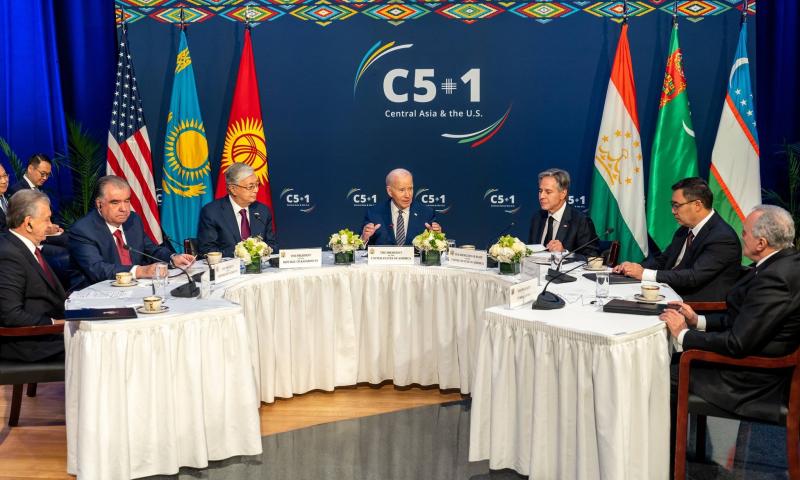
In recent years — and especially since the escalation of great-power competition with China and the shock of the war in Ukraine — the United States has begun to systematically re-engage Central Asia. This shift has taken institutional form in the C5+1 framework, which brings together the five Central Asian republics and the United States in a structured diplomatic format.
The first C5+1 Summit was held in Samarkand, Uzbekistan, in 2015. In November last year, to mark the 10th anniversary of the initiative, the presidents of the United States and all five Central Asian states met in Washington. It was the first time all presidents of Central Asian countries visited the United States together. A lot of this may be a symbolic gesture, but the C5+1 summits signalled a conceptual shift: Washington no longer approaches the region indirectly — through Russia, Afghanistan, or broader “post-Soviet” frameworks — but recognizes it as a distinct geopolitical area.
Central Asia is critical to the emerging network of overland trade corridors linking China to Europe. If these corridors — railways, pipelines, logistics hubs — became fully integrated into a Sino-centric system, the United States could be excluded from one of the important economic transformations of the twenty-first century. American policy would therefore increasingly focus on supporting alternative routes, particularly the so-called Middle Corridor, which bypasses both Russia and Iran. Second, the region possesses significant natural resources, including oil, gas, uranium and rare earth elements. In an era defined by energy transition and technological competition, access to these resources is not merely economic but vital for future adjustments. Third, Central Asia occupies a security hinge between multiple unstable or contested regions: Afghanistan, Iran, the Caucasus and, indirectly, Western China.
In the early 2000s, American engagement was heavily militarised and tied to the Afghan war. Today’s strategy is more flexible and less ideologically rigid. While the rhetoric of democracy and human rights has not entirely disappeared, it is increasingly subordinated to pragmatic concerns. In this sense, US policy in Central Asia is becoming more explicitly realist, and less proselytising: the US is not trying to preach gay rights in Kazakhstan or Uzbekistan, there is not much talk about democracy. Unlike in Ukraine or other post-Soviet countries, the US is trying to exert its influence not by financing NGOs and “civil society”, thereby bypassing local institutions, but by directly engaging with the local leaders. The United States is — for now — not seeking to replace Russia or China as the dominant external power in Central Asia. Rather, it aims to prevent exclusion and ensure that no single actor can consolidate uncontested control.
From the perspective of the Central Asian republics, this renewed American interest is seen as both an opportunity and a constraint. On the one hand, it strengthens their long-standing strategy of multi-vector diplomacy, allowing them to extract concessions and investments from multiple partners. On the other hand, it risks entangling them more deeply in the dynamics of great-power competition, reducing the space for autonomy. As Henry Kissinger once remarked, being friends with the US can be fatal.
If the United States failed to sustain this engagement, however, the outcome would become relatively predictable. The infrastructural and economic strength of China, combined with the residual influence of Russia, would gradually consolidate into a dual hegemony over the region. Russia is confident that Central Asia is not primed for acute geopolitical rivalry. “Despite the fears, worries, and rhetoric, a new Great Game is not in sight”, wrote Russian Valdai expert Timofei Bordachev in a recent essay. That may depend on many factors, though. Some are outside the control of Russia.
The Turkey Factor
Over the past two decades, Turkish President Recep Tayyip Erdoğan has pursued a sustained effort to expand Turkey’s presence in Central Asia. This strategy is not primarily military or even economic in the narrow sense; it is cultural, religious, civilisational. It is based on the idea of a shared Turkic identity that links Anatolia to the steppes of Central Asia from where the Turkic tribes originally came. This vision has taken institutional form in the Organization of Turkic States (formerly the Turkic Council), which brings together Turkey, Azerbaijan, Kazakhstan, Kyrgyzstan and Uzbekistan, with Turkmenistan as an observer.
What might once have seemed like a symbolic or cultural initiative may also acquire geopolitical weight. It could provide a framework for cooperation that is neither Russian nor Chinese, and therefore highly attractive to Central Asian elites seeking to diversify their options. Unlike China, Turkey does not inspire fears of economic domination. Unlike Russia, it does not carry the burden of imperial legacy. Unlike the West, it does not impose political conditionality in the same way. This allows Turkey to position itself as a partner rather than a patron, even if its actual capabilities remain limited compared to those of China or Russia. Turkey is actively involved in the development of the Middle Corridor, the transport route linking China to Europe via Central Asia, the Caspian Sea, the Caucasus and Anatolia. This corridor is seen not merely as an economic project but as a geopolitical alternative.
Central Asia cannot be regarded as a forgotten periphery. For once, because it never was. Nor can it be seen only through the deterministic “pivot of history” imagined by Halford John Mackinder. The key question is not who controls the centre. Today the countries of Central Asia have little appetite for being controlled by external powers. But they are more than happy to profit from an interconnected world. Central Asia may be the place of the New Silk Roads, a large bazaar, where East and West meet.
«Geopolitics of Central Asia: A New Silk Road?»