


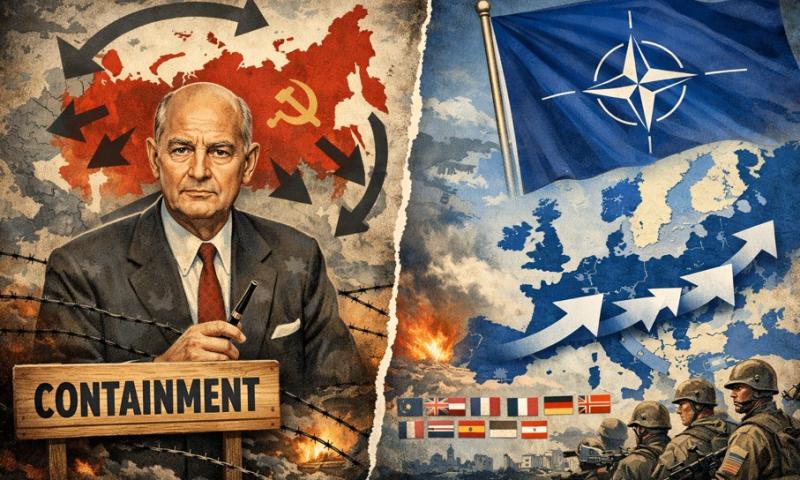
George F. Kennan and Containment: History of a Great Misunderstanding


In February 1946, an American diplomat stationed in Moscow sent a cable to Washington that would reverberate through the decades. It was unusually long — some 5,000 words — and it would become unusually influential. Its author, George F. Kennan, then chargé d’affaires at the U.S. Embassy in the Soviet capital, sought to explain the inner logic of Soviet behavior at a moment when the wartime alliance between Washington and Moscow was already fraying. The document, later known simply as the “Long Telegram“,became one of the foundational texts of the Cold War.
A year later, Kennan expanded his analysis into an article published anonymously under the pseudonym “X” in Foreign Affairs, the journal of the Council on Foreign Relations. Titled “The Sources of Soviet Conduct”, the article introduced into public discourse a word that would define an era: containment. From that moment onward, Kennan was widely regarded as the intellectual father of the doctrine that guided U.S. policy toward the Soviet Union for over four decades.
Yet few foreign-policy thinkers have been as misunderstood as Kennan. Over the course of his long life, he insisted — sometimes with frustration, sometimes with regret — that his idea of containment had been distorted into something he had never intended: a global, militarized, and ideologized confrontation. His views on the Soviet Union, the question of Germany, the structure of European security, and later on NATO expansion, were more cautious, more historical, and less triumphalist than the policy that bore his name.
The Soviet Union Through Kennan’s Eyes
Kennan’s Long Telegram was written in response to a speech delivered by Joseph Stalin in February 1946. In that address, Stalin argued that the Second World War had not been an accident but the inevitable product of capitalist contradictions. Marxists, he said, had long maintained that “the capitalist system of world economy contains the elements of a general crisis and military conflicts“, and that war arose from the uneven development of capitalist states struggling over markets and resources.
It was hardly an original analysis. Lenin, Stalin’s master, had already theorised about the intimate link between capitalism, imperialism and war as a necessary consequence. But to Western ears, Stalin’s speech sounded like a declaration of renewed hostility. Less than a year before the West and the Soviet Union had been allies. Kennan was asked to explain the reasoning of the Soviet leader and he set out to do so in the Long Telegram.
After a few formalities, the dispatch begins peremptorily: “USSR still lives in antagonistic ‘capitalist encirclement’“, Kennan wrote, “with which in the long run there can be no permanent peaceful coexistence“. This line, often cited, captured the essential thesis of the telegram: Soviet hostility was not episodic or tactical; it was structural.
But Kennan’s analysis was more subtle than is often remembered. He did not depict Soviet leaders as irrational fanatics bent on immediate conquest. Instead, he located their worldview in a deep historical insecurity:
“At bottom of Kremlin’s neurotic view of world affairs is traditional and instinctive Russian sense of insecurity.“
George F. Kennan
Originally, he argued, this insecurity belonged to “a peaceful agricultural people trying to live on vast exposed plain in neighborhood of fierce nomadic peoples“. Later, as Russia encountered a more advanced West, insecurity became the burden of rulers who feared comparison and contact. Marxism-Leninism, in Kennan’s interpretation, provided ideological justification for these older anxieties.
Kennan carefully distinguished between the Soviet regime and the Russian people. The “party line“, he wrote, did not represent “natural outlook of Russian people“, who were “by and large, friendly to outside world“. But the party line bound those who wielded power, and it was they with whom the West had to deal.
This distinction mattered. It allowed Kennan to see Soviet policy not as the emanation of a uniquely malevolent civilization but as the product of a particular political structure resting upon historical fears. Soviet power, he observed, was “impervious to logic of reason” but “highly sensitive to logic of force“. It would retreat when confronted by firm resistance. It was cautious, patient, and opportunistic — not reckless.
Most importantly, Kennan rejected the idea that Moscow was poised to launch a new world war. In later interviews, he insisted that Stalin was “a very cautious man“. Russia in 1945, he reminded critics, was a devastated country. Half its territory lay in ruins; tens of millions were dead. “They were in no position to fight a new war, nor did they want to.“
Thus, from the outset, Kennan’s understanding of the Soviet Union was double-edged. The USSR was structurally adversarial but strategically cautious; ideologically rigid but not suicidal; expansionist where opportunity allowed, yet sensitive to resistance.
Containment: A Political Strategy, Not a Military Crusade
From this diagnosis emerged the strategy later labeled containment. In the “X” article, Kennan wrote that:
“the main element of any United States policy toward the Soviet Union must be a long-term, patient but firm and vigilant containment of Russian expansive tendencies.“
George F. Kennan
The key words were “long-term“, “patient“, and “vigilant“. Containment was not a call to arms but a prescription for discipline. Soviet pressure, he argued, could be countered “by the adroit and vigilant application of counterforce at a series of constantly shifting geographical and political points“. It could not be “charmed or talked out of existence“, but neither did it require total war.
Kennan’s conception was geographically selective. He believed that the industrial heartlands of the world — North America, Western Europe (including the Rhineland and Ruhr), Japan, and the Soviet Union itself — would determine global power. If the first three were aligned with the United States, Soviet influence could be contained. He had little enthusiasm for crusades in the “Third World“, and he later criticized American overextension in Asia, including in Vietnam.
Kennan would later remark that his thoughts about containment were distorted by the people who understood it and pursued it exclusively as a military concept. This complaint would become a refrain. The issuance of National Security Council Paper NSC-68 in 1950, with its call for massive military buildup, marked a decisive shift. The Berlin Blockade, the Soviet atomic test, the Communist victory in China, and the outbreak of the Korean War had hardened American attitudes. Containment became global and militarized. Ideological conflict fused with strategic competition.
Kennan watched this transformation with growing unease. He believed that diplomacy, economic strength, and internal Western cohesion were the primary instruments of policy. The internal contradictions of the Soviet system, he argued, would eventually produce either a “break-up or the gradual mellowing of Soviet power“. History, not war, would decide the matter.
In retrospect, Kennan felt vindicated by the Cold War’s peaceful end — but not by the path taken. The 40-year confrontation, he said, had been “unnecessary, fearfully expensive and disoriented”.
Germany: A Central Question
If the Soviet Union was the problem, Germany was the pivot. The fate of Central Europe haunted postwar diplomacy. Twice in thirty years, Germany had plunged the continent into catastrophe. Now it lay divided, occupied by the victorious powers. Kennan’s views on Germany were consistent and caused controversy at the time. He believed that a neutralized, reunified Germany might offer a stable solution. In 1949 he proposed what became known as “Program A”: the withdrawal of most American, British, French, and Soviet forces from Germany as a prelude to reunification and neutralization. Years later, Kennan wrote:
“Someone, somewhere (I was told, from the military side), deliberately, on the eve of the Paris foreign ministers’ meeting, leaked to James Reston (who promptly made a front-page New York Times story out of it) a highly distorted version of what the plan was meant to be. No mention was made here either of the safeguards we had stipulated or of the recommendation for prior consultation with the French and British. The latter thus gained their knowledge of it from a misleading press report before we had even mentioned it to them on the official level. They were outraged; and our government promptly, publicly, and indignantly disowned the entire proposal.“
George F. Kennan
Kennan’s proposal clashed with the emerging logic of bloc politics. The creation of the Federal Republic of Germany in the West and the German Democratic Republic in the East institutionalized division. The formation of the North Atlantic Treaty Organization in 1949 further solidified the Western camp.
For Kennan, the integration of West Germany into a military alliance risked cementing division and heightening Soviet insecurity. He believed that Soviet control over Eastern Europe was “shaky” and that a firm but non-confrontational Western policy might encourage gradual relaxation. Instead, the consolidation of rival blocs deepened confrontation.
His views found critics across the spectrum. Dean Acheson, who succeeded George Marshall as Secretary of State, saw the Soviet threat as more acute and more military. West German leaders rejected neutrality as a disguised abandonment. Vice President Richard Nixon publicly disputed Kennan’s proposals after the latter delivered the Reith Lectures in Britain years later, where he again floated ideas for a neutral Germany.
Kennan’s influence waned. He resigned as director of policy planning in 1949 and eventually left government service. His dissent on Germany foreshadowed later disputes over NATO’s future.
NATO: From Defensive Alliance to Fateful Error
At its founding, NATO was presented as a defensive alliance — an institutional embodiment of containment. Its purpose was to “keep the Russians out, the Americans in, and the Germans down“, as one quip had it. Kennan supported the initial logic of strengthening Western Europe, particularly through the Marshall Plan. But he did not view military alliances as ends in themselves.
After the collapse of the Soviet Union in 1991, the raison d’être of NATO came into question. Instead of dissolving or transforming into a pan-European security structure, the alliance expanded eastward. Former Warsaw Pact states and even former Soviet republics sought membership.
In February 1997, Kennan published an opinion piece in The New York Times titled “A Fateful Error“. He warned that expanding NATO up to Russia’s borders would be “the most fateful error of American policy in the entire post-cold-war era“.
His language was unambiguous:
“Such a decision may be expected to inflame the nationalistic, anti-Western and militaristic tendencies in Russian opinion; to have an adverse effect on the development of Russian democracy; to restore the atmosphere of the cold war to East-West relations“.
George F. Kennan
Why, asked Kennan, with the Cold War over and Russia economically weakened, should relations once again be organized around military blocs and implicit enemies? Why center European security on “who would be allied with whom and, by implication, against whom in some fanciful, totally unforeseeable and most improbable future military conflict?”
Containment had been conceived as a response to a specific historical configuration: a powerful, ideologically driven Soviet state, ruling half of Europe and backed by a mobilized party apparatus. That configuration no longer existed. To extend a Cold War alliance into territories historically regarded by Russia as vital to its security was, in Kennan’s eyes, not realism but ideological blindness.
He dismissed Western assurances that NATO expansion was non-threatening. Russians, he wrote, would see their “prestige (always uppermost in the Russian mind)” and their security interests as damaged. They would have no means to prevent expansion, but they would internalize it as humiliation and betrayal. In this sense, NATO enlargement risked producing exactly the kind of Russia the West claimed to fear: resentful, nationalist, suspicious, and increasingly militarized.
This critique was not an isolated late-life opinion. It was entirely consistent with Kennan’s lifelong approach to geopolitics. He had always insisted that great powers respond not only to intentions but to capabilities, proximity, and historical memory. The collapse of the Soviet system did not erase Russia’s geography, nor did it abolish centuries of invasion trauma — from the Mongols to Napoleon to Hitler. To behave otherwise was, in Kennan’s view, profoundly irresponsible.
How Kennan Was Misread
The tragedy of Kennan’s legacy lies not in neglect but in selective appropriation. His name was invoked constantly, but his arguments were rarely followed in full. The Long Telegram and the “X” article were treated as blueprints for confrontation rather than as diagnoses intended to guide restraint.
One source of misunderstanding lay in the political culture of postwar America. As Kennan later observed, the United States had grown accustomed during the Second World War to having a single, absolute enemy. That moral absolutism did not dissolve with peace. Instead, it migrated from Nazi Germany to the Soviet Union. “We like to have our enemies in the singular“, Kennan remarked. The enemy must be “totally evil“, even if that made little sense from his standpoint.
This mentality encouraged ideological simplification. Kennan’s careful distinction between Soviet ideology, Russian history, and state behavior was flattened into a narrative of global communist aggression. The failure to explain these distinctions to the American public, he later said, contributed to “hysterical anti-Sovietism“.
Another source of distortion was bureaucratic. Once the “X” article was revealed to be Kennan’s, it acquired the aura of official doctrine. Policymakers treated it as a policy prescription rather than an analytical framework. Walter Lippmann, one of America’s most influential commentators, strongly criticized containment, warning that it committed the United States to resist Soviet influence everywhere, regardless of strategic importance. Lippmann favored negotiations, and the withdrawal of U.S. forces from Europe combined with German reunification.
Kennan acknowledged that he had not intended containment to mean resistance wherever it occurred, nor had he suspected the Soviets of planning a direct military attack on the United States. “I didn’t think I needed to explain that“, he later said. “But I obviously should have done it“.
Over time, the logic of containment fused with the logic of deterrence, then with the logic of ideological struggle. The result was a global posture of military readiness, alliance expansion, and proxy wars — far removed from Kennan’s original emphasis on patience and communication.
Against Militarization
Throughout his career, Kennan resisted the militarization of foreign policy. He regarded modern warfare as inherently catastrophic. “Everybody is a defeated power with modern warfare“, he said. This belief informed his opposition to nuclear brinkmanship, to the Vietnam War, and to excessive reliance on military alliances.
During the 1960s, he testified before the Senate Foreign Relations Committee against U.S. involvement in Vietnam. He argued that the United States had no vital interests there and that overcommitment in peripheral regions undermined global leadership. His testimony infuriated President Lyndon Johnson, who sought to undercut it with a high-profile summit.
Kennan saw Vietnam as another example of containment misunderstood: a local conflict elevated into a test of global credibility. The same pattern, he feared, was repeating itself in the post–Cold War era, where symbolic commitments replaced strategic calculation.
Kennan believed containment had succeeded in its most fundamental goal: avoiding a great-power war. The Soviet system collapsed without a direct military confrontation between nuclear-armed states. In that sense, the strategy vindicated patience over crusade.
But he refused to take pride in how containment had been practiced. The Cold War, as it unfolded, involved proxy wars, coups, arms races, and ideological rigidity. Much of this, he believed, was unnecessary.
“I’m sorry“, he reflected, “that in the telegram I did not more emphasize that this did not mean that we would have to have a war with Russia“. The failure to emphasize limits produced decades of fear and expense.
Kennan’s Relevance Today
Kennan died in 2005, before the most dramatic deterioration of relations between Russia and the West in the twenty-first century. Yet his warnings echo uncannily in contemporary debates.
At the core of his thought was a simple but demanding proposition: foreign policy must be rooted in historical understanding, not moral self-certainty. It must distinguish between adversaries and enemies, between intentions and capabilities, between what is desirable and what is sustainable.
Kennan never believed that the Soviet Union — or Russia — could be transformed by pressure alone. Nor did he believe that accommodation meant appeasement. He advocated firmness without humiliation, resistance without crusade, and patience.
His critics accused him of pessimism, even cynicism. But Kennan was neither. What he feared was the arrogance of power. George F. Kennan occupies a paradoxical place in modern history. He shaped the intellectual foundations of U.S. Cold War policy more than any other individual, yet he spent much of his life criticizing how that policy evolved. He was celebrated as the father of containment and alienated by its militarized offspring. He warned against NATO expansion decades before its consequences became visible, only to be dismissed as an anachronism.
Kennan understood that great powers are prisoners of geography and memory as much as of ideology. He also understood that misinterpretation — especially willful misinterpretation — can become a self-fulfilling prophecy. In this sense, his greatest fear was not the strength of adversaries but the blindness of one’s own side.
Containment, as Kennan conceived it, was never about victory. It was about survival without catastrophe. That this modest ambition was transformed into a global struggle for dominance is not only a historical irony — it serves as a warning.
«George F. Kennan and Containment: History of a Great Misunderstanding»