


Germany and the Enemy States Clause


Preliminary Remarks
Recently, the so-called “enemy states clause” of the UN Charter—which had long been forgotten—has once again become a topic of discussion. Since I have been studying this issue for several years now, I would like to address it once more in the following article. The first part of my analysis was already published in January 2024, for example in Overton Magazine[1] on January 18, 2023, as well as in my book „Niemand soll hungern, ohne zu frieren“ (No One Should Go Hungry or Cold), published in 2024. The second part is an excerpt from my book „Geopolitik im Überblick. Deutschland-USA-EU-Russland“ (Geopolitics at a Glance: Germany–U.S.–EU–Russia), published in July 2025, in which I discuss, among other things, the significance of the “enemy states clause” for the current political situation, which is becoming increasingly tense.
Now that Michael von der Schulenburg, a Member of the European Parliament, has largely adopted my remarks and insights a few days ago under the title “The Significance of the Enemy State Clause for Germany”, these will, fortunately, be widely disseminated—especially since von der Schulenburg’s article was published not only in German online forums but also in Russia’s leading foreign policy journal, “Russia in Global Affairs,” in both Russian and English.[2]
The Enemy State Clause
In order to prevent future threats to peace in light of the experiences of two world wars, 51 states—inspired by Immanuel Kant’s essay “Perpetual Peace”—adopted the Charter of the United Nations in 1945, which entered into force on October 24, 1945. [3] West Germany and East Germany acceded to the Charter in 1973; since 1990, reunified Germany has been a member of the United Nations as the Federal Republic of Germany.
The Charter establishes a peace clause to “maintain international peace and security and, to that end, take effective collective measures.” International disputes or “situations that could lead to a breach of the peace” are to be resolved or settled “by peaceful means in accordance with the principles of justice and international law”.
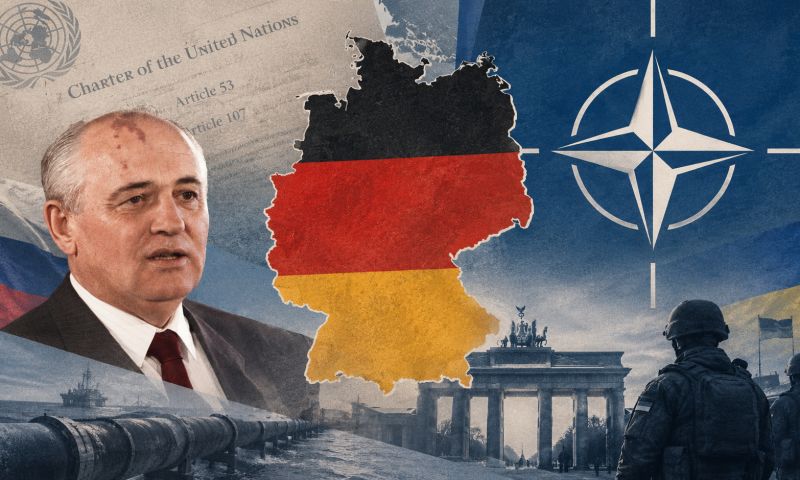
It is little known to the German public that, under the so-called “enemy states clause” in Articles 53 and 107 of the Charter, Germany is still considered an enemy state by its opponents from World War II (Article 77 is obsolete[4]). The enemy state clause states that coercive measures—including, if necessary, military intervention—could be imposed without specific authorization from the UN Security Council should Germany once again pursue an aggressive policy.
Article 53, paragraph 1, of the Charter reads: “…No coercive measures may be taken on the basis of regional agreements or by regional organizations without the authorization of the Security Council; except for measures against an enemy state as defined in paragraph 2, insofar as they are provided for in Article 107 or in regional agreements aimed at preventing the resumption of an aggressive policy by such a state; this exception shall apply until the Organization is assigned, at the request of the governments concerned, the task of preventing further attacks by such a State.” According to paragraph 2, the term “enemy State” means any State “which was an enemy of a signatory to this Charter during World War II.”
Article 107 of the Charter states: “Measures taken or authorized by the governments responsible for them as a consequence of World War II with respect to a state that was an enemy of a signatory state to this Charter during that war shall not be rendered invalid or prohibited by this Charter.”
In this context, Article 52 is also significant; paragraph 4 of that article refers to Articles 34 and 35, the application of which is “not affected.” Articles 34 and 35 concern the Security Council, which may take action in the event of international disputes. Furthermore, reference is made to Articles 11 and 12, which in turn govern the General Assembly’s powers to maintain international peace and security.
Is the Enemy States Clause obsolete?
There is debate over whether the “enemy states” provision arising from the aforementioned articles has become obsolete as a result of Germany’s membership in the United Nations. [5] But if that were the case, these provisions could have been repealed long ago. Although Germany was granted “full sovereignty” in the 1990 Unification Treaty (Two-Plus-Four Treaty),[6] the agreement was subsequently qualified by supplementary treaties, such as those concerning troop deployments and military cooperation.
The victorious powers of that time, which had forced an unconditional surrender, are still present; the Federal Republic of Germany remains under the tutelage of the United States and under the latent scrutiny of Great Britain and France, even if this is glossed over and many refuse to acknowledge it. When one considers this fact in light of the geopolitical situation in which we find ourselves, much becomes clearer: Washington has considerable leverage to exert pressure and influence the decisions of the German government—a reality that is constantly evident, for example, in the bombing of the Baltic Sea pipelines, the unconditional support for Ukraine, and the devastating policy of aggression toward Russia.
It should be noted that while the UN Charter’s principle of peace claims universal validity, it has been repeatedly violated in recent years, particularly by the United States, which—due to its policy of intervention that violates international law—has long since forfeited the right to invoke human rights and the defense of democratic freedoms.
It can be assumed that neither the United States nor the United Kingdom has any interest in repealing the enemy states clause of the UN Charter; in fact, the opposite appears to be the case. The same applies to a peace treaty.[7] Opportunities to establish forward-looking, orderly relations were not seized. (…)
Still in a state of unconditional surrender
The U.S. is calling on Germany to increase its military spending. The defense budget is to be raised to five percent of gross domestic product. Although there is no evidence to support this, it is claimed that Russia poses a threat not only to the Baltic states and Poland, but to all of Western Europe. During an inaugural visit to Paris on May 7, 2025, German Chancellor Friedrich Merz stated, following consultations with French President Emmanuel Macron: “Ukraine can continue to rely on Germany and France in its fight against Russian aggression.”[8]
Since 1945, Germany has been under guardianship and in a permanent state of emergency. It is high time to end this guardianship. The most important goals of a sensible policy for Germany must be:
Withdrawal from NATO, which has long been violating its own statutes
Termination of the stationing of foreign military forces on German territory
A halt to arms deliveries, particularly to warring parties
The resumption of normal relations with countries with which relations are currently strained
The resumption of affordable gas supplies from Russia
However, following the inauguration of the federal government under Chancellor Friedrich Merz and Vice Chancellor Lars Klingbeil, the conditions necessary for these goals to be implemented do not exist for the time being. (…)
Mikhail Gorbachev made a significant contribution to the unification of the GDR and the FRG in 1990, but this is ignored today. At that time, the Two-Plus-Four Treaty was concluded, which entered into force on March 15, 1991. It declared “that only peace will emanate from German soil. According to the constitution of a unified Germany, acts that are capable of and are carried out with the intent to disrupt the peaceful coexistence of peoples—in particular, the preparation for a war of aggression—are unconstitutional and punishable by law.” The renunciation of nuclear weapons was also reaffirmed. Is all of this just a dead letter? (…)
The Russian Federation is now making serious efforts to terminate the Two-Plus-Four Treaty—with consequences that are difficult to predict, as reported, for example, by independent journalist Mark Hegewald in his show Markmobil. [9] At the very latest with the planned deployment of U.S. missiles, Germany is in violation of the treaty. As early as March 2022, Russia had already classified Germany as “unfriendly.”
Sources
[1] https://overton-magazin.de/hintergrund/politik/deutschland-als-feindstaat-nach-der-un-chara/
[2] see: https://globalaffairs.ru/articles/ogovorka-shulenburg/ und https://eng.globalaffairs.ru/articles/enemy-states-schulenburg/ sowie https://de-rt.com/international/291744-von-schulenburg-feindstaatenklausel-fuer-deutschland-fuer-deutschland-ist-nicht-obsolet/
[3] Text: https://unric.org/de/wp-content/uploads/sites/4/2022/10/charta.pdf
[4] Article 77, which addresses the international trusteeship system and the corresponding trust territories, became obsolete following Germany's accession to the United Nations pursuant to Article 78.
[5] see: Resolution 49/58 der Generalversammlung, 9.Dec.1994. See also https://www.bundestag.de/resource/blob/484610/dc5a3c061feef095da5885a52b92134c/WD-2-147-07-pdf-data.pdf; and Ress/Bröhmer, in: Simma/Khan/Nolte/Paulus (Hrsg.), „The Charter of the United Nations“, Vol. II, Oxford, 3. Aufl. 2012, Art. 107, Rdnr. 21; Ipsen (Hrsg.). Völkerrecht, München, 6. Aufl. 2014, § 6 Rdnr. 131.
[6] Since the Two-Plus-Four Treaty was not a peace treaty, as some have suggested, the Federal Republic of Germany—as a subject of international law identical to the German Reich (see https://www.bundestag.de/webarchiv/presse/hib/2015_06/380964-380964)—remains in a state of armistice. An expert opinion by the Scientific Service of the German Bundestag illustrates just how complicated the legal situation is according to prevailing doctrine: https://www.bundestag.de/resource/blob/579362/47b6ac2d55fcb4c12dfcce3cedc0e7d0/WD-2-149-07-pdf-data.pdf
[7] Allegedly, a peace treaty would have required the payment of substantial reparations. But that would hardly have been an obstacle, since the Berlin government is constantly distributing—and squandering—millions and billions anyway.
[8] Zit. n. www.ndr.de/nachrichten/info/Merz-Ukraine-kann-sich-auf-Deutschland-verlassen,audio1868266.html
[9] Vgl. https://t.me/MARKmobil/3456
«Germany and the Enemy States Clause»