


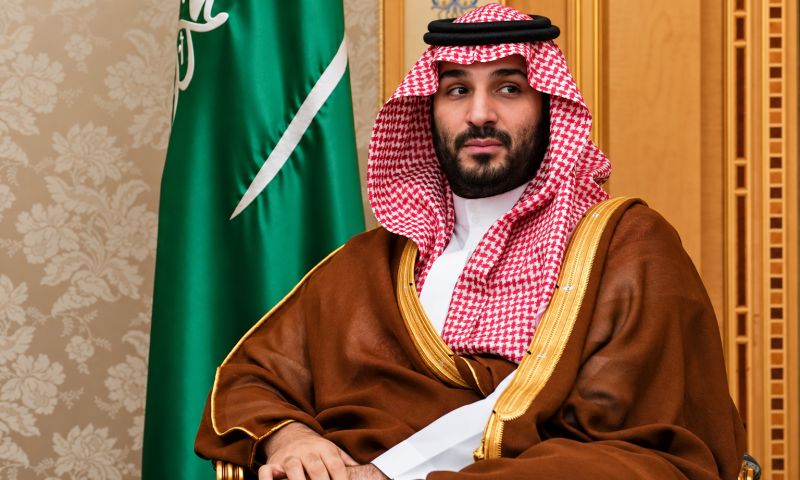
Mohammed bin Salman is more at risk internally than from AnsarAllah attacks


As part of its ‘blockade-for-blockade’, ‘airport-for-airport’ strategy, Ansarallah carried out a third attack on Riyadh International Airport on Saturday — 12 people (mostly civilians) were killed and more than 300 injured. This, in tandem with Iran’s escalating attacks on tankers, and expanding its maritime operations, immediately increases the pressures on President Trump to respond — at the precise moment when midterm elections loom.
As the military conflict between Yemen and Saudi Arabia continues, the latter has become increasingly dependent on attacks against Yemeni civilian targets — by Sept 2025, reports confirm that “nearly 15,000 civilians have been killed by direct military action, most of them in air strikes by the Saudi-led Coalition”. Yet the Yemeni armed resistance, taking its cue from Iran's experience, sees that Saudi is infinitely more vulnerable via its energy infrastructure sitting out in the open.
If Yemen continues to strike at key Saudi economic and energy assets with precision, the consequences for Riyadh will multiply — the battlefield will increasingly become that of Saudi infrastructure destruction and pain for the West versus Yemeni civilian casualties.
This scenario could lead to major capital destruction, a sovereign debt crisis, and Riyadh forced to abandon yet more of its Vision 2030 projects on which MbS has staked the kingdom’s future.
Saudi Arabia continues to behave as though the old formulas of sectarianism, anti-Iran propaganda and an anti-Shia narrative can once again be used to maintain their pro-Western positioning. But those tired mantra have lost their effectiveness — even among large parts of the region’s Sunnis.
The situation today is fundamentally different. AnsarAllah does not represent the Twelver Shia framework that Saudi propaganda could easily portray as an 'Iranian project'. AnsarAllah-governed Yemen has its own ideological framework, theological traditions, political history, and system of governance. Neither AnsarAllah nor the broader pro-Sana’a camp can simply be reduced to one sect or social class.
The AnsarAllah Yemeni landscape includes Hanafi Sunnis, Zaidis, Jaroodiya, Ismailis, and other Islamic schools, with even elements of Salafi groups existing within the broader Yemeni social structure.
In short, unless MbS capitulates to AnsarAllah demands — which it seems he is incapable of so doing — the consequences could develop into a devastating macro-economic cascade occurring within the key pivot situated at the centre of the Gulf economic model; a cascade, furthermore, which, as its momentum grows, and foreign capital flees the kingdom, will bring a systemic collapse to the entire western colonial enterprise in the Gulf.
The more paradoxical element to this drama is that it is not from AnsarAllah's attacks that MbS’ is most at risk — or from which his downfall might be precipitated. It will not come from the battlefield either. Regime change inside Saudi Arabia will come about as a result of his own hand — his compulsive quest to centralise control.
Even Edward Luttwak, known for his links to the western security state, observes that —
“the reason for [the impotence] of Saudi Arabia, in the face of the Houthi offensive, is that, for the Kingdom’s ruling family, the most deadly danger has long been a military coup d’état — such as the one which ended Iraq’s monarchy and killed every single member of its Husseini ruling family on 14 July 1958.”
“Against that danger, the successive heads of the Saudi ruling family have implemented the most effective remedy possible: divide and rule, not against foreign enemies, but within their own armed forces. For that reason, the different combat elements of the armed forces are geographically separated in the country’s vast territory, and commanded by different princes in charge of various parts of the ministry of defence, all of which are subordinate to the minister himself, Prince Khalid (a younger brother of Mohammed bin Salman)”.
MbS’ fear is that one F15 pilot, outside of the privileged Royal family Stipendiary circle, might choose to attack one of the Kingdom’s princely palaces (instead of striking at an AnsarAllah target) as a prelude to an all-out military revolt. This is no fanciful threat — an old ‘Saudi hand’ recalled recently hearing one young Saudi officer threatening to do exactly that.
By cutting off traditional tribal patronage by which tribal leaders had expected to receive their share of the kingdom’s oil wealth; by seizing tribal lands earmarked for MbS ‘vanity projects’; and by actively working to reshape Saudi Arabia's core legitimacy away from traditional tribal-religious alliances towards a nationalist, youth-driven identity centred around Vision 2030, MbS has cut away the political leverage that traditional tribal elders historically held within the Royal Court.
MBS has made many enemies through the transformation of the Kingdom not towards a nation-state, but rather toward being the property of a single family. He has concentrated immense political, economic, and security powers within his immediate branch of the family, acting as an absolute authority.
As one commentator writes —
“For traditional tribal groups like the 'Anizah, this means that policy decisions are made strictly from the top down, leaving little room for the traditional consensus-building or special autonomy that tribes historically enjoyed”.
The erosion of the historic social contract has left a deep sense of economic anxiety and loss of prestige among traditional tribal structures — and among the Wahhabi religious establishment.
The result is that —
“a tribal realignment is under way. In the north and central areas, the Shammar and Anizzah desert tribes have reportedly sealed the borders to Jordan and Iraq. In the south, mountain tribes with historical kinship ties to AnsarAllah are more likely to ignore the border with Yemen than defend the crown”.
“And we’ll know, soon enough, whether there is any foundation to the [multiple] rumours that representatives of more than a dozen Saudi tribes have sat with IRGC representatives and floated a new political compact — a federal state with tribes receiving a share of oil and gas revenues”.
It wouldn't be surprising if there are not other tribes and clans throughout the Region (Syria, Iraq …) who have a similar smouldering resentment to that of the Saudi tribes, festering secretly away, and similarly derived from their own experience of top-down colonial exploitation.
Might the Saudi Kingdom experience a revolt against MbS? Such a possibility is not without precedent: When King Saud’s reckless governance threatened the monarchy’s survival in 1964, the family, senior princes, and the religious leadership stepped in to strip him of power and enforce his abdication.
In the event of the collapse of MbS-led al-Saud family rule, this would not only topple the Gulf colonial project, but would then initiate a scramble for a fundamental geopolitical re-alignment of the region.
The colonial ‘current shape’ imposed upon West Asia for more than a century is at an inflection point. Everything is ‘up in the air’. How will President Trump react to AnsarAllah’s accelerated attacks on Saudi Arabia? Will he launch a wider war across the region by attacking Iran, Yemen or Iraq? Or will a major attack on north Yemen against Ansarallah, with Pakistani and Israeli participation, be authorised? Or might the Sistan-Baluchistan region of Iran erupt as a result of a Pakistani-CIA insertion of cross-border Balochi insurgents into Iran, potentially leading to Iranian exchanges of fire with Pakistan?
We don’t know. But it is widely understood that the region’s current shape was drawn up for other, earlier purposes — Bahrain was Persian for two centuries before 1783; Kuwait was a district of Basra until Britain drew a line of separation in 1899; the United Arab Emirates were Trucial Oman (coastal sheikhdoms under British protection, until December 1971). Qatar was a Bahraini suzerainty, then Ottoman, then British, before it became a state in 1971. Lebanon and Syria were carved out of the Ottoman ruin by France in 1920. Jordan was proclaimed a ‘state’ by a British High Commissioner in 1921.
Luttwak forewarns that — "Ultimately … the [al-Saud] inheritors must learn to share Saudi Arabia’s vast flow of oil revenues with everybody else, or else risk losing more than just their wealth”.
Iran has just launched large-scale military exercises amid indications of a possible imminent Israeli-American escalation to come very soon.
Change seems inevitable.
«Mohammed bin Salman is more at risk internally than from AnsarAllah attacks»