


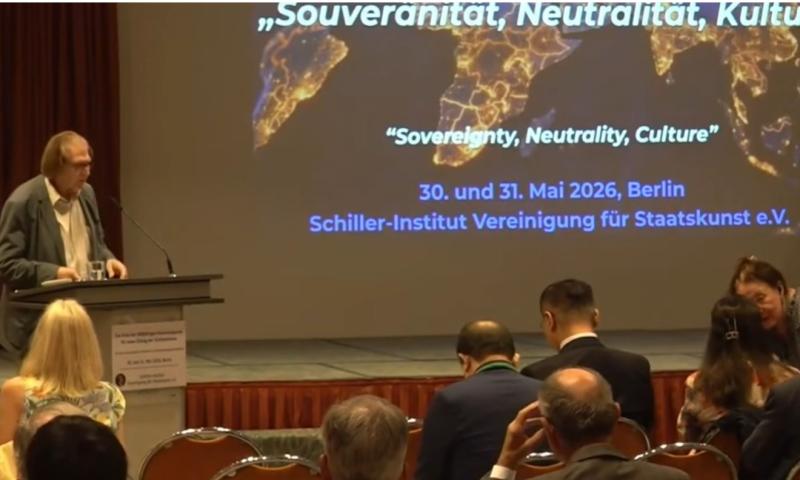
Sovereignty, Neutrality, Culture: Germany—Ruined by External Forces


On April 14, 2026, German Chancellor Friedrich Merz agreed to a strategic partnership with Ukrainian leader Volodymyr Zelenskyy,[1] and a month later, Defense Minister Boris Pistorius was in Kyiv to discuss closer military cooperation. [2] Germany is set to become—once again—the strongest military power in Europe, and Germany is to support Kyiv’s Ukraine in its war until victory over Russia is achieved—at the expense of its own population, which faces the threat of existential annihilation in the event of war.
How did it come to this? After all, following the so-called reunification in 1990, a promising partnership for both sides seemed to be taking shape. However, after the U.S. government under Barack Obama declared that Russia must be ruined in order to open it up to Western capital interests, the U.S. and the EU imposed increasingly severe sanctions. The Western leadership elite, which initially resisted, was—as Joseph Biden revealed in a 2014 speech—coerced by Barack Obama into participating.
It is an ironic twist of history that a European “coalition of the willing” is continuing the policy of aggression against Russia—imposed in 2014—with almost fanatical determination, even though it has lost the support of the United States under the Trump administration. Evidently, the opinion-shaping European politicians and journalists—many of whom attained their leadership positions through patronage from U.S. networks and the Obama and Biden administrations—have internalized their hatred of Russia to such an extent that they are even planning war against Russia. How this might end is all too well known.
Recently, calls have emerged for Germany to adopt a neutral stance,[3] an idea that Stalin had already proposed in 1952. At that time, he offered to negotiate a peace treaty with Germany with the other three victorious powers of World War II. The condition was the neutrality of a future unified Germany, with the exception of the eastern territories placed under Polish administration. Because the Adenauer government had already decided, in secret negotiations at the same time, to rearm and join NATO, the Western Allies boycotted the Soviet proposal. Konrad Adenauer also rejected it as a frivolous “distraction tactic” intended to block the FRG’s integration into the West, thereby squandering the opportunity for a self-determined German policy.
Instead, the two German entities—which had been stripped of their sovereignty by the victorious powers following their unconditional surrender—remained under foreign administration, a situation that was only gradually relaxed. According to prevailing opinion, the Federal Republic of Germany, as a “subject of international law identical to the German Reich,”[4] regained “full sovereignty” through the Two Plus Four Treaty of September 12, 1990 (Article 7, Paragraph 2), so that—theoretically—German neutrality would be achievable today.
That is the official state of affairs.[5] However, the granting of sovereignty has been qualified by supplementary treaties, such as the Troop Stationing Agreement, NATO membership, the military alliance for “Permanent Structured Cooperation” (PESCO)[6], other military and economic agreements, as well as overarching EU legislation. In particular, Germany’s scope for action in foreign policy is limited by the Allies’ rights of reservation and their ability to exert influence.[7]
While agreements such as the Troop Stationing Agreement or the NATO Treaty can be terminated, and Germany could also withdraw from the EU, it is highly doubtful whether a German government would dare to take this step or be able to stand up to the United States and the United Kingdom. It is also well known that the United States does not abide by treaties once they no longer suit its government.
CDU politician Wolfgang Schäuble[8], who has played a key role in shaping German politics for decades, said on November 18, 2011—twenty years after the so-called reunification and the Two Plus Four Treaty—at the “European Banking Congress” in Frankfurt am Main: “…we in Germany have not been fully sovereign at any point since May 8, 1945.”[9] That was the opinion of an experienced politician.
Under international law, sovereignty is, according to traditional legal doctrine, the absolute authority of a state over its domestic and foreign policy actions. [10] This is clearly not the case for Germany. However, according to more recent interpretations of international law, a state may, through treaties with other states, waive certain rights—that is, voluntarily restrict its sovereignty. This could be an option for Germany. However, various restrictions to which Germany is subject are not self-imposed.
This raises the following questions:
1. Can a country whose population is constantly lied to, deceived, and humiliated—a country that has no peace treaty and, according to the United Nations Charter (Articles 53 and 107), is still considered an enemy state by the victorious powers of World War II—be sovereign? The enemy state clause states that coercive measures, including military intervention, could be imposed without specific authorization from the UN Security Council should Germany once again pursue an aggressive policy. What this means is open to broad interpretation, and such interpretation would, if necessary, be made by the victorious powers of World War II—namely, the United States.
It is true that there is debate over whether the “enemy states” provisions set forth in the aforementioned articles have become obsolete due to Germany’s membership in the United Nations.[11] But if that were the case, these provisions could have been repealed long ago.
2. Can a country with eleven massive U.S. military bases—which permanently keep approximately 39,000 soldiers armed in Germany (including with nuclear weapons) and invite them to international conferences at their Ramstein military base, from which they command drone strikes—be considered sovereign?[12]
3. Can a country in which the victorious powers of World War II have retained authority still be sovereign? There is a view that so-called “petrified occupation law” still applies,[13] that is, “occupation law that was not subject to any disposition by the German state upon the conclusion of the ‘Transition Agreement’ of 1955,” and that individual provisions of which remain in force.[14]
4. Can a country that is unquestioningly cut off from favorable energy supplies from Russia, that constantly allows itself to be dictated to, and that has disadvantageous laws imposed on it by the European Commission, be sovereign?
A New Constellation
The question of Germany’s sovereignty is a difficult issue that has existential implications for the population, yet one that officials tend to avoid. But it is time to bring it into the public discourse, which is what several peace organizations are currently attempting to do.
In fact, the political situation as it stands in the spring of 2026 would be favorable for initiating and implementing German neutrality. With the new U.S. National Security Strategy (NSS), President Donald Trump has created the opportunity to undertake a fundamental reassessment of the transatlantic system and U.S. security conditions. Among other things, this document puts an end to further NATO expansion and thus to the speculations of the Western European “coalition of the willing” regarding Ukraine’s NATO membership.[15]
But Berlin’s politicians remain entrenched in the deep state of the Obama and Biden administrations, which, through its media and networking campaigns, made them fit to govern and positioned them against Russia. Instead of seizing the opportunity to advance Germany’s interests, the Merz government has, since taking office in May 2025, been working to provide money and weapons to Ukraine at the expense of its own population, in order to prolong the proxy war against Russia. A shift could result from the war in Iran and Germany’s looming economic ruin.
Summary
Perhaps one could say that Germany is not fully sovereign (if such a thing as “incomplete sovereignty” even exists), and that with a self-assured, independently acting government, it would be possible to achieve at least an approximate form of sovereignty in the sense of a more recent interpretation of international law. However, given the circumstances mentioned, it stands to reason that the German government is not capable of acting autonomously for the benefit of the population; thus, Germany is not sovereign in the sense codified in the Two Plus Four Treaty. It is also questionable whether the Two Plus Four Treaty remains valid, given that Germany has failed to comply with it.
In this respect, the current realities stand in the way of achieving German neutrality, which would resolve many of today’s problems. Intensive diplomatic efforts at the highest level would be necessary to pave the way for a more peaceful future. There is little hope of this at present. But despite seemingly insurmountable hurdles, the goal of German sovereignty and neutrality should not be lost sight of. In this regard, there are commendable initiatives that deserve support.[16]
In all of this, two eminently important global political developments must be taken into account—developments that are misjudged, denied, or completely overlooked by politicians in both Berlin and Brussels.
First: The current escalating global conflicts, driven by Western financial and economic elites, represent a fundamental clash between the collective West and the Global South, including Russia. This carries the risk of a global, potentially nuclear war that could spell the end of humanity. One way out would be to further develop BRICS and establish a global security system.
Second: The current pre-war situation offers an opportunity to break free from the military and cultural stranglehold of the U.S. and rediscover one’s own cultural roots. In this respect, the Ukraine conflict also presents itself, in the broadest sense, as a clash between two cultural spheres: the US-dominated Western culture, which is sliding into decadence, and a historically grown conservative European culture.
Russia, currently at war, may not be a model of civil rights, and of course the United States offers more than just lowbrow entertainment; but based on the conviction that culture is the foundation of a society, U.S. cultural imperialism takes on significant importance. It cannot be overlooked that, alongside its military actions, the U.S. has established influence over billions of people through Hollywood and Disneyland. And it seems that in Russia, the largest country in Europe, despite the West’s policies of aggression and war and despite many problems, an attempt is being made to preserve a European culture of consciousness, spirituality, and humanity—whatever one’s stance on the matter may be.
It will be difficult to restore a relationship of trust with Russia in the foreseeable future, yet this is necessary to achieve economic recovery and to protect European culture from the destructive, politically motivated influences of the United States. This must be one of the goals of the peace movement currently taking shape in Europe, and to achieve this, it is necessary to educate as many people as possible about the causes and background of the aggressive policies pursued in particular by the Anglo-Americans.
The writer and journalist Dr. jur. Wolfgang Bittner lives in Göttingen. His most recent book, published by Verlag Hintergrund, is “Geopolitics at a Glance: Germany, the U.S., the EU, and Russia,” Berlin 2025. The text above is the speech manuscript, expanded to include footnotes, of a lecture given by Wolfgang Bittner on May 30, 2026, in Berlin on the occasion of a conference organized by the Schiller Institute.
Notes and Sources
1 See. www.rbb24.de/politik/beitrag/2026/04/selenskyj-kommt-nach-berlin.html
3. See http://www.nrhz.de/flyer/beitrag.php?id=29559&css
4 See. www.bundestag.de/webarchiv/presse/hib/2015_06/380964-380964
5 On this subject, the Research Services of the German Bundestag provide a detailed but weakly argued analysis in “The Transition Agreement and ‘Enemy State Clauses’ in Light of the Federal Republic of Germany’s Sovereignty under International Law”: www.bundestag.de/resource/blob/414956/52aff2259e2e2ca57d71335748016458/wd-2-108-06-pdf-data.pdf
6 See. Spiegel online, 13. November 2017, www.spiegel.de/politik/ausland/bruessel-23-eu-staaten-gruenden-pesco-zusammenarbeit-bei-verteidigung-a-1177685.html
7 See Sebastian Fries, „Zwischen Sicherheit und Souveränität: Amerikanische Truppenstationierung und außenpolitischer Handlungsspielraum der Bundesrepublik Deutschland“, https://edoc.bbaw.de/opus4-bbaw/frontdoor/deliver/index/docId/359/file/26PiNaLFNd6L_327.pdf
8 Schäuble (1942–2023) served as Federal Minister for Special Tasks and Head of the Federal Chancellery from 1984 to 1989, and as Federal Minister of the Interior from 1989 to 1991 and again from 2005 to 2009. From 2017 to 2021, he was President of the German Bundestag.
9 www.youtube.com/watch?v=hdg8_9diL2E (abgerufen am 17.1.2026)
10 See also: Burkhard Schöbener (Hrsg.), „Völkerrecht. Lexikon zentraler Begriffe und Themen, C.F. Müller, Heidelberg 2014, S. 393.
11 See General Assembly Resolution 49/58 of December 9, 1994. See also www.bundestag.de/resource/blob/484610/dc5a3c061feef095da5885a52b92134c/WD-2-147-07-pdf-data.pdf; Ress/Bröhmer in: Simma/Khan/Nolte/Paulus (Hrsg.), The Charter of the United Nations, Bd. II, Oxford 2012, Art. 107, Rdnr. 21; Ipsen (Hrsg.), Völkerrecht, München 2014, § 6, Rdnr. 131
12 See also Wolfgang Bittner, „Niemand soll hungern, ohne zu frieren“, Verlag zeitgeist, Höhr-Grenzhausen 2024, S. 63 ff.
13 See ibid: „Überleitungsvertrag und ‚Feindstaatenklauseln‘ im Lichte der völkerrechtlichen Souveränität der Bundesrepublik Deutschland“, S. 7.
14 Here are the details: https://de.wikipedia.org/wiki/Überleitungsvertrag (accessed on January 17, 2026)
15 https://www.whitehouse.gov/wp-content/uploads/2025/12/2025-National-Security-Strategy.pdf (accessed on January 17, 2026)
«Sovereignty, Neutrality, Culture: Germany—Ruined by External Forces»