


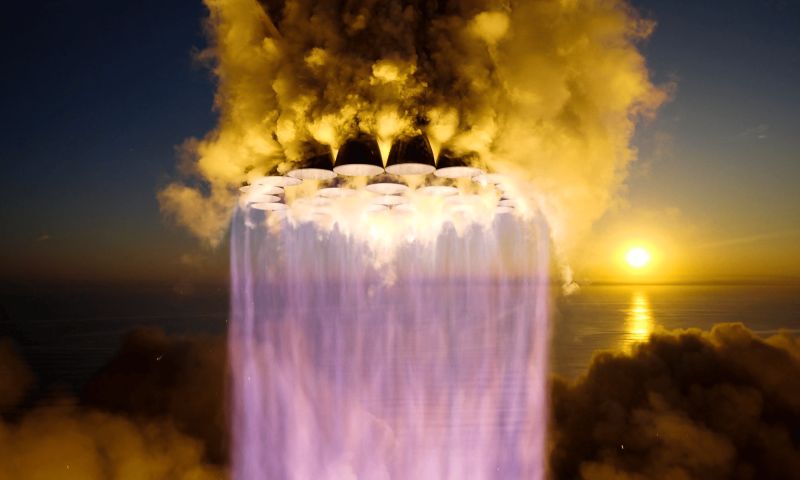
SpaceX: Rockets, Satellites and AI at the Service of American Power


“Our mission is to build the systems and technologies necessary to make life multiplanetary, to understand the true nature of the universe, and to extend the light of consciousness to the stars.” — SpaceX Prospectus, May 2026
“My Starlink system is the backbone of the Ukrainian army. Their entire front line would collapse if I turned it off” — Elon Musk, March 2025
June 12, 2026, will mark a turning point in global finance. On that day, SpaceX completed the largest initial public offering ever seen: by selling just 4% of its equity, Elon Musk’s company raised $75 billion, valuing the company at nearly $1.8 trillion. In trading floors, euphoria reigns. The financial press is scrutinizing every slight fluctuation in the stock price, while investment banks have just raked in some $500 million in commissions.
However, this should not be seen as a purely speculative event. History shows that major financial bubbles usually accompany major technological revolutions — from canals and railroads to the internet. The emergence of a multipolar world, coupled with rapid advances in AI, is fueling massive investments in defense and technology. And SpaceX sits at the crossroads of these two trends.
Controlled by the world’s richest man and closely linked to the U.S. military-industrial complex, Elon Musk’s company holds significant macroeconomic and geopolitical importance. Renowned for its rocket launch capabilities, SpaceX operates in three complementary fields: access to space, connectivity, and artificial intelligence.
The Launch Industry: Access to Space
Founded in 2002, SpaceX’s mission is to colonize Mars by drastically reducing the costs of space transportation. At the time, the space establishment—government agencies (NASA) and major defense contractors (Boeing, Northrop Grumman)—was skeptical of Elon Musk’s bold venture.

And yet, the company quickly racked up successes, such as launching the first private liquid-fueled rocket into orbit (2008) and docking the first commercial spacecraft with the International Space Station (2012). The real turning point came in December 2015, when the company succeeded, for the first time in history, in landing the first stage of its Falcon 9 rocket vertically after its mission was complete.
The first stage of a rocket is the largest and most expensive part. This is where the main engines are housed. It propels the launch vehicle during the first few minutes of flight, then separates from it once its fuel is exhausted. Until then, it would inevitably fall back into the ocean and be lost, meaning that each launch required the construction of a new rocket.
It’s as if, in air travel, every airplane had to be destroyed after a single flight. Powers that have not yet mastered this technology—such as China, Russia, and the European Union—remain stuck in this economic absurdity, even though Beijing is closing in on it by leaps and bounds.
In 2017, the company took a decisive step forward by relaunching a stage that had already been used. Thanks to this reusable launch vehicle, the cost per kilogram placed into orbit plummeted from $54,500 for the U.S. space shuttle to approximately $2,720 for the Falcon 9—a twentyfold reduction.
This drop in costs has enabled SpaceX to significantly increase its launch cadence. Annual launches of the Falcon family are set to rise from 31 in 2021 to 165 in 2025, propelling the company toward unchallenged dominance in orbital access.
Since 2023, the company has been delivering more than 80% of the total mass of payloads placed into orbit each year worldwide. This technological feat gives the Americans a virtual monopoly on the gateway to space.
Global Connectivity: The Starlink Challenge
SpaceX’s second pillar is based on the deployment of a global communications infrastructure. The goal is to use the Starlink service to provide high-speed internet access, data services, and mobile phone service covering nearly the entire planet—to individuals, businesses, and governments alike.
To achieve this, SpaceX is deploying a massive number of its own satellites into low Earth orbit. Until now, satellite services have been expensive, slow, and geographically limited. By placing its satellites at an altitude of just 550 km—compared to nearly 36,000 km for traditional geostationary satellites—the company has significantly reduced latency and costs while increasing data throughput.
Just a few years after its commercial launch, Starlink has established itself as the world’s leading satellite operator. In March 2026, the constellation surpassed the milestone of 10,000 active satellites in low Earth orbit, serving more than 10 million subscribers across more than 150 countries.
The war in Ukraine has revealed to the world the strategic importance of this constellation. After the Russians targeted critical Ukrainian infrastructure, Starlink terminals became—in Musk’s words—the backbone of military communications, drone coordination, and civilian access to information.
These satellites operate independently of ground infrastructure. A simple portable antenna, set up in a matter of minutes in a trench, is all that’s needed to receive the signal, even in the midst of devastated areas. With latency reduced to 20–40 milliseconds and high data throughput, the system enables real-time drone control and artillery targeting.

Elon Musk also sparked controversy by temporarily cutting off access to Starlink during a Ukrainian attack on Sevastopol. This incident prompted the Pentagon to accelerate the deployment of Starshield, the secure military version of the network, designed to avoid any unilateral control by the SpaceX CEO.
Artificial Intelligence: From Grok to Orbital Servers
SpaceX’s third pillar is the newest and most speculative. In 2023, while OpenAI (ChatGPT), Anthropic (Claude), and Google (Gemini) were vying for dominance in large language models in the United States, Elon Musk entered the race late by founding xAI and its AI assistant, Grok.
Grok has a trump card up its sleeve: the social media platform X (formerly Twitter). While AI labs are scrambling to acquire training data at exorbitant prices, Grok draws directly from a goldmine that Musk already owns: the interactions of nearly 1.3 billion accounts. The 550 million monthly active users and 350 million posts published each day provide it with a constantly updated stream of information that no competitor can replicate.
But the data is worthless without the computing power to process it. That’s the role of the Colossus and Colossus II supercomputers, located in Memphis, Tennessee. These are data centers where hundreds of thousands of graphics processing units are interconnected to function as a single giant machine. Together, they form the world’s largest computing complex dedicated to AI, with one gigawatt of installed power—equivalent to the electricity consumption of a city of one million people.
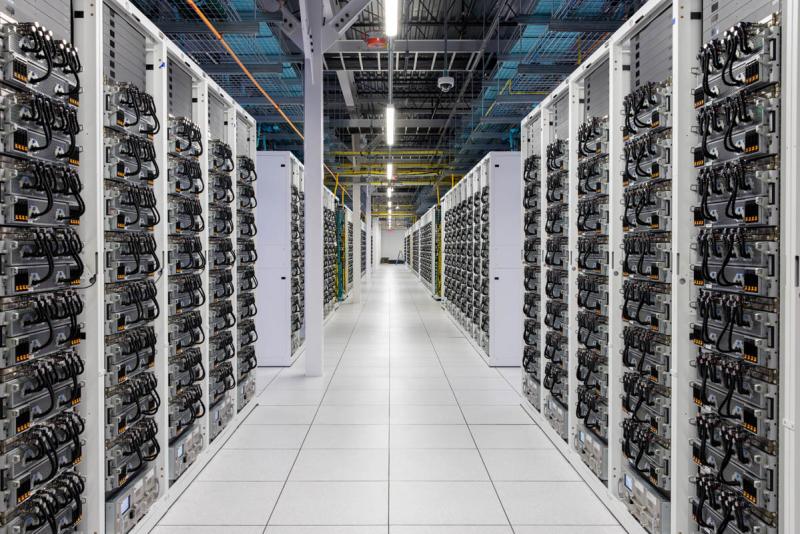
Purchasing semiconductors from a handful of Asian giants (TSMC and Samsung) is proving to be another bottleneck for the growth of Elon Musk’s company. To overcome this, SpaceX is moving up the value chain and, in partnership with Tesla and Intel, is unveiling the Terafab project. This Texas-based megafactory brings together design, lithography, memory, and assembly all under one roof. Its goal is to produce the equivalent of one terawatt of computing power each year—the equivalent of a thousand Colossus supercomputers.
According to Musk, the final barrier the AI industry is likely to hit soon is that of Earth’s energy constraints. Power grids are saturated, available power is becoming scarce, and new generation capacity is being deployed slowly. Musk’s solution is to move this infrastructure en masse into orbit. In space, sunlight is constant, and constraints such as land availability and cooling requirements are largely eliminated. At least, that is the promise made to investors, which justifies the company’s sky-high valuation.
Already mastering reusable launch vehicles, mass-produced satellites, and global connectivity, SpaceX believes it holds a unique advantage in building tomorrow’s AI infrastructure in space. The company brings together under one roof the model, real-time data, computing power, and—soon—chip manufacturing—a level of vertical integration unmatched in the industry.
Valuation, Profitability, and Financing
In 2025, SpaceX generated $18.7 billion in revenue (up 33% year-over-year) but posted a net loss of $4.9 billion. At the time of its Nasdaq listing, however, the company was valued at $1.8 trillion—96 times its revenue. By comparison, Nvidia, which is profitable, trades at around 25 times its sales. In other words, SpaceX trades at a multiple that is incomparable to that of other technology or defense companies.
A closer look at the financial statements sheds light on this paradox. The launch segment posts the highest gross margins, at nearly 67%, but remains unprofitable, with an operating loss of $657 million in 2025. This is primarily due to $3 billion in R&D expenses. Starlink accounts for the bulk of revenue (61%) and generates $4.4 billion in operating profit, making it the group’s only truly profitable segment. AI, however, is a money pit. The segment posted an operating loss of $6.4 billion on just $3.2 billion in revenue—a deficit twice as large as its revenue.
How, then, can such a valuation be justified? With even larger numbers. SpaceX estimates its total addressable market at $28.5 trillion, which it presents as the largest quantifiable market in history. In practical terms, this figure represents the total revenue the company could theoretically generate if it were ever to serve all customers likely to purchase its products and services. Of this total, $26.5 trillion relates to artificial intelligence, and enterprise applications alone account for $22.7 trillion.
These projections leave some market veterans skeptical. Jeremy Grantham, co-founder of GMO (approximately $70 billion in assets under management), has called SpaceX a “fabulous BS story.” In his view, asteroid mining and the promises of immense AI success are the classic hallmarks of a market peak—typical of what is observed at the height of a massive bubble.
The company’s governance structure will do little to silence critics. By selling only 4% of the company and issuing two distinct classes of stock, Elon Musk retains more than 85% of the voting rights. Shareholders are expected to pay, not to govern. Buying SpaceX stock therefore amounts to a double bet: on a highly optimistic scenario involving the deployment of AI infrastructure into orbit, and on Musk himself to lead the company.
One thing, however, is certain: the sheer amount of capital raised reflects a historic technological convergence in the United States, where space, telecoms, AI and defense are increasingly intertwined. Even if the stock price were to collapse, the rockets, satellite constellations, and factories built in the meantime will remain.
SpaceX and the U.S. Government: An Ambiguous Yet Openly Acknowledged Interdependence
The relationship between Elon Musk and the U.S. government is something of a paradox. On the one hand, there is an entrepreneur who is shaking up the space sector—traditionally the preserve of major defense contractors and NASA—by reducing the cost of launching a payload into orbit by a factor of twenty. On the other, a government that grants him a virtual monopoly over such sensitive areas as military communications, even going so far as to let him decide single-handedly, in the midst of a war, on the coverage of Ukraine’s network.
As long as this growth in Musk’s economic and political power reinforces U.S. dominance in space and its military implications, the relationship remains tenable—despite President Donald Trump’s strong personality. We recall the spectacular falling-out in June 2025.
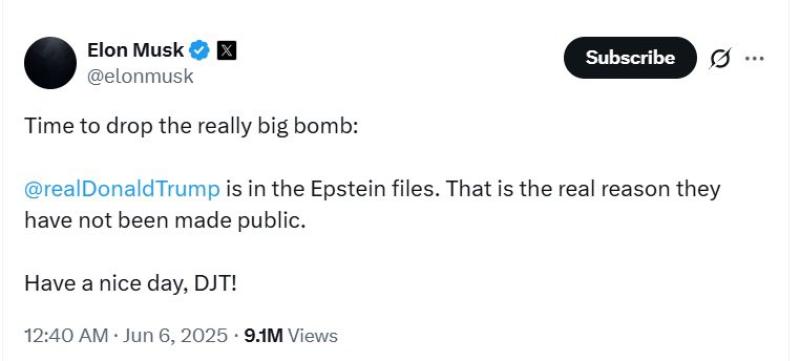
At the time, Musk denounced the budget bill, while Trump threatened to cut off subsidies to Tesla. The back-and-forth was immediate: Musk claimed that Trump was directly involved in the Epstein case, while Trump threatened to terminate SpaceX’s federal contracts. Musk retorted that he would ground the Dragon capsule, the only American spacecraft capable of transporting crews to the International Space Station. A few days later, it was all forgotten. None of the threats were carried out, as Musk’s role in the U.S. space program had become indispensable.
What’s striking about Musk is this duality. On the one hand, there’s the dreamer who’s picking up the space race where the 1970s left off, promising a multiplanetary world and teaching us to think big again by revolutionizing three industries: space, digital technology, and energy. He repeats it over and over: “You want to wake up in the morning and think the future is going to be great — and that’s what being a space-faring civilization is all about. It’s about believing in the future and thinking that the future will be better than the past. And I can’t think of anything more exciting than going out there and being among the stars.” On the other hand, there’s the hyper-realist—the one who methodically solves physical problems deemed unsolvable and unhesitatingly aligns himself with the U.S. defense establishment.
But for now, the company is still a long way from realizing its ideals. In practical terms, SpaceX offers the U.S. government dominance over access to space, control of the global communications infrastructure, and the ability for its security services to monitor everything.
Musk’s genius lies in having understood that to go to Mars, he first had to make money on Earth—with the Pentagon. The risk is that he will end up as nothing more than a military subcontractor for the U.S. government, losing his spirit of exploration in the process.
«SpaceX: Rockets, Satellites and AI at the Service of American Power»