


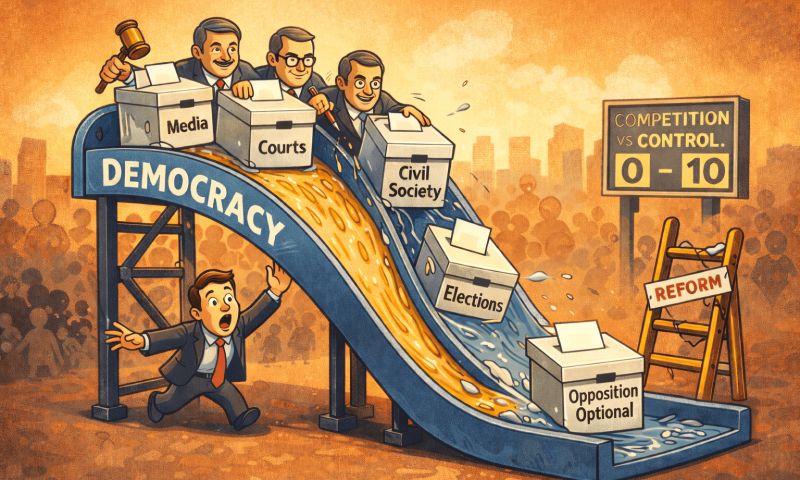
Step-by-Step Guide to Democratic Backsliding (Elections Included)


Introduction
Democracies rarely collapse overnight anymore. They erode. Elections continue, constitutions remain in place, and leaders insist that nothing unusual is happening. Meanwhile, the rules are adjusted, institutions are reshaped, and political competition becomes less equal step by step. By the time the system starts to look different, it has usually been changing for years.
Process-oriented theories of democratic backsliding were developed to explain this kind of slow transformation. Instead of coups or revolutions, these theories describe a sequence in which incumbents weaken democratic norms, capture key institutions, limit opposition, and use crises to expand executive power. The result is not always dictatorship, but often a hybrid regime in which elections exist without guaranteeing real alternation of power.
Turkey under the Justice and Development Party (AKP) offers one of the most instructive examples of this process. Since 2002, the party moved from reformist rhetoric and European Union alignment to increasing polarization, institutional restructuring, and eventually a highly centralized presidential system. None of this happened in a single moment, and almost all of it happened through legal changes rather than open repression.
Poland under the Law and Justice Party (PiS) followed a similar path after 2015, yet the outcome was different. Democratic institutions weakened, but they did not collapse, and the government eventually lost power through elections. This contrast raises an important question: if the sequence of backsliding looked similar, why did one case end in competitive authoritarianism while the other did not?
This paper argues that process-oriented theory remains highly useful but incomplete. It explains the mechanics of democratic erosion, but it often underestimates the importance of international pressure, political crises, and opposition strength. Turkey shows how the sequence can run to completion. Poland shows how it can be interrupted.
Process-Oriented Theory of Democratic Backsliding
Older theories of regime change expected democracies to fall suddenly. Scholars studying the late twentieth century focused on coups, revolutions, and economic crises as the main causes of breakdown. Democracy was supposed to collapse with a clear rupture, not fade gradually while elections continued.
The post-Cold War period produced a different pattern. In countries such as Hungary, Venezuela, Turkey, and Poland, elected governments weakened democratic institutions without abolishing them. Courts were packed rather than closed, constitutions were amended rather than suspended, and opposition parties were harassed rather than banned. The system still looked democratic, but the balance inside it kept shifting.
Process-oriented theories describe this change as a sequence. Democratic erosion usually begins with the weakening of informal norms such as mutual toleration and institutional forbearance. When political opponents are treated as enemies rather than rivals, and when leaders use every legal loophole available simply because they can, the unwritten rules that protect democracy start to disappear.
The next step is institutional capture. Governments try to control courts, bureaucracy, and media, often in the name of reform or efficiency. These changes rarely appear revolutionary at first, but over time they reduce the independence of the institutions that should limit executive power.
Electoral manipulation follows. Elections continue, but the playing field becomes uneven through media bias, legal pressure, and unequal access to resources. Civil society restrictions often come next, as NGOs, universities, and protest movements face increasing regulation and scrutiny.
Crises can accelerate the entire process. Security threats, protests, or coup attempts allow governments to introduce emergency powers that would normally face resistance. What might take years under normal conditions can happen in months during a crisis.
The end result is what Levitsky and Way call competitive authoritarianism: a system where democratic institutions exist formally, but the incumbents hold such an advantage that real alternation of power becomes unlikely.
The strength of this approach is that it explains how democracies erode without dramatic breaks. Its weakness is that it sometimes assumes the sequence will unfold the same way everywhere, leaving less room for factors such as international pressure, crisis timing, and opposition unity.
Turkey: Sequential Backsliding in Action
Norm Erosion
When the AKP came to power in 2002, it presented itself as reformist, pro-European, and committed to democratic change. Early reforms reduced military influence, expanded some civil rights, and improved relations with the European Union. For a time, Turkey looked like a country moving toward democratic consolidation.
The tone began to change after the party secured repeated electoral victories. Political opponents were increasingly portrayed as enemies of the nation, journalists as agents of foreign interests, and civil society groups as suspicious actors. Once this language became normal, extraordinary measures could be justified as necessary for national survival rather than political advantage.
As polarization increased, informal democratic norms weakened. State institutions began to act in more openly partisan ways, and media ownership gradually shifted toward groups close to the government. None of these changes destroyed democracy by themselves, but together they altered the political environment in which democracy operated.
Media Pressure and Civil Society Containment
After polarization became normal, control over information became more important. Independent media faced tax fines, regulatory pressure, and ownership changes that encouraged more supportive coverage. Television licenses were revoked, newspapers faced financial penalties, and government advertising rewarded friendly outlets.
Social media proved harder to control, but legal cases for insulting public officials and organized online harassment created constant pressure. The goal was not total censorship, but a climate in which criticism carried risks.
The Gezi Park protests in 2013 showed both the limits and the effectiveness of this strategy. The demonstrations were large and unexpected, but the government combined police force with narrative control, presenting the protests as the work of extremists and foreign-backed groups. After Gezi, civil society organizations faced increasing legal and administrative obstacles, making large-scale mobilization more difficult.
Judicial Capture
The 2010 constitutional referendum marked a turning point. Presented as democratic reform, it changed the structure of the Constitutional Court and the High Council of Judges and Prosecutors, allowing the government greater influence over appointments. Once the new system was in place, the balance inside the judiciary began to shift.
Legal cases against critics moved quickly, while challenges to government policies moved slowly or not at all. Trials against military officers, journalists, and opposition figures demonstrated how powerful the courts could be when they worked in one direction. When the alliance between the government and the Gülen movement collapsed, the same judicial tools were used again, this time against former allies.
By the middle of the decade, the judiciary was no longer a reliable check on executive power.
Crisis Exploitation
The failed coup attempt in 2016 gave the government a moment that every backsliding executive hopes for: a crisis large enough to justify almost anything. Under the state of emergency, tens of thousands of officials were dismissed, media outlets were closed, and rule by decree became normal.
Measures that might have taken years were implemented in months. Institutional resistance was weak, public fear was high, and international criticism had limited effect. The crisis did not start the process of backsliding, but it accelerated it dramatically.
Electoral Tilt
The 2017 constitutional referendum created an executive presidency with broad powers. Elections continued, but the system became increasingly uneven. Media coverage favored the government, legal cases against opposition figures became common, and state resources were used more openly in campaigns.
Opposition victories were still possible, but they were harder to achieve and easier to challenge. By the early 2020s, Turkey fit the model of competitive authoritarianism almost perfectly: elections existed, opposition parties competed, but the system was tilted enough to make alternation of power uncertain.
Poland: A Similar Path That Stopped Halfway
Poland after 2015 followed a pattern that looked familiar. Political rhetoric became more confrontational, the judiciary turned into the main arena of conflict, and public media became strongly supportive of the government. From the perspective of process-oriented theory, the early stages of democratic backsliding appeared to be unfolding in the expected order.
The difference was that the sequence did not continue as smoothly. Membership in the European Union created legal and financial constraints that limited how far institutional changes could go. Court rulings, infringement procedures, and the suspension of funds increased the political cost of further consolidation.
At the same time, Poland did not experience a crisis comparable to the 2016 coup attempt in Turkey. Without such a moment, it was harder to justify extraordinary powers. Opposition parties also coordinated more effectively, keeping electoral competition alive despite an uneven playing field.
As a result, the government lost power in the 2023 elections. The sequence described by process-oriented theory began in Poland, but it stalled before producing a fully competitive authoritarian system.
Critical Assessment
The Turkish case shows how well process-oriented theory can explain democratic erosion. Norms weakened, institutions were captured, crises accelerated change, and elections became increasingly uneven. The sequence fits the model almost perfectly.
The Polish case shows the limits of the theory. Similar strategies did not produce the same result because external pressure, crisis dynamics, and opposition strength differed. International constraints raised the cost of consolidation, the absence of a major crisis slowed institutional change, and coordinated opposition kept competition alive.
These factors suggest that democratic backsliding is not automatic. The sequence described by the theory exists, but whether it reaches the final stage depends on context as much as on strategy.
Conclusion
Modern democracies rarely fall in a single moment. They change gradually, through legal reforms, institutional conflicts, and political crises that shift the balance of power step by step. Process-oriented theory captures this pattern better than older models that expected sudden breakdowns.
Turkey shows how the sequence can run to completion. Poland shows how it can stop halfway. The difference lies not only in the actions of governments, but in the limits they face from institutions, opposition, and the international environment.
Democracy is rarely destroyed in one blow. More often, it is taken apart piece by piece, in full daylight, and with legal justification. Whether the process ends in authoritarian stability or electoral defeat depends on how many constraints remain when the sequence begins.
«Step-by-Step Guide to Democratic Backsliding (Elections Included)»