


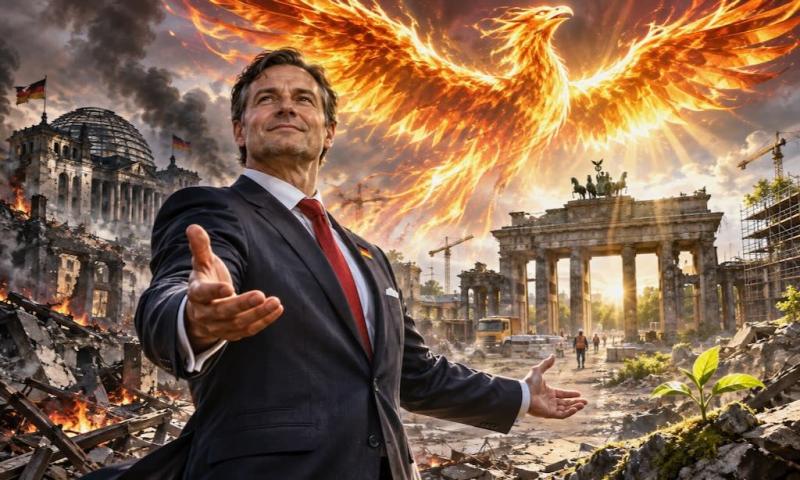
The Candidate Who Will Save Germany – Utopian Thoughts


Introduction
Many Germans believe that the policies Germany is pursuing will plunge the once-great “land of poets and thinkers” into ruin. We, too, have often written about Germany’s disastrous economic, domestic, and geopolitical course and have regularly come to the bitter realization that a complete turnaround—not merely a course correction—is necessary to bring about a change for the better. In my article “Is the U.S. Shifting Course?” I described the possibilities and opportunities for a change in direction by the U.S., in which—in this thought experiment—Europe would be sacrificed by the U.S.—not a utopian assumption, but standard behavior on the part of the U.S., which regularly leaves its allies out in the cold.
Today we are creating the “Candidate” who, in this essay, does and proposes what, in my opinion—and also in the opinion of many of my German interlocutors—would be necessary to pull the cart out of the mud. In doing so, we are empowering our candidate to do whatever he deems necessary. Adolf Hitler received such powers from the German parliament in the spring of 1933, arguing that these laws were necessary to restore order. There is thus a precedent in German history for granting sweeping powers, albeit one that people are reluctant to discuss. We are certainly not advocating a Reichstag fire as a false flag attack to grant our candidate the necessary powers. I have read the book “A Day in March” by Philipp Austermann and can recommend it; German politicians needlessly gave Hitler the opportunity to establish a dictatorship, thereby plunging Germany into the abyss. In this thought experiment, our candidate has similar powers but does not abuse them, which makes this utopia all the more appealing and worth considering.
I divide the issues that require a radical approach into groups, discuss the problems, the course of action, and the effects I would expect. It goes without saying that the proposals discussed can serve only as examples. Germany’s domestic political problems are so complex—and are driven in part by interests that are sometimes impossible to identify—that this text is ultimately intended to be food for thought, albeit a very provocative one. Given the state of German society, however, only very provocative and, in some cases, drastic measures can prevent what the Germans have, at least in the past, ingloriously demonstrated themselves to be world champions at: Sliding into the abyss with their fists in their pockets. On the other hand, paradoxically and in an almost uncanny correlation, the Germans are magnificent at reconstruction. Is it really necessary to destroy the entire country first before setting about rebuilding it?
The theses presented in this article are certainly provocative. But why shouldn’t this country, this time around, make a turnaround—a comprehensive and sustainable change of course—before it completely collapses? That would be far less bloody and brutal and could unleash enormous creative forces in all areas.
The First Day on the Job
The EU and the Euro Are Not, by Any Means, Gifts to Germany
The EU has weakened Germany as a nation and is a completely authoritarian, undemocratic organization that is steadily stripping its member states of more and more powers. The result is a creeping destruction of nation-state institutions through the transfer of their responsibilities to the EU level. What is officially presented as the harmonization of structures and powers has an effect comparable to colonialism. This is exacerbated by financial dependencies on EU funds, which are disguised as democratic measures. Although member states have rights and opportunities for input defined by rules, these are often tied to political compliance, which makes economically weaker recipient states—such as Hungary, Slovakia, and Romania—pawns in the interests of the economically dominant donor states—namely Germany, France, and Austria.
At the helm of the EU are two amazonian women who have no democratic legitimacy. They are mired in corruption scandals, yet remain in power nonetheless. They claim to represent Europe—though the term “Europe” is being usurped in much the same way as the term “America.” Europe is nothing more than a geographical term—and one that is deliberately misinterpreted, since the EU is preparing for war with Europe’s largest country: Russia. If one takes the “European” idea further and actually views Europe as a supranational entity, then a civil war is being prepared. There is no sense of national identity for an “EU Europe”; no one feels like a European: People feel like Italians, Spaniards, Germans, etc., and that’s a good thing.
Using the U.S. as a comparison to argue for strengthening the EU is not only flawed but also incorrect. The U.S. developed in a completely different way: First, they stood together against the colonial rulers in London; afterward, they set out together to conquer or steal the rest, step by step, and to carry out genocide against the former owners—numbering approximately 20 million—leaving only a few alive to be exhibited in zoos—reserves. Thus, apart from the Civil War (1861–1865), Americans have—at least since the end of the 19th century—always stood together and viewed themselves as a nation.
The EU is purely a power structure that is used—or abused—by its founders—the Americans and the British—to more easily control their colonial empire in Europe.
The euro was a stillbirth from the very beginning. A single currency requires a politically unified economic and monetary area—yet the European Union is neither a nation nor a homogeneous economic area. The economic structures, competitiveness, debt levels, and fiscal policy problems of its member states differ, in some cases fundamentally. These differing conditions cannot be accommodated by a single monetary policy.
The consequences were not long in coming. Since its introduction on January 1, 1999, the euro has lost approximately 93.3% of its value relative to the absolute standard of value—gold. Even against the Swiss franc, the loss in value amounts to 42.6%. These figures are a striking indicator of just how severely the purchasing power and international value of the common European currency have eroded.
At the time the euro was introduced, Germany was by far the largest economic power in the new monetary union. In 1999, with a GDP of 1.98 trillion euros, Germany accounted for about 32% of the eurozone’s total economic output—far more than France, at 1.34 trillion, or Italy, at 1.10 trillion euros. Germany thus inevitably became the economic heavyweight and the largest creditor of the new monetary union.
In addition to its substantial net contributions to the EU budget, Germany also assumed increasingly greater financial risks within the Eurosystem during the euro crises. This is particularly evident in the Deutsche Bundesbank’s TARGET receivables: At times, they rose to well over one trillion euros and still stood at around 1.0 trillion euros at the end of September 2026. Germany has thus borne—that is, financed—a significant portion of the financial imbalances within the eurozone on its balance sheet for decades.
The EU and the euro have harmed Germany: financially, as a nation-state, and in terms of its independence.
So far, we’ve only been talking about the economic aspect of the EU. For years, the recipient of the 2012 Nobel Peace Prize—and we’re actually talking about the EU—has been pushing for this alliance of states to be transformed into a military alliance. This ambition already existed in 2012, which only casts an even harsher light on the farce surrounding the awarding of this once-highly-esteemed honor. At that time, the EU’s proposed association agreement with Ukraine failed, in part, because of this military-political component, which Ukraine’s leadership at the time viewed as one of the obstacles.
NATO
The West always refers to NATO as a defensive alliance. That is a brazen lie that was already exposed during the Yugoslav War, when NATO bombed Serbia for 78 days. NATO is, by its very nature, the European arm of the United States, holding European member states together administratively and organizationally. This alliance should have been dissolved in 1990 at the same time as the Warsaw Pact. However, it was never the Americans’ goal to live in peace with Russia after the collapse of the Soviet Union. Hence NATO’s eastward expansion, which—contrary to the assurances of James Baker, Helmut Kohl, Dietrich Genscher, and others in the 1990s—gained momentum quite deliberately and is the main cause of the war in Ukraine.
Our candidate will face this explosive situation on his first day in office. On that first day, he will sign all the necessary documents required to withdraw from NATO. If you want peace, you have to act accordingly.
No U.S. Troops in Germany
Germany has not been a sovereign nation since 1945. Wolfgang Schäuble, among others, made this statement before the ECB in 2011. How should we assess its status? When viewed objectively, the EU’s strongest economic power is effectively a colony of the United States. A country that, among other things, has foreign troops stationed on its territory cannot be sovereign. But that is only one reason.
In the German Wikipedia, “colony” is defined as follows:
“In modern times, a colony (from the Latin colere, ‘to cultivate, to work the land’) refers to a foreign, dependent territory of a state that lacks its own political and economic power (overseas possession).”
It will be difficult to reconcile this definition with the status of the Federal Republic of Germany.
In the Russian Wikipedia, readers will find this explanation:
“Colony (from the Latin colōnia) – a country that has been deprived of its independence and is under the rule of a foreign state (the metropolis)."
Incidentally, we’ve also learned something about Wikipedia’s manipulative tendencies: Readers of the German-language version are misled by “As a colony (from Latin colere, ‘to cultivate, to work the land’)…”. The Russian-language version, on the other hand, teaches us that there is also a direct equivalent for “colony” in Latin. Whether ironic or cynical, the “Russian” definition fits the reality of the German state as if by magic: a country that has been stripped of its independence and is under the rule of a foreign state.
So if our candidate explains to the U.S. in a friendly manner that all U.S. troops must leave the host country within 30 days, he is thereby complying with the self-evident demands for a self-determined state that the EU and NATO advocate for all over the world. Surprisingly, there is no article in the German Basic Law that defines this status for the German state.
Incidentally, this approach has a precedent in Europe: On March 7, 1966, French President Charles de Gaulle, in a personal letter to U.S. President Lyndon B. Johnson, demanded the restoration of France’s full military sovereignty and, consequently, the withdrawal of American forces or the end of their deployment under foreign command.
I'll quote a paragraph:
“For this reason, France intends to reassert its full sovereignty over its territory—which is currently being compromised by the permanent presence of allied military units or by the regular use of its airspace—to cease its participation in ‘integrated’ commands, and to no longer make troops available to NATO.”
Letter from President de Gaulle to Lyndon B. Johnson, March 7, 1966
Israel – Genocide – Nuremberg 2.0
Severing Diplomatic Relations with Israel
On Day 1, the candidate would sever all diplomatic relations with Israel and expel all diplomats. Germany cannot afford to maintain diplomatic relations with countries that commit genocide.
In the wake of Nuremberg, it must be a matter of course for every German politician to take action—not just verbally, but in practice—against even the slightest sign of genocide and to rigorously demand a “Nuremberg 2.0.” I will refrain from listing arguments in favor of this course of action, as I believe that Israel’s behavior is indeed out of the question. I therefore refer only to two of my articles: “Genocide as ‘Self-Defense’—Western Media as Accomplices in the Genocide in Gaza—Let’s Stand Up!” and “Israel—A Genocidal Democracy.”
Nuremberg 2.0
During the Nazi era, Germany not only murdered 6 million Jews, but also 16 million Soviet civilians and millions of other civilians in the occupied territories. In light of the slogan “Never again!” it is in no way and from no perspective comprehensible—indeed, it is unacceptable, especially in light of human dignity—that Germany not only tolerates the genocide perpetrated by the Israelis in Gaza, the West Bank, and Lebanon, but actively supports it and reflexively accuses opponents of this genocide of anti-Semitism, even though many Jews themselves hold anti-Israeli views. I doubt that Mr. Merz, his colleagues, and the German media are capable of distinguishing between Judaism (religion) and Zionism (project); see my article “Anti-Zionism Is Not Anti-Semitism”
More than any other country, Germany—with its grim past—has a responsibility to show the world that genocide is unacceptable, no matter who is responsible for it. However, ARD in Germany—that is, the public, state-run television network—is taking a diametrically opposite approach. As early as October 18, 2023—just a few days after the events of October 7—it issued a memorandum, or a set of guidelines for its employees, that classified Palestinians as terrorists and Israelis as victims—a document of horror. We reported on this: “ARD Glossary Justifies Genocide—Dr. Goebbels Would Be Proud.”
The entire German federal government and the leaders of the media in Germany—and, incidentally, in Switzerland as well—have thereby not only made genocide socially acceptable, but have enabled, promoted, and fueled it, and thus incited murder and manslaughter. All those responsible should be imprisoned and brought before a war crimes or genocide tribunal. Nuremberg would be a suitable venue, or alternatively Gaza City or Tehran. The latter location would serve as a tribute to Iran’s unwavering and unbroken support over the years for the implementation of UN resolutions calling for the creation of a Palestinian state and the containment of Israel.
The most famous defendant from the media in Nuremberg was Julius Streicher, the publisher of "Der Stürmer". He was sentenced to death and hanged—and rightly so. If we applied the same standards today, the politicians responsible—Merz and company—as well as nearly all editors-in-chief and publishers in the German-speaking world would be convicted. And quite rightly so.
Strict Screening of All Israelis
In light of the expected court rulings in Nuremberg, Gaza City, and Tehran, it would be imperative to implement strict controls on Israelis entering Germany and to conduct rigorous vetting of all Israelis already living in Germany regarding their stance on genocide, since the overwhelming majority of the Israeli population supports genocide.
The mandatory questions regarding Israel’s right to exist on the German naturalization test must be eliminated. A clear condemnation of all forms of genocide and a firm endorsement of the 1948 Universal Declaration of Human Rights render any special treatment of ethnic groups unnecessary.
Sanctions against Israel and the freezing and confiscation of all Israeli assets in Germany
A rigorous review of all Israelis also includes the imposition of sanctions against the State of Israel as long as it fails to implement, within the shortest possible time, all UN resolutions regarding the two-state solution for the territory of former Palestine demanded by the international community. Until then, all business ties with Israel must be severed with immediate effect, and all assets of Israeli origin in Germany must be frozen and confiscated without delay.
Peace with Russia and Iran
Russia will not attack Europe; there is simply no reason to do so. It has always been this way. The West has attacked Russia countless times: in 1812, 1853, 1914, and 1941. The war in Ukraine, too, is an attack by the West on Russia. The underlying causes are identical to those of the wars mentioned above. The West’s Russophobic attitude was invented by the British—Russia was too big and too rich for the British, and they were worried about their global empire. The latter concern was unfounded. Russia never challenged the British Empire.
The sanctions against Russia—numbering approximately 30,000—are causing problems for Russia, but these problems can be solved. The problems these sanctions are causing for Germany, however, cannot be solved—they call into question Germany’s very existence in its current form. .
Based on this, the candidate will request an audience in Moscow on Day 1 and travel to Russia immediately. There, he will make peace, since Germany is at war with Russia. The fact that Russia has not yet launched any missiles at Berlin is due solely to President Putin’s incredible patience and de-escalating stance.
Germany will immediately lift all sanctions and ask Russia to resume operations on Nord Stream. One of the three pipelines is still operational, and the remaining ones will be repaired jointly within a reasonable timeframe and brought back online as a German-Russian project. Since Germany finally wants to become a sovereign state, the Americans will, of course, be left out of the process.
Russia wants peace with Germany, but I assume that Moscow will set certain conditions that Germany must, can, and—given its new political direction under the candidate—will want to meet.
Iran has not started a war in the last few hundred years and will agree to normalize relations with Germany. If the new Germany remains true to its new policy, opportunities will arise for the German economy outside of the EU that are likely to more than offset any losses resulting from leaving the EU in the medium term.
Domestic Policy
Laws Are Strangling the Economy
Germany is still a world leader—in creating legislation that is so extensive and so unreadable—as a lawyer, I can confirm this—that life in the business world is no longer possible without an army of consultants. Here’s an example: German tax legislation is so extensive that even the Bundestag cannot calculate exactly how many tax laws—around 125—there are, not to mention the fact that thousands of tax provisions are embedded in other laws. As a result, entrepreneurs can never be certain that they are complying with all the requirements. This is an untenable situation and is more than detrimental to a thriving economy.
In principle, tax legislation would not be very difficult to draft: What is taxed and by whom is a political decision—progressive income tax leads to redistribution; progressive sales taxes tax those who spend a lot, and so on. Once you know the direction in which you want to go politically and socially, it is relatively easy to draft the legislation in clear terms. The candidate would establish the tax principles and then enact a law that would comprise little more than one percent of the existing regulations.
Tax legislation in Germany serves only as an example. It is not just the legislation in Germany. All business dealings with the German government are a gauntlet that stifles the economy.
Freedom of Expression
Freedom of expression will be restored so that Article 5 of the Basic Law can once again have meaning.
“Everyone has the right to freely express and disseminate their opinions in speech, writing, and images, and to obtain information without hindrance from sources that are generally accessible. Freedom of the press and freedom of reporting through radio and film are guaranteed. There shall be no censorship.”
Article 5, Section 1 of the Basic Law
Major Challenges
As vast as the flood of legislation is—which, as is well known, not even the German Parliament can quantify anymore—so great will be the challenge of reducing it to a necessary level. The goal must be to scrap 99% of laws and regulations. First of all, this is not impossible, and second, it will allow people to breathe again. It’s possible that an army of civil servants who administer this current apocalypse of freedom will lose their jobs—a solvable problem: these people will be needed in the new, emerging economy.
Conclusion
This article has focused primarily on changes in foreign policy, since, on the one hand, these changes are most damaging to Germany, but, on the other hand, they can be implemented most quickly there; De Gaulle bid farewell to the U.S. troops with a letter.
The domestic political problems are easy to describe: a lack of freedom and a flood of laws. The problem, however—as tax legislation illustrates—is that regulatory frameworks in Germany have been spreading like a metastatic cancer for decades, and only a radical cure—akin to chemotherapy that eliminates 99% of the laws—will be successful.
If the candidate uses his power solely in Germany’s interest and is of unquestionable character, then Germany can break free from the vicious cycle in which it finds itself. I already pointed out at the outset that I do not want “the candidate” to be viewed as the resurrection of a “German Führer.” Since we are talking about Germany, I would like to emphasize this once again to rule out any misinterpretations. My “candidate” symbolizes the changes that must be addressed in Germany through government structures. Not tomorrow or the day after tomorrow, but today, now, immediately.
Jetzt bleibt nur eine Herausforderung, um beginnen zu können: Die Deutschen müssen einen hochkompetenten und charakterlich einwandfreien Kandidaten finden. Eine solche Person gibt es sicher in Deutschland. Bei der Suche sollte man jedoch auf keinen Fall Politiker berücksichtigen, speziell solche, die sich bereits am Kelch der großen Politik labten.
«The Candidate Who Will Save Germany – Utopian Thoughts»