


The Iran War as an ETE (Empire Terminating Event)


The failure of the United States and Israel to defeat Iran after nearly 40 days of incessant bombing using the totality of the conventional strike capability available to two of the largest and most modern air forces in the world is more than simple military humiliation. The defeat of the US-Israeli hegemon at the hands of Iran has triggered consequences that extend far beyond the geographic boundaries of the Persian Gulf and the Middle East—the collapse of confidence in the trans-Atlantic NATO alliance, and the effective economic and political disenfranchising of critical Asian alliances, when viewed in conjunction with the effective dismantling of the US military architecture that has underpinned security in the Persian Gulf for decades, signal the end of the American Empire that has lorded over the world since the end of the Second World War.
The 2025 National Security Strategy (NSS) of the United States represented a blueprint for the new American Empire as defined by Donald Trump. The document served as prima facia evidence of the arrogance and ignorance which combined to define the national security posturing of Trump’s America. Starting with the stated intent to “recruit, train, equip, and field the world’s most powerful, lethal, and technologically advanced military” which would either deter wars or “win them quickly and decisively, with the lowest possible casualties to our forces,” before going on to declare the desire for “next-generation missile defenses—including a Golden Dome for the American homeland—to protect the American people, American assets overseas, and American allies,” Trump’s NSS described a world that existed more in the realm of fantasy than reality, and one which projected a narrative which turned out to be the exact opposite of what went down during the current round of fighting between the US-Israeli hegemon and Ira.
Nothing was deterred, and the combined US-Israeli militaries proved incapable of imposing their will on the battlefield, while Iran’s advanced missiles and drones made a mockery of the missile defenses of the US, Israel and the Gulf Arab States.
Arrogance and ignorance combine to produce assessments which are far removed from reality and nowhere was this more the case than with the Trump administration’s underlying assumptions about Iran and the Middle East as set forth in the 2025 NSS. While noting that “Conflict remains the Middle East’s most troublesome dynamic,” the 2025 NSS went on to declare that Iran— which it described as “the region’s chief destabilizing force”—was weakened through US and Israeli actions since October 2023. Trump’s foundational document stated that keeping the Strait of Hormuz and the Red Sea open to navigation was a top priority of the United States, as was the safety and security of Israel.
But these concerns were readily mitigated, the 2025 NSS noted, but a new reality that had emerged thanks to the leadership of President Trump. “[T]he days in which the Middle East dominated American foreign policy in both long-term planning and day-to-day execution are thankfully over,” and instead the region had emerged “as a place of partnership, friendship, and investment—a trend that should be welcomed and encouraged.”
Looking at the Middle East today, one must acknowledge just how far off base the 2025 NSS was when it came to Iran and the Middle East.
The nexus of failure of US policy when it came to Iran can be found in the inconsistency between the stated “core values” of the Trump administration and how these “values” were acted on. The 2025 NSS declared that the US wanted to “prevent an adversarial power from dominating the Middle East, its oil and gas supplies, and the chokepoints through which they pass while avoiding the “forever wars” that bogged us down in that region at great cost” all the while adhering to a noninterventionist policy that recognized that war was “bad for American interest.” The US, this 2025 NSS declared, viewed “peaceful commercial relations with the nations of the world without imposing on them democratic or other social change that differs widely from their traditions and histories” as the new American standard, stating the President Trump would use “unconventional diplomacy, America’s military might, and economic leverage to surgically extinguish embers of division between nuclear-capable nations and violent wars caused by centuries-long hatred.”
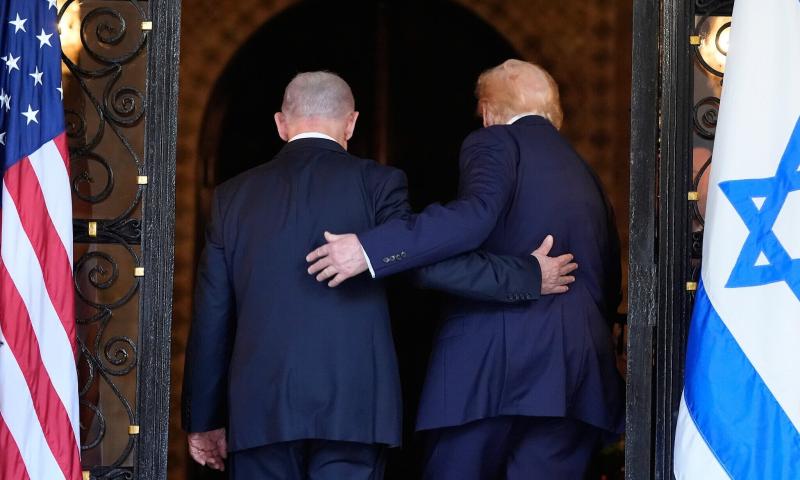
This calculus, however, appeared not to factor in the reality of the dominating influence the state of Israel has on the foreign and national security policy of the United States. Nothing in the 2025 NSS suggests that the President of the United States would embrace a policy narrative briefed to him in isolation by an Israeli Prime Minister and an Israeli intelligence chief, and then disregard the consensus of his own cabinet and military advisors when it came to initiating a war of choice on Iran that violated every principle the 2025 NSS ostensibly espoused.
And there is no one who would have logically thought that “unconventional diplomacy” would have included multiple acts of perfidy on the part of the United States which used diplomatic engagement as a ruse to facilitate surprise attacks on Iran’s leadership to effect the very kind of regime change that noninterventionism based upon respect for sovereign differences should have ruled out.
Instead of peace and prosperity, Trump’s policies—derived as they were from Israeli interests which deviated significantly from the stated goals and purpose of the 2025 NSS—left the Persian Gulf region devastated by violence, the energy production capacity of the region crippled by attacks on critical infrastructure and the closure of the Strait of Hormuz, the military bases the US relied upon to project its military power in ruins, and key Gulf Arab allies feeling betrayed and abandoned as decades of US security guarantees and assurances collapsed in the face of the reality of Iran’s ballistic missile and drone capabilities, which proved to be a decisive overmatch for the US-provided missile defenses that had been purchased and deployed at great expense.
The American failure, however, resonated far beyond the Middle East region. The fragility of US-European relations, already strained by perceptions of European freeloading and a failed proxy war against Russia in Ukraine, was stressed to the breaking point as European opposition to the US action against Iran ran up against the US strategic belief that the European component of the NATO alliance should be responsive to US demands for assistance, even if the conflict fell outside the rational geographic boundaries of the trans-Atlantic alliance. As things currently stand, the NATO alliance is in ruins, most likely beyond repair, driven to its current state because of the US defeat at the hands of Iran.
The Pacific region had been singled out by the Trump 2025 NSS as being of particular importance to the United States. In this regard, the Trump administration was not only banking on the inherent military capacity of the United States to challenge China in Taiwan and the Indo-pacific, but also a network of alliances, including a tripartite pact with Japan and South Korea, the AUKUS alliance (Australia, United Kingdom, and US), and the “Quad” security framework bringing together the US, Japan, India and Australia. The combined impact of US capabilities and the forces that could be arrayed from these alliances and partnerships were designed provide “military overmatch” over China.
Today this system of alliances and partnerships lies in ruins, destroyed by the demonstrated impotence of the US military in confronting China, the unreliable nature of US security guarantees, and the economic consequences of the failure of US policy against Iran. Missile defense networks which anchored the concept of “military overmatch” against China were shown to be ineffective against Iran’s missile threats. Moreover, when one US ally—Israel—required additional missile defense assistance, the US stripped away the very missile defense architecture it had built in Asia to defend its allies, all without seeking permission or even coordinating in advance.
Moreover, the inability of the US to keep Iran from shutting down the Strait of Hormuz, or the Houthi in Yemen of shutting down Red Sea shipping lanes, spelled disaster for the economies of all of America’s Pacific allies. The fact that the failure of US policy was so readily translated into economic calamity derived from energy insecurity revealed the Achilles Heel of US foreign and military policy under Donald Trump—at the end of the day, the US was all talk, and little action.
Or as they say in Texas, “All hat, no cattle.”
In short, the American dog don’t hunt.
And that, ladies and gentlemen, is how empires die.
The war between the US and Iran will go down in the history books as a colossal defeat by the US and Israel at the hands of Iran.
But it is so much more than that.
The US defeat is an Empire Terminating Event.
The farewell may be decades in coming, or the collapse could unfold rapidly over the next few months and years.
But the bottom line is this—the world envisioned by Donald Trump in his 2025 National Security Strategy no longer exists—if it in fact ever did.
We are entering a brave new world, where the global hegemon has been replaced by emerging regional powers who will have to find a better way to co-exist than the path chosen by the United States.
«The Iran War as an ETE (Empire Terminating Event)»