


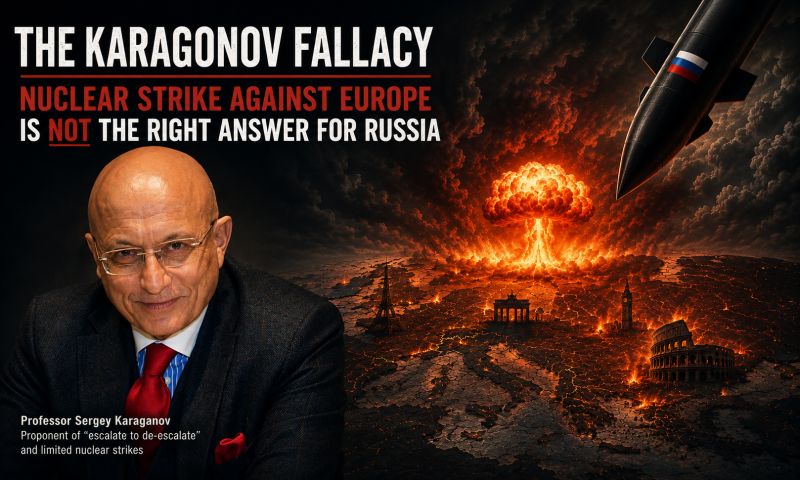
The Karaganov Fallacy


Editor's Note : After publishing our article "Is 1914 repeating itself? Will war between Europe and Russia finally break out openly?" where we discussed – among others – the nuclear doctrine of the Russian Federeation and also the Karaganov doctrin, Dmitry Orlov published the article «How to survive a Russian tactical nuclear strike». In today's article Scott Ritter analyses the Karaganov doctrine and argues that nuclear weapons are not the right tools for Russia.
Back in the late 1970’s and early 1980’s, the Wallstreet brokerage firm, E.F. Hutton, came up with one of the most iconic television ad campaigns in history, built around the catch phrase “When E.F. Hutton speaks, people listen.”
Sergei Karaganov is the Russian analog to E.F. Hutton—when Karaganov speaks, people listen. The 73-year old political scientist, who currently heads the Council for Foreign and Defense Policy and serves as the dean of the Faculty of World Economy and International Affairs at Moscow's Higher School of Economics, has advised both post-Soviet era Russian Presidents, Boris Yeltsin and Vladimir Putin, and his opinion continues to carry weight among the senior-most decision making circles of the Russian government.
Karaganov has, for the past several years, been warning about the growing threat to Russia from NATO, and in particular the European nations of NATO who have constructed a world view which postulates Russia as an existential threat which must be decisively confronted and defeated.
In this Karaganov is not wrong.
The language of the Europeans is self-indicting.
According to a newly published German military strategy, Russia represents “the greatest and most immediate threat for the foreseeable future” to Germany and transatlantic security. The classified strategy concludes by declaring “Russia is laying the groundwork for a military attack on NATO member states.”
Germany's chief of defense, General Carsten Breuer furthered this argument in a 2025 statement to the media where he noted that “There's an intent and there's a buildup of the stocks” by Russia for a possible future attack on Nato’s Baltic state members.
Brueuer and Germany’s defense minister, Boris Pistorious, are using the threat from Russia as an excuse for the rearmament of Germany, with the goal of making the German army the most powerful in Europe by 2029.
Why that date?
According to General Breuer, this is when Russia will attack Europe. “This is what the analysts are assessing,” Breuer said, “in 2029. So we have to be ready by 2029.”
The German analysis is nearly identical to that of their British allies. Former Chief of the General Staff, General Sir Patrick Sanders, who retired in the summer of 2025, has warned that a war with Putin was a “realistic possibility” by 2030. “If Russia stops fighting in Ukraine,” Sanders told the British media, “you get to a position where within a matter of months they will have the capability to conduct a limited attack on a NATO member that we will be responsible for supporting, and that happens by 2030.”
These warlike ruminations by some of NATO’s leading military minds do not exist in a vacuum but rather are reflective of a general posture of war preparation being promoted by the NATO alliance itself. Just ask Mark Rutte, the NATO Secretary General, who recently warned that NATO was in a race against time when it came to preparing for an inevitable war with Russia. “We are Russia’s next target,” Rutte said. “I fear that too many are quietly complacent. Too many don’t feel the urgency. And too many believe that time is on our side. It is not. The time for action is now. Conflict is at our door. Russia has brought war back to Europe. And we must be prepared. Russia has brought war back to Europe. We must be prepared for the scale of war our grandparents and great-grandparents endured.”
The rhetoric of Breuer, Sanders and Rutte lends itself to an argument where the nations of NATO are responding to Russian aggression. But one must not be fooled into believing that aggression is a one-way street. Enter, stage left, Lithuanian Foreign Minister Kestutis Budrys, who recently opined that “We [NATO] must show the Russians that we can break through the small fortress they have built in Kaliningrad. NATO has the means to flatten Russian air defense bases and missile systems if necessary.”
Budrys’ lunacy, which even if successful would amount to little more than the collective suicide of NATO, didn’t appear from a vacuum, but rather echoed similar sentiment expressed by General Chris Donahue of the US Army, who serves as the commander of US forces in Europe. Donahue bragged that Kaliningrad, Russia, is approximately 47 miles wide and surrounded by NATO on all sides. He claimed that NATO and the US Army now have the capability to “take that down from the ground in a timeframe that is unheard of and faster than we’ve ever been able to do.” Donahue went on: “We’ve already planned that and we’ve already developed it.”
In many ways, Donahue’s bluster is far more embarrassing that the pugilistic nonsense espoused by his NATO colleagues, if for no other reason than he more than anyone should know both the extreme limitations of US and NATO power (something demonstrated very publicly with the recent US failed aggression against Iran) and the consequences of any NATO attack on Kaliningrad, which would be immediately fatal to Donahue, his staff, and the entire leadership of NATO, given the inevitability and severity of the anticipated Russian retaliation.
And therein lies the rub. NATO’s jingoistic rhetoric aside, there is no conventional military power in Europe, whether singularly or collectively, which poses an existential threat to Russia. Recent NATO military exercises demonstrated just how inexperienced NATO ground forces were in modern combat operations incorporating drone warfare on any appreciative scale. Imagine for a moment a NATO Brigade running into a Rubicon detachment on the battlefield. The results would be as one-sided as they would be fatal to the defeated party, which would in every scenario imaginable be the NATO forces.
The words of Breuer, Sanders, Rutte, Budrys, and Donahue amplify one universal constant when it comes to NATO today: militarily it is very much a paper tiger, incapable of sustained intensive ground combat at any appreciable level. The warlike verbiage spouted by these mouthpieces of mayhem is simply a desperate plea for relevancy in an effort to mobilize public support for a militarization campaign requiring energizing both populations and industry in a way hitherto fore unimaginable in post-Cold War Europe, and for all sense and purposes impossible to achieve today.
As the fictional Commander, Air Group (CAG) told Tom Cruise’s Maverick in the first Top Gun movie, “Son, your mouth is writing checks your body can’t cash.”
Welcome to the NATO collective today.
While Sergei Karaganov and his fellow Russian hardliners are more than justified in taking extreme umbrage at the warlike posturing Europe is assuming today in opposition to Russia, the reality is Europe poses absolutely no threat whatsoever to Russia as things currently stand, and the probability of Europe overcoming the sizeable political and economic hurdles required to build a military force capable of surviving on a Russian battlefield, let alone prevailing, is slim to none.
More worrisome, however, is the nuclear posturing being done by certain NATO countries to compensate for the alliance’s extreme shortcomings regarding conventional military power projection. This nuclear flexing has taken on an even greater urgency now that President Trump’s hostile ambivalence toward NATO and European security throws into question America’s commitment to fulfilling any hypothetical Article 5 scenario—a stance which simultaneously throws into question the reliability of America’s nuclear umbrella. France and the United Kingdom are working to create a joint nuclear doctrine to offset the loss of America’s nuclear arsenal, and both nations are in active discussions with other NATO members to extend their respective nuclear umbrellas over the Arctic, the Baltics, Poland and Germany.
Sergei Karaganov famously postulated that no American President would be willing to trade Boston for Poznan, meaning that if Russia were to hypothetically attack this unfortunate Polish urban center with a nuclear weapon, the United States would not respond in kind.
This, of course, is the kind of hypothesis that should never be tested and, given the fact that Russia faces no threat of an existential nature from the European collective, has zero justification for even being contemplated being tested.
Russia, together with the other major nuclear weapons states (the US, China, UK and France) co-signed a joint statement in early 2022 which affirmed that a nuclear war cannot be won and must never be fought. The statement went on to declare that “As nuclear use would have far-reaching consequences, we also affirm that nuclear weapons—for as long as they continue to exist—should serve defensive purposes, deter aggression, and prevent war.”
Russia has not officially renounced that joint declaration, which on the surface would indicate that the Karaganov initiative to preemptively use nuclear weapons against Europe has zero viability when it comes to reflecting official Russian policy.
There is, of course, one major problem—Karaganov was instrumental in crafting the 2025 nuclear posture for the Russian Federation, which in part declared that nuclear weapons could come into play in situations where conventional forces are insufficient to deter an opponent or achieve a military objective. So far, the SMO in and of itself does not meet the criteria for preemptive nuclear weapons usage. Whether a large-scale conventional war with NATO would cross this threshold is a separate matter.
But the situation Russia faces today, which Karaganov addresses, involves a nuclear armed power aiding a non-nuclear armed state to launch conventional attacks on Russia that could pose an existential threat. This is, of course, the very definition of what the ongoing proxy conflict between Russia and the collective West over Ukraine is, especially when it comes to the ongoing NATO-backed campaign of drone strikes against strategic Russian targets.
It’s not just Karaganov who is crying foul. Dmitri Polyansky, the Russian Ambassador to the OSCE, noting that the ongoing Ukrainian drone strikes against Russia are only possible with Western military expertise, technology, and intelligence, recently declared that it might already be “too late” to avert a Russian retaliatory strike against European targets directly affiliated with the facilitation of Ukrainian long-range drone strikes against Russia.
But even in this circumstance, nuclear weapons are not necessarily called for, something even Karaganov acknowledges. Conventional missile strikes, using weapons such as the Oreshnik intermediate-range missile, should be mounted against select European targets. But Karaganov then goes further, advocating for the use of nuclear strikes if the conventional missiles don’t “deter Europe.” Here, Karaganov puts value on the need to instill “primal fear” in Europe not by the threat of nuclear weapons, which clearly hasn’t worked, but through their actual use.
In this instance, Karaganov is dead wrong.
The use of nuclear weapons obviates the strategic advantages Russia has accrued by building the World’s largest, most combat capable (and tested) military. It nullifies the escalatory dominance Russia has achieved by deploying the Oreshnik conventional strike system. But worst of all it erases the very doctrinal paradigm that has prevented the world from stumbling down the path of nuclear oblivion—the idea that nuclear wars cannot be won and therefore must never be fought.
The Karaganov doctrine, so to speak, introduced a new paradigm—nuclear wars can, in fact be won, and as such should be fought.
Karaganov proves his thesis by postulating an unproven hypothesis—the US won’t trade Boston for Poznan.
He avoids the uncomfortable question as to whether France or the United Kingdom, singularly or together, would opt to put forward a nuclear response by declaring that Russia would eliminate both these nations and all of Europe if they were to try.
But this begs the question whether a Russian leader would be willing to trade Saint Petersburg or Moscow for London, Berlin and Paris.
Does Karaganov really want to test this hypothesis?
But let’s postulate, just for the sake of argument, that Karaganov’s thesis holds, and that Europe is collectively cowed by a Russian preemptive nuclear strike on Poznan, and the US opts out of sacrificing Boston and doesn’t retaliate.
Then what?
Nuclear war has, to date, been averted by the notion that there can be no winners.
Karaganov’s doctrine flips the script, and declares that there can, in fact, be winners.
But what exactly has been “won”? Decades of deterrence theory will have been washed away, leaving in its stead a massive strategic imbalance that cannot stand. There can be no nuclear deterrence if one side is willing to use nuclear weapons and the other side isn’t. Yes, the United States may likely forego sacrificing Boston or any other American city for a European urban victim of Russian nuclear annihilation. But the United States will need to immediately equalize the nuclear deterrence equation by demonstrating that it, too, can use nuclear weapons, and thus test the hypothesis of whether Russia would be willing to sacrifice Kazan for Tehran.
The answer is likely to be no.
Crisis averted.
Or not.
No longer is the world one where nuclear war cannot be fought, but rather one where nuclear war has become an accepted practice. War gaming and basic game theory hold that once nuclear weapons are used, it is simply a matter of time before matters escalate toward a full nuclear exchange, terminating all life on the planet. This isn’t idle speculation. In 1983 the Pentagon conducted a war game called Proud Prophet, an unscripted event involving the highest levels of the US military and its global warfighting commands, using real-world communication channels, doctrines and secret war plans. The game allowed for the consideration of limited small-scale nuclear strikes, but always ended the same way—global nuclear Armageddon.
Karaganov doesn’t address this issue, with good cause—because no leader, Russian or American, would start a nuclear war in a situation that fell short of manifesting a threat to their respective existential survival, if they knew that no matter what, the result was always the same—everyone dies.
Karaganov has done the world a great service in forcefully postulating the possibility of a winnable limited nuclear war.
Not just because it allows the world to once again embrace the foundational notion that nuclear wars cannot be won, and as such should never be fought.
No, the true lesson is that nuclear wars cannot be won, should never be fought, and as such nuclear weapons should be done away altogether to avoid falling into intellectual traps such as the one offered by Karaganov, where their use is deemed possible.
There is no greater justification for nuclear arms control and disarmament than the scenarios put forward by Karaganov.
And in the present time, when nuclear arms control has been removed from the global diplomatic playbook, the world needs the kind of kick in the seat of the pants that any reasoned reflection on the fallacy of Sergei Karaganov’s nuclear theories brings—without nuclear arms control, our collective demise at the hands of the weapons we refuse to eliminate is all but assured.
«The Karaganov Fallacy»