


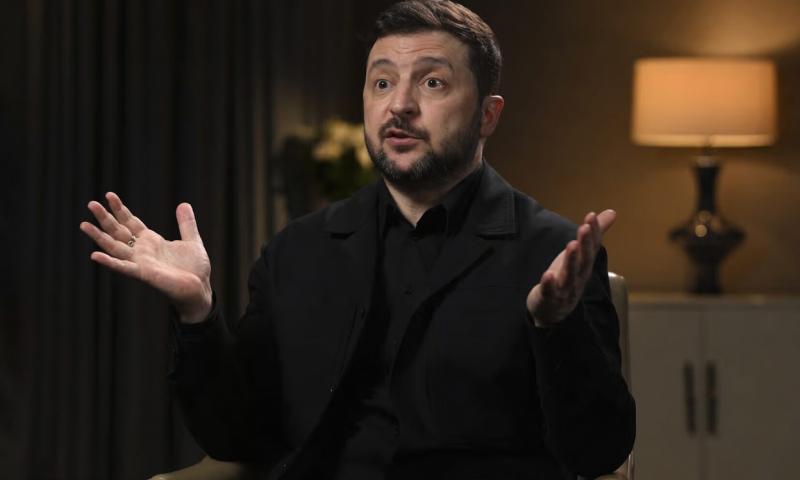
The Power to Hurt — Ukraine wants it, Russia has it


The President of Ukraine, Volodymyr Zelensky, will travel to Washington DC for the funeral of late U.S. Senator Lindsey Graham, scheduled for July 28. Zelensky is expected to meet U.S. President Donald Trump while he in the United States.
On the top of the agenda will be the pressing need for a negotiated solution to the Russia-Ukrainian conflict. There has been a concerted effort in the past few weeks by the United States to try and find a mechanism to break the diplomatic impasse that currently exists between the US and Russia when it comes to finding a pathway to viable negotiations to end the proxy war between Russia and the collective West over Ukraine.
On July 22 the U.S. Ambassador to NATO, Matt Whitaker, travelled to Kiev to discuss the possible licensing of Patriot missile production by the US to Ukraine promised by President Trump during the NATO Summit in Ankara, Turkey earlier this month, as well as a pending U.S.-Ukraine Drone Deal that will see Ukraine export its combat-tested drone technology to US defense industry for inclusion in the Pentagon’s newly announced “Drone Dominance” program.
That same day, Zelensky held a separate phone conversation with President Trump's special envoys, Steve Witkoff and Jared Kushner. Witkoff and Kushner last visited Russia in March of this year, where they met with Russian President Vladimir Putin. They were expected to return to Moscow in early June, but that visit hit a snag. “There's no exact date yet for their visit,” Kremlin spokesperson Dmitry Peshkov noted on June 9, once it became clear the anticipated visit was not materializing. “However, we would be happy to welcome them here in Russia at any time.”
The prospects of such a visit seemed to brighten somewhat when, on July 23, U.S. Secretary of State Marco Rubio met with Russian Foreign Minister Sergey Lavrov in Manila on the sidelines of the Association of Southeast Asian Nations (ASEAN) Foreign Ministers' meeting, where the prospects of a resumption of peace talks were discussed. Rubio noted afterwards “If, when peace comes, it will be because of some new idea and some new concepts, and we’re prepared to offer some of those in the right setting and form if the opportunity presents itself and the conditions are right.”
Setting those conditions has been a top priory for the Trump administration, which had approached Kazakh President Kassym-Jomart Tokayev to push for the resumption of mediation efforts between Russia and Ukraine during a July 25 meeting with President Putin. “If I may offer my humble opinion,” Tokayev said, “since I have been asked, perhaps it is time to freeze this conflict and return to the Istanbul formula 2.0”, adding “With (security) guarantees from the great powers, including Russia, we could move forward toward a long-awaited peace. This (war) must be brought to an end.”
Critically, Tokayev praised Putin’s “utmost diplomatic flexibility” during the August 2025 Summit with Trump in Anchorage, Alaska. Both US Secretary of State Rubio and Russian Foreign Minister Lavrov had signaled that the so-called “Spirit of Alaska” was dead, with Rubio noting that the conditions discussed in Alaska had proven unacceptable to Ukraine, and Lavrov observing that, from the Russian perspective, it was clear that the U.S, in Alaska, was only seeking to buy time to rearm Ukraine.
The talk of resurrecting “Istanbul 2.0” seemed to cement the death of the “Spirit of Alaska”, predicated as it was on a compromise “3+2” formula put forward by Russia which would cede the Donbas and Crimea to Russia in exchange for freezing the border between Russia and Ukraine along the line of contact in Kherson and Zaporozhia, a controversial position which would have seen Russia giving away territory which was constitutionally part of Mother Russia, long seen as non-negotiable on the part of the Kremlin.
“Istanbul 2.0” would reset the clock to June 2025, when Ukraine was pushing a ten-point peace plan which included, among other things, Russia withdrawing its troops to the pre-2014 border, i.e. giving up Crimea and the Donbass and creating a Euro-Atlantic Security Architecture which included Ukraine joining NATO.
When asked to comment on Tokayev’s intervention, Dmitri Peskov said such a move would be impossible until Russia achieves its objectives. “The freeze of the conflict in Ukraine proposed by Tokayev is impossible given Kiev’s stance.,” he noted. “Russia’s main condition is achievement of its goals. Everything could stop today, before the end of the day, if the Kiev regime makes the appropriate decisions.”
The “appropriate decisions”, however, would require Ukraine to endorse the Anchorage “3+2” formula, modified to consider Russia’s advances since August 2025.
This Zelensky will not do.
The question now is how to break this new impasse and come up with the “new ideas” and “new concepts” Secretary of State Marco Rubio spoke of.
Instead of opting for peace, however, Ukraine’s President chose violence. Back in May, Zelensky had noted that “Our long-range capabilities (Ukraine’s long-range drones) are significantly changing the situation— and, more broadly, the world’s perception of Russia’s war.” In a social media post published that same month, Zelensky stated that “we are clearly telling the Russians: their state must end its war.”
This posture became official policy when, on June 25, Zelensky announced that he had authorized a 40-day intermediate- and long-range drone-based strike campaign designed to pressure Russia to end the war in Ukraine.
Ukraine is now 30-plus days into a campaign that has sowed terror throughout the Donbas, the New Russian territories of Zaporozhia and Kherson, and the Crimean Peninsula, as well as striking energy infrastructure targets deep inside the Russian federation, including targets in Siberia.
The kinetic aspects of this campaign have been promoted across the broad spectrum of western media, including mainstream outlets and social media platforms. Voices such as the self-proclaimed “Russianist”, Gilbert Doctorow, have declared Russia all but defeated because of these drone attacks.
But the reality is far different. While the Ukrainian attacks have indeed created difficulties in the regions directly impacted by the conflict, Russia itself remains on an even keel economically, politically, socially, and militarily.
The same cannot be said about Ukraine.
Newton’s Third Law of Physics—for every action there is an equal and opposite reaction—applies to Zelensky’s “40-Day Drone War”, and Russia has struck back with a vengeance, unleashing an unprecedented wave of ballistic missile and drone attacks of its own which have devastated Ukraine’s defense industrial base, including that used for drone production, as well as further eviscerating Ukraine’s energy sector, all the while sustaining and expanding its offensive military operations along the totality of the line of contact with Ukraine.
Zelensky’s much-touted “long-range sanctions” effort against Russia was the brainchild of the man who served as his social media marketing manager during the 2019 presidential campaign, Mykhailo Fedorov. Fedorov went on to become Ukraine’s first Minister of Digital Transformation, where his legacy achievement was the launch of government web portal Diia, involved in facilitating e-governance in Ukraine. Appointed Minister of Defense in January 2026, Fedorov assumed the mantle of a reformist who sought to use technology as a means of defeating Russia on the battlefield while reducing casualties on the frontline.
Fedorov was the brains behind Ukraine’s strategic shift away from building brigades for service on the frontlines and instead building drones to use in attacking Russia throughout its strategic depth. This policy was wildly opposed by General Oleksandr Syrskyi, the Commander-in-Chief of the Armed Forces of Ukraine, who insisted that Ukraine’s only path to victory against Russia was to defeat them on the battlefield.
Fedorov was the architect of Zelensky’s “40-Day Drone War.” While the echo chamber provided by mainstream media and social media platforms sympathetic to Ukraine helped shape the perception that Ukraine was inflicting an embarrassing strategic defeat on Russia, the actual evidence pointed to the fact that all Fedorov’s brand of technological violence did was awaken the Russian bear.
By July 15, it became apparent the Fedorov’s gambit had failed. When Zelensky sought to redirect resources to Syrskyi, whose forces were being battered to death at the front, Fedorov objected, and was subsequently fired as Defense Minister.
Fedorov was replaced by Major General Yevhen Khmara, the head of the Ukrainian Security Service who, as the commanding officer of the Center for Special Operations “A” or Alpha Group, oversaw “Operation Spiderweb”, the audacious Ukrainian drone attack against Russian strategic aviation assets conducted on June 1, 2025.
One of Khmara’s first directives was for Ukraine to expand its targeting inside Russia to include a new focus on logistical hubs of Wildberries, Russia’s largest online retailer, ostensibly on the excuse that Wildberries was doing double duty as a supplier of drone parts for the Russian Ministry of Defense (this allegation remains unproven and has been denied by the Wildberries management.) Starting on July 18, Ukrainian drones struck several Wildberries warehouses which served as distribution centers for its merchandise. Several of these attacks, including one outside Moscow, resulted in the destruction of the building—even more importantly from the Ukrainian perspective—imagery showing fires sweeping through the stricken facility while massive clouds of dark smoke billowed into the sky. Imagery capturing the results of these attacks was plastered across the media to echo the notion of the inevitability of Ukraine’s victory over Russia.
Fabian Hoffmann, a fellow with the Transatlantic Defense and Security Program at the Center for European Policy Analysis (CEPA) and a Senior Research Fellow at the Ukraine and Full Spectrum Threats Program at the Norwegian Defense University College. who publishes a blog entitled Missile Matters with Fabian Hoffmann which unabashedly pushes a pro-Ukrainian narrative, has likened the Wildberries campaign as a moment which transforms Ukraine into a nation possessing what game theorist Thomas Schelling called “the power to hurt”.
According to Hoffmann, “the Wildberries strikes destroy the last illusion of a comfortable peacetime existence for Russia society.”, cutting directly against “Russian society’s image of itself as powerful, protected and untouchable, and against its superiority in relation to others, particularly Ukraine.”
Hoffmann goes on to proclaim that the Wildberries campaign “is framed as coercion intended to force Moscow into negotiations: pain applied today, relief offered in exchange for concessions tomorrow. The capacity to inflict and withhold pain”, Hoffmann writes, “is a key factor turning Ukraine into a party to the bargaining over the future of Ukraine, Europe, and the wider world, rather than a subject of it.”
It is said that perception creates its own reality, and it with this objective in mind that Volodymyr Zelensky will travel to Washington DC on July 28 to pay his respects to Senator Graham and for his fateful meeting with President Trump.
But fantasy-based perceptions cannot trump fact-based reality if those seeking to be swayed refuse to fall victim to the psychological predations of those promoting the artificial narratives.
The truth of the matter is that reality creates its own reality, and this Russian maxim is being driven home with full effect in the aftermath of the Wildberries offensive.
The Wildberries offensive has, by some estimates, caused around $1.3 billion in economic damage to Russia, exclusively in terms of its impact on the domestic retail activities of Wildberries and those online retailers it supported.
It had zero impact on either Russia’s ability to wage war, or the determination on the part of the Russian government and Russian population to wage war.
It has caused Russia’s new reactive-based counterstrike strategy, which has devastated Ukraine’s drone-based defense industrial base, to expand its target deck to include Ukrainian analogs to Wildberries. Russia is now on track to destroy all major commercial logistics centers in Ukraine, actions which, when combined with its ongoing destruction of Ukrainian thermal power plants and gas distribution stations, will leave Ukraine without electricity and heat in the coming winter—and no supplies.
Ukraine, in short, will become uninhabitable.
Unlivable.
“The power to hurt is bargaining power,” Thomas Schelling wrote in his classic 1966 treatise on game theory, Arms and Influence. “To exploit it is diplomacy, vicious diplomacy, but diplomacy.”
Zelensky plans to meet with Donald Trump to impress upon the American leader the diplomatic credibility of Ukraine’s self-declared (via its compliant missile-themed publicist, Fabian Hoffmann) drone-based “power to hurt.” The ability to credibly signal the power to hurt and inflict pain on Russia is Ukraine’s way of continuing a war it cannot otherwise win. This is, Schelling noted, the essence of deterrence, the “art of coercion and intimidation.”
At the end of the day, however, deterrence is about resolve, about divining the true intentions of the enemy and oneself. “Nations,” Schelling wrote, “have been known to bluff; they have also been known to make threats sincerely and change their minds when the chips are down.”
Schelling warned that the power to hurt, once unleashed, could readily escape rational control, and instead spiral into a cycle of retaliation and destruction that defies all original intention.
Zelensky and Ukraine are in the process of learning this terrible lesson.
They are witnessing the destruction of a nation—their own—because of the inadequacies of their own leadership.
Zelensky will ask Trump to try to convert his “40-Day Drone War” into a viable diplomatic path for peace with Russia on terms dictated by Ukraine.
President Trump would do well to reflect on the ongoing fiasco with Iran, and understand the consequences of playing, and losing, the “power to hurt” game.
Ukraine with Russia, like the US with Iran, gambled and lost.
To lose the “Power to Hurt” game with Iran is to face short-term embarrassment.
To lose against Russia is to die.
Ukraine is already marked for death.
The United States need not be.
The power of choice allows one to opt out of the “Power to Hurt” game.
Trump needs to reject Zelensky’s overtures of death and destruction and instead focus on how he can avoid falling into the spiral of national destruction that has captured Ukraine.
The overtures made by Witkoff and Kushner have been exposed as being empty or worse—as a cover for buying time to rearm Ukraine.
The “new ideas” and “new concepts” Secretary of State Marco Rubio spoke of will neither come from the Witkoff-Kushner tandem, nor Zelensky.
President Trump is dispatching his FBI Director, Kash Patel, to Russia in mid-October. By then the folly of Zelensky’s “40-Day Drone War” will be obvious to all—even the Ukrainian government.
As President Putin has declared, the war between Ukraine and Russia could end “today” if Ukraine were to embrace certain realities, number one of which that there is nothing that can be done to lessen the pain generated by Russia’s overwhelming capacity to inflict the power to hurt.
Ukraine started this war, egged on by the US and Europe,
Russia will finish it on its own terms.
«The Power to Hurt — Ukraine wants it, Russia has it»