


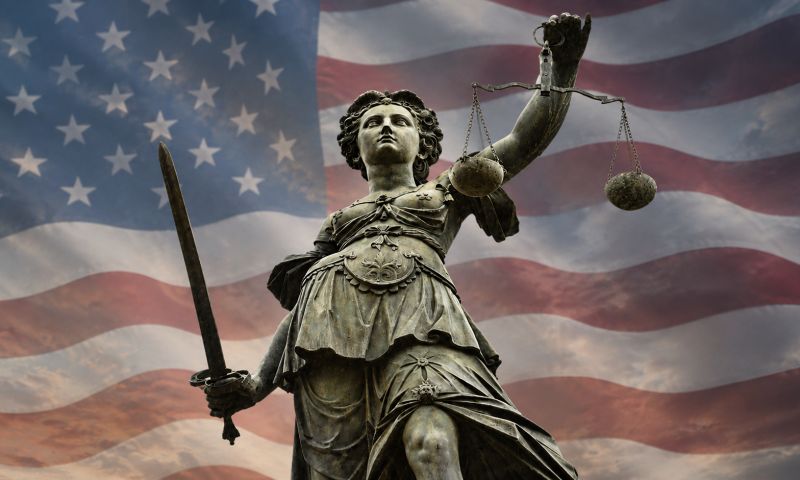
The Problem with International Law


“I don’t care what the international lawyers say, we are going to kick some ass” — Former US President George W. Bush, 11 September 2001
"America never agreed to a world tribunal that can override our own courts and the Constitution.” — Marco Rubio, US Secretary of State, July 2026
On July 13, US Secretary of State Marco Rubio launched a campaign to “dismantle” the International Criminal Court (ICC), the international tribunal in The Hague, Netherlands. The ICC has in recent years been criticised from different quarters, yet the US initiative to disempower the court, which it accuses of interference “with US military and law enforcement operations at the risk of American sovereignty” appears unprecedented.
In a lengthy editorial for the Wall Street Journal, Marco Rubio wrote: “The ICC’s interfering with American military and law enforcement operations isn’t only a grave overreach of its purported authorities. It would mean the death of the U.S. as a sovereign and independent nation. Our decision and our people would be at the mercy of the ICC and its collaborators in the international community. To accept the ICC is to surrender control of our national destiny”. Strong and apocalyptic words from the US Secretary of State.
The American ire against the ICC is nothing new. In fact, the US has never accepted the ICC. The US did not subscribe to the Rome statute that laid the foundation for the ICC in 2002, so technically the ICC has no authority over the US anyway. Last year US president Trump imposed sanctions against the ICC, accusing it of having “engaged in illegitimate and baseless actions targeting America and our close ally Israel”. But the US campaign to dismantle the ICC is an extraordinary development in many respects.
A short trip to Westphalia
When communities organise, they give themselves laws to establish norms, regulate disputes between individual citizens and entities and promote social order and cohesion. Although written laws do not belong to the necessary attribute of a civilisation, it is not by chance the first written law codes appeared in Mesopotamia around four thousand years ago, in what is generally regarded as the first civilisation, that of the Sumerians.
While communities saw themselves compelled to conceive laws as a mechanism to regulate several aspects of life the subjects, relations between different countries were often happening in a legal vacuum. A country establishes laws and enforces them, but treaties and agreements between countries are something much more volatile and often it is not clear who can enforce these agreements. Even within the European Union, which was created around the idea of a shared corpus of laws (the “Acquis communautaire”, the dispute over the primacy of national law over EU law is still ongoing and not likely to be solved anytime soon.
While polities and countries established treaties, pacts and alliances between themselves pretty early on, what we call today “international law” is generally considered to have been established only with the Treaty of Westphalia of 1648, at the end of the Thirty Years War. If it looks like a Western-centred perspective it is because this is indeed the case. The current world order is still in many ways a product of Western history and legal developments.
Roughly 20% of the population of Europe perished as a consequence of the Thirty Years War. In some regions of the Holy Roman Empire of Germany Nation, 50% to 60% of the population died. These horrendous figures meant that the Thirty Years had, relative to the population of Europe at the time, a higher death rate than World War I and World War II and of any other war in European history for that matter. The necessity to establish an order that could guarantee a stable peace was then more urgent than ever.
The Treaty of Westphalia, while falling short of establishing lasting peace between nations, is generally credited for having given primacy to the principle of sovereignty, one of the key concepts of international law. For centuries, on the territories of the Holy Roman Empire there had been conflicts between the central authority of the Emperor and the local principles. The Treaty of Westphalia significantly curtailed the authority of the Emperor, transforming the local princes into de facto absolute monarchs whose authority could not be contested within the boundaries of their possessions. The Treaty of Westphalia was to further regulate relations between each of the statelets within the Empire until the dissolution of the Holy Roman Empire in 1806.
But while communities and states have given themselves laws since time immemorial for the sake of stability and survival and in more recent times for the “common good”, the issue of finding legal and binding agreements between independent states has always been a more difficult one.
A law for the whole world
Today the United Nations is one of the most tangible manifestations of the international system. An assembly of sovereign nations created in the aftermath of World War II, with the declared purpose of promoting peace and cooperation, the United Nations is the closest thing to a global institution that the world has. Practically every country in the world, with very few exceptions, is a member of the United Nations.
Yet the United Nations, in spite of its declared noble purposes, embodies also in a very glaring manner some of the most thorny issues around international law. For one thing, while there are nearly two hundred countries in the world, the United Nations Security Council, which in theory is the single international body that decides on the legality of war and peace, is made only of 15 countries, 10 rotating members and the 5 countries that emerged from World War II as victors: the United States, Russia (the Soviet Union at the time of the foundation of the UN in 1945), the United Kingdom, France and China. 80 years after the end of World War II and in spite of repeated calls to reform the UN Security Union, some nations remain more equal than others. This has many implications.
One of the main tenets of contemporary understanding of law is that every subject is equal before the law. However, some individuals sometimes manage, thanks to connections, institutional affiliation or money to gain a privileged position in front of the inflexible objectivity of the law. Institutions can grant immunity, and even discounting the possibility of corruption, money can in an absolutely legal manner buy the best lawyers, the best lobbyists, the best pressure groups and thereby affect the way the law is enforced.
In international relations, inequality before the law is even more evident than with individual people. When Russia invaded Ukraine in February 2022, it appealed to the right to self-determination of the people of the Donbass and the responsibility to protect the Russian people in the area from genocide. The definition of genocide is rather broad and the application of international law would require the expert opinion of a special commission to analyse a specific case. However, Russia’s case for the protection of people against genocide was strongly rejected. Instead, Russia was hit with an unprecedented number of sanctions.
On the other hand, when the US attacked Venezuela in January and removed the local president Maduro there was no concerted response of condemnation. When the US and Israel attacked Iran on February 28 this year, there have been numerous UN resolutions, but there have been no sanctions against the aggressor states. The double-standard is all too obvious. Western propaganda calls this argument “whataboutism”, from the old habit of Soviet leaders and diplomats to raise concerns about Western actions when they were faced with criticism: “What about Cuba?”, “What about Vietnam?”. Yet whataboutism serves one purpose: it means “you are not holier than us”, “you don’t live up to your own principles”, “your actions don’t match your words”.
Sanctions are not a problem per se. But when there are no neutral and impartial organs that can apply sanctions on states and entities that violate shared norms, this raises the question of the universality of international law. A law that is not universal, a law that does not apply to everyone, is not a law based on the principle of justice.
Idealists versus realists — justice or power?
International law is a shared set of rules that, in theory, regulate the conduct of states towards other states. Yet the topic of international law, its essence and its scope, is intensely debated within the community of international relations experts. Norms are a necessary and desirable thing, but to what extent does international law really influence the conduct of nations, especially powerful ones? To what extent does international law matter?
There are several schools of thought among the scholars of international relations. At the moment the two most prominent ones are the liberal internationalist school and the realist school. The realist school has probably seen better days. During the Cold War, with a world divided between two large power blocs (and the neutral “Third World”, a predecessor of today’s “Global South”) the realist school appeared to have the upper hand. The very real possibility of confrontation between two very hostile nuclear armed blocs forced scholars and policy makers to cold calculations and pragmatism. Henry Kissinger, the grandee of US foreign policy in the Cold War years, was the embodiment of realism.
In the view of the realist school, in part inspired by the vision of the English Renaissance philosopher Thomas Hobbes (1588 – 1679) expressed in his work Leviathan (1651), society and the world at large are a place of incessant competition (“homo homini lupus” – “man is a wolf to another man”). With regard to relations between states, this translates into the idea that the wider world is a place of anarchy. It does not mean that chaos reigns over the world, rather states compete in a legal void, and unlike within a state, there is no-one that can enforce laws. In this sense, states are incentivised to maximise their power, protect their interests and impose their will through power: power is, in other words, the only factor that counts. International law is something nice to have, but it is in no way the ultimate factor behind the conduct of powerful states. States, in particular powerful states, act to defend their national interests, and if international law is violated in the process, so much for international law. The consequences that a powerful state can face for breaking the tenets of international law will not be substantial, while the national interests are strengthened.
The ancient historian Thucydides put it succinctly in the famous speech of the Athenians to representatives of the small island of Melos: “The strong do what they can, the weak suffer what they must”. This is generally regarded as the quintessence of political realism. It must be said that the realist school does not condone the “might is right” approach to international relations and international law. The realist school is not normative, it simply describes the world as it is, without illusions. It does not stand for cynical and amoral Realpolitik. The most prominent proponent of the realist school today is Professor John Mearsheimer of the University of Chicago, who in recent years has gained a huge notoriety also beyond academic circles. He has taken no small amount of heat in public debate for his stance on the Ukraine war, for which he has consistently blamed the West.
* * *
The liberal internationalist school of international relations takes a different approach, decisively more “progressive” and idealist at the same time. Its spiritual father can be seen in the German philosopher Immanuel Kant (1724 – 1804), in particular for his treaty on perpetual peace (“Perpetual Peace: A Philosophical Sketch”, published in 1795) and his idea of a universal categorical imperative, a moral direction that everyone accepts and that applies to everyone. Political science has moved a long way since the days of Kant, but the main ideas that underpin liberal internationalism can be traced back to him and other Enlightenment philosophers. Prominent contemporary liberal internationalist scholars include Joseph S. Nye Jr., who died last year and is considered the father of the concept of “soft power”, and John Ikenberry, professor at Princeton, whose works include titles like “Liberal Leviathan: The Origins, Crisis, and Transformation of the American System” and “A World Safe for Democracy: Liberal Internationalism and the Crises of Global Order”.
In theory, the principles of liberal internationalism appear humanistic and sacrosanct. But as always, the devil lies in the details. For one thing, the US has traditionally been one of the main proponents of “liberal internationalism”, at least since the day of Woodrow Wilson, a professor of Princeton and a scholar before becoming president in 1912. In 1916, Wilson campaigned for reelection taking credit for having kept the US out of the Great War in Europe. However, only a few months into his second mandate, after the Zimmermann Telegram affair, announced that “the world must be made safe for democracy”.
Ever since then, “democracy promotion” has become one of the most powerful tools in the kit of US foreign policy. It is deeply ironic that the US, a country that insists on its right to sovereignty and rejects any sort of interference into its legal matters, claims the right to alter the internal political organisations of other countries based on the universalism of principles like democracy and freedom. To critics, “liberal internationalism” becomes just another power tool and a very hypocritical one at that.
The hollowness of international law
International law is one of the most remarkable achievements of human civilization. Yet, in practice it is rarely effective. International law did not stop the US invasion of Iraq in 2003, one of the biggest crimes of this century, or the bombing of Libya in 2011, and the wars launched by the US and Israeli against Iran in 2025 and 2026. While there was widespread condemnation of the US and Israel actions, this did not result in the imposition of sanctions against the US and Israel. In the West, people may consider this state of affairs “normal”. But the rest of the world does not fail to spot the contradictions and takes note. The US controls the world financial system: who could be in the position to impose sanctions against the US and to persuade a large number of other countries to apply them?
In spite of the many differences, the EU has kept regarding the US as its major ally, not seeking a strategic independence from the US. On the contrary, it was deeply hurt when the US signalled that it may not be interested in the EU anymore: the EU felt more like an abandoned spouse than an actor seeking genuine autonomy based on universal principles of justice and rule of law.
In his WSJ piece on the International Criminal Court, Marco Rubio writes: “Perhaps more polite and compliant nations could make their peace with that arrangement. But this is America. Our forefathers fought a revolution against a foreign power »transporting us beyond Seas to be tried for pretended offences. « Independence is our birthright. We don’t intend to trade it for rule by a self-appointed priesthood of international law.”
The ICC may have its flaws. Yet the current US assault on it one more time demonstrates that while the US is very sensitive to any form of criticism of its actions, it does not want to face any sort of consequences for them. The duplicity is blatant: the US cares little about the universal principles it affects to promote.
«The Problem with International Law»