


The Rise and Fall of the Flamingo, Ukraine’s Once and Future Wonder Weapon


Fire Point’s Flamingo (FP-5) drone seized headlines last year as one of Ukraine’s most hyped indigenous long-range weapons, capable of “bringing the pain” to Russia. A year later, allegations of inflated production claims, modest combat results, and deep corruption probes have brought the Flamingo crashing to the ground.
The rise of the Flamingo legend was matched by the accelerated ascendancy of its parent company. Formed in 2022–2023 (initially linked to film/casting-industry figures and a non-profit that pivoted to drones), Fire Point scaled from a handful of people to thousands of employees across dozens of sites in Ukraine and abroad. Its FP-1 long-range fixed-wing drones became a workhorse of deep strikes on Russian oil infrastructure, with claimed ranges eventually pushed beyond 2,000 km in upgraded versions and a significant share of Ukraine’s Ministry of Defense drone budget. In 2024 alone the firm received roughly 13.2 billion hryvnias (around $320 million), nearly a third of the ministry’s drone allocation that year, while overall revenue jumped from a few million to over $100 million.
The Flamingo represented a leap for Fire Point from drones to cruise missiles. Unveiled in mid-2025 and quickly endorsed by President Zelensky as Ukraine’s “most successful” missile, the FP-5 was presented as a large, relatively cheap turbofan-powered cruise missile: roughly 6 tons at launch, a 1,150 kg warhead (far heavier than typical Ukrainian drones), a claimed range of up to 3,000 km (later tempered by company executives toward 1,800 km in practice), and a unit cost of about $500–600,000 versus a U.S. Tomahawk’s multi-million-dollar price.
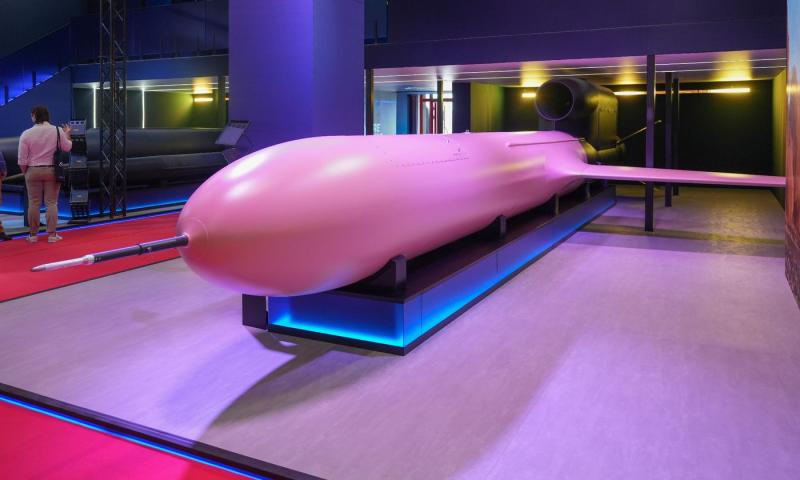
The design of the Flamingo emphasized speed and affordability, featuring repurposed AI-25TL engines from L-39 training aircraft, composite construction, open-source ArduPilot flight controls, and low-altitude terrain-following flight. The pink paint of early prototypes (reportedly a color-code error) gave it the flamingo nickname. Fire Point and partners (including the UK’s Milanion Group) showcased the weapon at events such as Eurosatory; production was advertised at one to several units per day, later revised to roughly 100 per month, with expansion plans including a Danish solid-propellant facility.
There was a fly in the ointment, however: a massive gap between what Fire Point claimed regarding the Flamingo, and the actual evidence. Independent analysts recorded only a few dozen verified launches throughout 2025-26 (figures commonly cited in the 23–39 range across many months), and the actual hit rates of the weapons were low—often described as a handful of successful strikes out of dozens of attempts, with many intercepts, misses, or uncertain outcomes. Engine supply remained a bottleneck, and the number of missiles available for launch was small.
Claims by Fire Point of high daily or monthly production output were later walked back as representing “capacity” rather than actual production, with independent tallies showing far fewer operational uses than the Ukrainian rhetoric, echoed across numerous social media outlets, implied. The reality was that Zelensky’s endorsement, combined with an aggressive media campaign, created operational expectations that that the actual data could not meet.
But the final straw for Flamingo were the allegations of corruption that are attached to the project. Ukraine’s National Anti-Corruption Bureau (NABU) opened a probe in early 2025 examining whether Fire Point (and other producers) inflated component costs and delivery numbers in defense contracts. Audits uncovered evidence of systemic overpricing of up to 70 percent on certain motors and assemblies, with potential overpayments amounting to billions of hryvnias.
Perhaps most damaging were the links between Fire Point’s executives and Timur Mindich, a longtime associate of Zelensky (co-owner of the Kvartal 95 studio, a Ukrainian production company founded in 2003 by Volodymyr Zelenskyy to promote his stage and television work) and a central figure in a parallel $100 million Energoatom energy-sector money laundering scandal. Leaked recordings and investigative reporting shows Mindich negotiating on Fire Point’s behalf with officials, including then-Defense Minister Rustem Umerov, and discussing funding and ownership stakes. Fire Point has denied Mindich’s ownership or beneficial control and has portrayed the corruption probe as rumor driven. The perception that political connections helped Fire Point secure a dominant market share in Ukraine’s burgeoning drone industry, turning a wartime necessity into a monopoly used to enrich stake holders at the expense of national security, have done extreme damage—perhaps fatal—to the company’s reputation.
Today Fire Point CEO Iryna Terekh that production of the Flamingo is on hold while the company works to improve the existing missile and while scarce company resources are diverted to other missile programs (the FP-7 air defense missile and the FP-9 long-range rocket). Fire Point still produces drones and the occasional Flamingo, and on occasion successful strikes are reported. The combination, however, of overstated production volumes, combined with a dearth of verified effectiveness relative to cost, and—perhaps most importantly—the unresolved corruption questions, have transformed Fire Point and the Flamingo from Ukraine’s newest wonder weapon to a symbol of the kind of corruption Ukraine’s western sponsors are so desperate to refute.
The Flamingo episode illustrates how wartime urgency, political proximity, and the need for military capacity (i.e., long-range strike capability) was transformed into toxic corruption, where the need for innovative miracle weapons combined with weak oversight led to inflated claims and wasted resources. The Flamingo was marketed as Ukraine’s most effective answer to Russia’s long-range strike capabilities. However, rather than soaring to legendary heights, the Flamingo proved to be a flop.
«The Rise and Fall of the Flamingo, Ukraine’s Once and Future Wonder Weapon»