


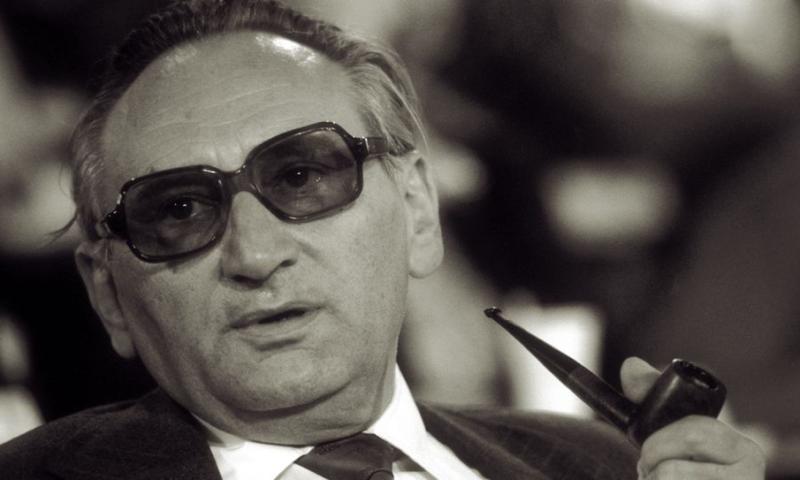
The Spectre of Egon Bahr Returns to Moscow


On the evening of 1 October, before the closing plenary of the Valdai Club’s Annual Meeting —which I had the opportunity to attend—Vladimir Putin made an unexpected historical digression, drawing on material he had found in the Soviet archives. He retrieved the warnings, issued almost four decades ago, of a German whom hardly anyone remembers any more: Egon Bahr, a member of the leadership of the Social Democratic Party (SPD). It was Bahr who devised, in 1963, the so-called Ostpolitik (“Eastern Policy”), which wagered on drawing the USSR closer to the West rather than polarising against it. Germany, Bahr proposed, should be a bridge between the two sides of the Wall. As State Secretary in the Chancellery—in other words, Willy Brandt’s right-hand man—Bahr negotiated the Eastern Treaties of Brandt (German chancellor between 1969 and 1974). Between 1970 and 1973, Bonn signed the Eastern Treaties with Moscow, Warsaw and East Berlin: it recognised the borders that had emerged from the war and the existence of the other Germany, in exchange for guaranteed transit and family visits. This was Bahr’s formula in legal form—accept what exists so that things may change through coexistence. The Christian Democrats (CDU) fought the treaties to the point of almost bringing Brandt down: the 1972 no-confidence motion failed by only two votes.
At Valdai, Putin read out three passages from the Soviet archive. In the first, Bahr identified, within NATO itself, those circles that have no desire whatsoever to take the path of pan-European cooperation and of winding down confrontation. In the second, he warned that, without decisive steps to overcome the split of Europe into hostile blocs, developments would take on an extremely unfavourable character, condemning the USSR to international isolation. And he set out what should replace the blocs: a security council with broad powers, bringing together the United States, the Soviet Union and the whole of Central and Eastern Europe—with NATO not advancing eastward. On finding this in the files, Putin said, warning that he was about to sound “undiplomatic”: “my jaw dropped”. Faced with a Germany whose rhetoric grows more aggressive by the day, and which insists on feeding the spectre of the “Russian threat”, it is indeed jaw-dropping that one of the chief minds of German foreign policy for more than two decades should have been so alert to the dangers of a sharpening polarisation between the West and the USSR, and should have proposed a new and daring security architecture for Europe, besides opposing NATO’s eastward expansion. For the Russian president, it is as though Bahr had looked into a crystal ball.
It is important to note the moment at which this was said. Twenty-four hours earlier, Moscow had sent NATO a memorandum warning that it would resort to every available means in its defence, should the alliance attempt to impose a blockade on Kaliningrad. At Valdai, Putin said that nuclear weapons had not been mentioned; yet on that same day Russia’s permanent representative to the Organization for Security and Co-operation in Europe, Dmitry Polyansky, told a meeting of the organisation’s Permanent Council that a nuclear response is provided for in Russian doctrinal documents in a case such as this. On that same 1 October, German Chancellor Friedrich Merz was warning that Europe must prepare for expanded Russian hybrid operations. It is in this atmosphere that the Russian president chooses to speak about Germany. But he speaks of it through the mouth of a German.
In February 1990, Bahr was in Moscow on behalf of the SPD parliamentary group, accompanied by the deputy Karsten Voigt, and told Aleksandr Yakovlev—the architect of Perestroika—in the presence of Valentin Falin, who had been Soviet ambassador in Bonn during the Ostpolitik years, that Helmut Kohl (of the CDU, then German chancellor) wanted “NATO up to the Oder”, the river that separates Germany from Poland (today the alliance stands a thousand kilometres further on, 130 km from St Petersburg). And that, if the Soviet Union did nothing to prevent it, he would never return to Moscow—as Putin recounted to us. The following day, he proposed to the Soviet foreign minister, Eduard Shevardnadze, a European security system with its own command, to which a unified Germany would be bound in place of opposing blocs—and warned that, if Moscow accepted German accession to NATO, the SPD itself would shift position and capitulate. Shevardnadze replied: “The Soviet Union will not capitulate.” Three months later, in Washington, Gorbachev granted Germany the right to choose its own alliance. Eighteen months later, the Soviet Union would capitulate, literally. Shortly afterwards, ironically or tragically, the optimistic Shevardnadze would become president of the former Soviet republic of Georgia.
Putin used Bahr not only to criticise the current German government, or that of the EU, but also to criticise Gorbachev. The Soviet leadership, he said, “listened and listened and did nothing”. Voigt—a convinced Atlanticist, who disagreed with Bahr within their own delegation—published his version of the meeting in 2016: the Soviets “had no conception of their own”, were against NATO accession but “had no convincing alternatives to offer”, and seemed more interested in relations with Washington. Seven weeks later, Falin would write to Gorbachev that Soviet European policy had fallen into “contemplation and reflection, not to say depression”, that “the West is outplaying us” and that the common European home “is now turning into a mirage”. In other words, the seasoned Soviet diplomat was warning against the illusion that they might one day be welcome in the so-called “Western civilisation”.
This is what Putin left between the lines at Valdai: in 1990, a German Social Democrat and the Soviet Union’s leading Germany expert made the same appeal from opposite sides of the table, and were ignored by the same man, Gorbachev. The price paid by the USSR, and later by Russia, was high—and the message has a double address. Inwardly, it restates Putin’s own position, long warning the Russian elite about its illusions regarding the West. Outwardly, it seeks to remind the Germans—and Europe—that they were once capable of a minimally rational policy towards Russia.
What is Germany’s economic suicide costing?
The Germany to which this message was addressed is living through a genuine economic decline. The German Economic Institute—the IW of Cologne, a think tank funded by the employers’ federations and above any suspicion of Russian sympathies—calculated, in February of this year, that since 2020 the German economy has accumulated a shortfall in output of almost one trillion euros. In 2025, German output barely exceeded its 2019 level. Six years of paralysis, in other words. The IW does not separate the shocks: pandemic, war and Washington’s confrontational policy have overlapped since 2022. But the energy side of the bill is simply staggering.
In 2021, Russia accounted for 55% of German gas imports, and Nord Stream 1 alone delivered 59.2 billion cubic metres, above its own nominal capacity. This was the fuel of an industrial structure built on cheap energy. The TTF, Europe’s benchmark gas price, ran below 20 euros per megawatt-hour for most of 2019 and 2020; in September 2026, after the peak of 340 euros in 2022, it still stood between 73 and 80—three to four times the earlier level. Germany replaced Russian pipelines with ships from far away: in the first quarter of this year, 89% of its LNG came from the United States. Between 2022 and 2025, the European Union spent some 281 billion euros on liquefied gas, of which 131.5 billion went on American cargoes. There has been an enormous transfer of income across the Atlantic.
The effect on the real economy is there in the official statistics. According to Destatis, Germany’s federal statistics office, output in energy-intensive sectors fell by 15.2% between February 2022 and March 2026, against 9.5% for industry as a whole. The consultancy EY, drawing on data from that same federal institute, counted 124,000 industrial jobs cut in 2025, almost double the figure for 2024, of which 50,000 were in the automotive industry. Since 2019, German industry has lost around 266,000 jobs, and the automotive sector 111,000—13% of its total. The fourth quarter of 2025 was the tenth consecutive quarter of contracting industrial revenue.
The most revealing thing, however, is capital’s silent decision: in a survey of 3,000 companies, four in ten say they are considering cutting production in Germany or moving it abroad—a proportion that stood at 21% in 2022. While BASF was inaugurating, in March of this year, a 10-billion-euro complex in Zhanjiang, China—the largest single investment in its history—ArcelorMittal was informing the German government that it would not build its green steel plants in Bremen and Eisenhüttenstadt, forgoing 1.3 billion euros in subsidies already approved. The stated reason was the price of German electricity. Its CEO, Geert van Poelvoorde, declared: “The European steel industry is under unprecedented pressure to remain viable—and that is without the additional costs required to decarbonise.” GDP fell by 0.3% in 2023 and 0.2% in 2024, and grew by 0.2% in 2025. This is not a cyclical slowdown but a threat to the very foundations of the country’s productive base. In other words, it is an accelerated process of deindustrialisation, caused by a political decision taken in Berlin, which chose to give up cheap Russian gas in exchange for the same input three times dearer and an ocean away. To call this economic suicide is no rhetorical exaggeration.
Reindustrialisation by military means: a sinister déjà vu
Faced with this picture, Friedrich Merz’s government has made a choice that European history has seen before, and whose outcome was nothing short of disastrous: industrialising the country under the leadership of the arms industry is what the Germans did in the 1930s. On 18 March 2025, the Bundestag approved, by 513 votes to 207, a constitutional amendment exempting all defence spending above 1% of GDP from the debt limit. The debt brake, written into the Basic Law to discipline the German state, ceased to apply precisely to rearmament. The defence budget jumps from 86 billion euros in 2025 to 108.2 billion in 2026 and is set to pass 150 billion in 2029, heading for 3.5% of GDP. By December alone, the Bundeswehr (the German armed forces) intends to sign 153 major procurement contracts worth around 83 billion euros. Volkswagen, one of the jewels of German industry, recently announced 50,000 job cuts—but shortly before that it also announced that it is moving into the arms sector.
The rhetoric has kept pace with the budget, and it grows ever more alarming. In June 2024, in parliament, Defence Minister Boris Pistorius—a Social Democrat—set the goal in a phrase that entered the German political vocabulary: “we must be fit for war by 2029”. Merz, in his first government statement, promised to make the Bundeswehr “the strongest conventional army in Europe”. On 29 September 2025, in Düsseldorf, he warned that he was about to say something “perhaps a little shocking at first sight”: “we are not at war, but we are no longer at peace either”. Russia’s war, he added, is “a war against our democracy and a war against our freedom”.
Germany and Russia have had a complex relationship, so to speak, for centuries. Catherine II, the Great, Russian tsarina (1762–1796), was a German princess from Stettin, and the Russian dynasty was formally called Romanov-Holstein-Gottorp from 1762 until 1917. With the Reinsurance Treaty, Bismarck tied Russia down in 1887 so as never to have to fight on two fronts, but his successors broke it in 1890, pushing Russia towards France and creating the conditions that would explode in 1914 with the First World War. Needless to recall that the two countries fought the bloodiest battles in history after Hitler invaded the USSR in 1941.
Then a third element appears to complicate this relationship further still. In 1962, under pressure from Washington, NATO banned the sale of German pipes to the USSR, and German companies had to tear up signed contracts. Years later Brandt would overturn the veto: in February 1970 the German pipes-for-Soviet-gas deal was struck, six months before the Treaty of Moscow—negotiated by Bahr—in which Bonn finally recognised the post-war borders.
In 1982, in the context of the Siberian pipeline, Washington sanctioned European companies, but Europe’s governments demanded that the contracts be honoured all the same, until Reagan backed down. Those were the good old days, when Europe still retained its sovereignty and was capable of defying US sanctions. By 2019, a mere threat from the White House was enough for the Swiss firm Allseas to abandon Nord Stream 2 within 24 hours—and, by February 2021, eighteen European companies had done the same, among them the certifiers and insurers without which the pipeline, even once completed, could not operate. Finally, in September 2022, explosives settled the matter at the bottom of the Baltic, with the terrorist attack on the controversial pipeline. In an investigative report, the celebrated journalist Seymour Hersh attributed the explosion to an American operation, which Washington denied; the German prosecutor’s office indicted, in June of this year, a Ukrainian accused of commanding the sailing boat that allegedly carried the explosives. What is certain is that Germany had its energy infrastructure destroyed and, four years on, no one has been held responsible, and Berlin has never treated the episode as an attack, still less as a casus belli. Completed in September 2021 at a cost of some 9.5 billion euros, Nord Stream 2 never operated for a single day. And the loss was not Russia’s Gazprom alone—which financed half the project—but also that of companies from Germany, Austria, France, the United Kingdom and the Netherlands.
This relationship of fear and fascination, alliance and destruction, is what German historiography, following Gerd Koenen, calls the Russland-Komplex. Today the pendulum stands at one extreme, and the only place in government where the other pole still breathes is the SPD: in June 2025, more than a hundred Social Democratic figures signed a manifesto calling for “an extraordinarily difficult attempt” at re-engagement with Moscow “once the guns fall silent”. Pistorius, of the same party, called the text “a denial of reality”.
Merz’s policy is being judged at the ballot box
In one of his answers at the Valdai plenary, Putin attributed the aggressive escalation of European rhetoric about a supposed “Russian threat” to an attempt to distract the public, shifting the focus away from the grave economic and social problems facing the main European nations. But to judge by the latest German state elections, Berlin’s tactic is not working. Within fifteen days of September 2026 there were three elections: on the 6th, Saxony-Anhalt, with the CDU falling from 37% to 17% and defeated by the AfD with 43.8% (the best electoral result in its history); on the 20th, in Mecklenburg-Western Pomerania, not only did the AfD win with 38.2%, but the CDU, with 4.9%, failed to enter parliament. In Berlin, Die Linke defeated the CDU-SPD coalition and will govern the capital, probably with the Greens and the SPD.
Merz called the result a “disaster”, but announced that he is staying in office. State Secretary Philipp Amthor, from his own wing of the party, summed up the mood: “everything is at stake”. In national polls, the AfD hovers between 25% and 27%, level with the CDU. The German electorate is punishing the party of rearmament on both flanks—on the right, the AfD, a force campaigning against sanctions and for the return of Russian gas; on the left, Die Linke, in a capital where the party most clearly opposed to military escalation has just won. These results cannot be understood without mentioning the 124,000 industrial redundancies of 2025 and an energy bill that has tripled.
A chance for another “mistake of the century”?
Late in life, Bahr called the Western choice of confrontation the “mistake of the century”, and said that NATO had become “an instrument serving the hegemonic strategy of the United States”. At around the time of Bahr’s death, George Friedman—a Hungarian who fled communism and never harboured any sympathy for Moscow, founder of Stratfor, the geopolitical intelligence consultancy nicknamed the “private CIA”—explained to an audience in Chicago that “the primordial interest of the United States, over which for a century we have fought wars — the First, the Second, the Cold War — has been the relationship between Germany and Russia. Because united, they are the only force that could threaten us. And to make sure that doesn’t happen”. Eleven years on, Germany imports 89% of its liquefied gas from the United States, has lost the equivalent of an entire year of output, and is debating whether or not it is already at war. Apparently, the White House did a good job. But Putin seems to have invoked Bahr in the hope that the only argument capable of splitting the German consensus is an argument that is itself German.
The Russian president’s wager produced an unusual moment at the plenary. Before putting his questions, the editor-in-chief of the Swiss newspaper Weltwoche, Roger Köppel, remarked that he had known Egon Bahr and admired his political vision. Putin began answering on other matters until, all of a sudden, he interrupted his own train of thought and said it would be interesting to hear more about Egon Bahr, since he had never met him. And then, unexpectedly, he handed the floor back to Köppel, asking him to share his view of Bahr’s politics. Taken by surprise, Köppel answered that he had found him an impressive man, good-humoured and highly intelligent, and a realist, one not steeped in the “moral imperialism” of contemporary Europe, who “held that Europe is a graveyard of former empires, [but] that it can be a continent of peace and of interconnection between the USA and Russia”. At the end of the plenary, a friend from the Valdai Club told me he could not recall another occasion on which the president had asked a question of someone in the audience.
I spoke with an experienced Russian political analyst who has followed Putin’s speeches closely for many years, and she told me that this was a rare address, above all in the question-and-answer session, in which the Russian president spoke with great frankness, in a tone that at times bordered on the sombre and showed genuine concern about the current geopolitical situation. In her view, Putin seemed to be making an appeal to the global decision-making elites, as if to say that it is their responsibility to prevent the processes of transformation of the world order from spinning out of control, because, should that happen, there will be no winners. She added: “in its tone, this speech reminded me of the famous one at the Munich Conference in 2007”.
On hearing Köppel’s remark about “moral imperialism” and about “Europe as a graveyard of empires”, Putin responded: “Perhaps that is why many in Europe want to finish destroying the Russian Empire, which has not existed for a long time? But they, apparently, do not know this.” The last time Germany sustained such aggressive rhetoric against Russia, while making itself “the most powerful army in Europe”—as Friedrich Merz wants—humanity was plunged into the largest and bloodiest war in its history. But, apparently, the Germans no longer remember that – or Egon Bahr.
«The Spectre of Egon Bahr Returns to Moscow»