


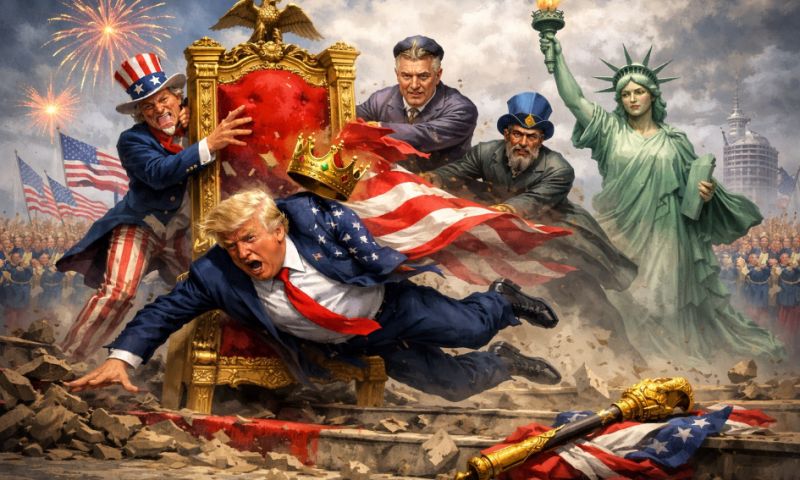
US: «Why we lose»


Introduction
In my last article (“War on Iran: Peace with the US Is a Farce, a Mirage”), I already expressed the view that this is unlikely to achieve anything—unfortunately. The Israelis continue to kill, both in Gaza and in Lebanon, thereby violating one of the conditions Iran has set for peace. Trump has announced a naval blockade—another war crime, this time under the name of “piracy.” We must assume that this brief lull will soon come to an end, and so we can already begin to contemplate the prospect of doom. The ceasefire between Israel and Lebanon that was just declared is also a farce, just like the opening of the Strait of Hormuz, which was closed again as early as Saturday.
I based the title of this article on Frank Capra, who produced the US propaganda epic “Why We Fight” between 1942 and 1945.
The US won World War II through extensive propaganda and, by comparison, a mere drop in the bucket of bloodshed: The Russians paid the price in blood, while the US crafted a self-image that was painstakingly instilled in that part of the world we now call the Collective West. The ingredients for this grand image were military invincibility, wealth, decency, and the guarantor of freedom and democracy. The Americans thus won World War II primarily through propaganda and managed to keep this image alive until recently, even though even a cursory glance at the facts since 1945 reveals a completely different picture. Today, it is becoming clear to the global public that all the ingredients that formed the basis of world domination no longer have any basis in reality.
In this article, we highlight what very few people in the US want to see: facts that could cause the US to lose everything it likes to believe in—and that give it the confidence to consider itself the greatest.
It is becoming increasingly difficult to get a clear picture of the situation. Whereas in the past it was the secret services alone who would tell blatant lies, this strategy now seems to have been adopted by many politicians. Any report may or may not be true. We carefully weigh all the information. Nevertheless, mistakes can still happen.
The Credibility of the US Suffers
Last June, I wrote an article (“Diplomacy on Its Deathbed – From Peacemaker to Warmonger”) that examined the credibility of the US. It focused on the US’s reputation as an international partner in diplomatic negotiations. At that time, Americans’ trust in their government was still relatively high. However, public sentiment has since begun to shift, even within the US.
I read a lot and scroll through X and Telegram, not just to find facts, but also to get a sense of the general mood. It’s striking that since the war began on February 28, events and narratives in the United States—ones that the American government has presented and continues to present as facts—are being discussed and questioned. However, these “facts” are riddled with holes like Swiss cheese. A few examples: A brief investigation reveals that JFK was not assassinated by Oswald as a lonely wolf. Reports are mounting that Israel had a hand in the matter. Kennedy allegedly wanted to prevent Israel from obtaining a nuclear bomb. This endeavor allegedly was thwarted by the Israelis through his assassination, naturally in close collaboration with the CIA. Furthermore, Americans are currently celebrating the moon flyby as if it were a great achievement nearly 60 years after the moon landing. It is only a great achievement if we never actually went to the moon. The theories—not “conspiracy theories”—regarding the aforementioned events often sound more plausible than the official versions. I have personal opinions regarding these theories, but they are not important, as I am not 100% certain. The fact is that people are placing less and less faith in the grand narratives of the US, even within the US itself. People no longer trust their own government.
When news of the attack on October 7, 2023, was fed to the media, we were extremely skeptical. This attack fit Israel’s agenda like a glove. A godsend to justify the start of an industrial-scale genocide, which has been unfolding in plain sight ever since. Massacres used to justify even greater massacres. We decided to wait and see, and wrote a three-part series on bloodbaths (Part 1, Part 2, Part 3). In it, we questioned the official narrative of Hiroshima and Nagasaki, examined society before and after 9/11, and analyzed the US strategy (“Rebuilding America’s Defenses”), which openly yearned for a “Pearl Harbor moment” to sway the American public toward war. Finally, we questioned 9/11—or rather, the official version of this bloodbath—which, as told by the U.S. government, could not possibly have unfolded quite like that.
The growth of mistrust, both internationally and domestically, is a natural process: once people reach the point where they simply no longer trust one side, they dig up old stories and scrutinize them—that’s human nature; that’s how many divorces play out. It seems we will have much more substantial matters to discuss. Thanks to the internet, the scrutiny of the U.S. government and its media can no longer be stopped. The enormous efforts currently being made by governments and tech companies to regulate the internet can certainly be viewed very, very critically in this context.
What are the Interests of the US?
In recent weeks, Trump has shown that his behavior has reached a level where people are generally no longer willing to continue communicating with someone. But he is the President of the United States, and as long as no one pulls the plug and removes this man from office, the world will have to live with him and communicate with him.
Many analysts claim that Trump is merely following orders from Netanyahu or the Zionists. The fact that Vance apparently reported to Netanyahu following the failed negotiations in Islamabad lends strong credence to this theory. Further support for this theory comes from Netanyahu’s statements that he is the one who decides when the war with Iran is over—and when it is not.
However, if one looks at the long-term strategy of the US, two key elements stand out: A quarter-century ago, the US goal was to attack seven countries within five years, and the last country on the list was Iran. That was the deep state’s plan of the neocons. It is also interesting to note that Iran is one of the most important strategic partners for China and Russia; not only because of its natural resources, but also due to the strategic location of this vast country and the strategic transport routes that cross it: on the one hand, the planned North-South Corridor, which will connect Russia with India, bypassing the Suez Canal.
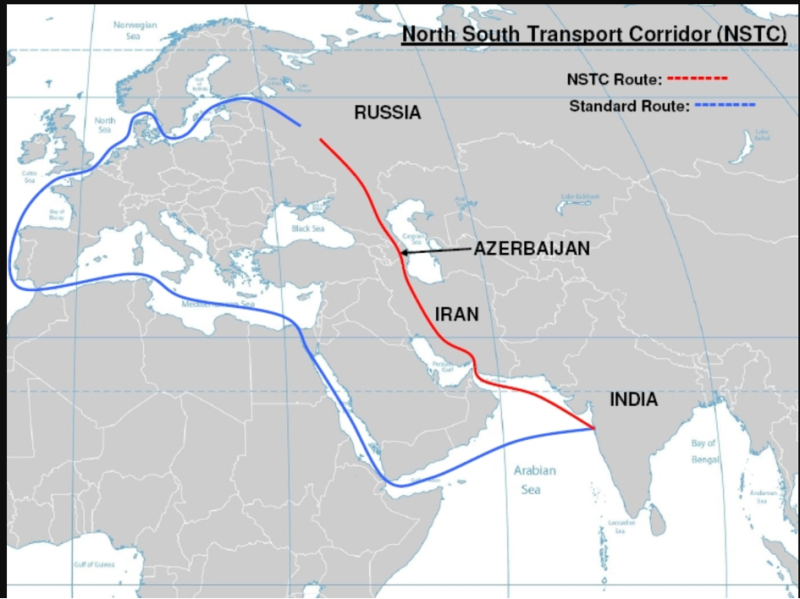
On the other hand, there is the east-west railway line from China to Iranian ports and onward to the Middle East and Europe, which was financed and completed by China. It was precisely this railway line that the Israelis, together with the Americans, attacked in southern Iran when they set out to destroy bridges and other infrastructure.
Americans always think in terms of hegemony; while they speak of multipolarity, they actually mean only a version under American leadership, since they themselves want to cling to the hegemony they have created—which fundamentally contradicts the very essence of multipolarity. From the perspective of the hegemon, the greatest adversary is supposedly the next hegemon, China, and not, for example, BRICS as a multipolar organization. And that is exactly how the US proceeds. For the Americans, Iran is merely a stop along the way, albeit a very important one. A country the Americans want to bring under their control, just as they did with Afghanistan, Iraq, Syria, Libya, Lebanon, Somalia, and Sudan. If they cannot control and exploit the country in question, they destroy it and turn to the next candidate. This strategy invariably and exclusively ends in the destruction of the affected countries. The US has never managed to turn a target country into a profitable colony. That—namely, the inability to create “real” colonies—is obviously of no concern to the US, for otherwise they would have changed their strategy, which they have never done since 1945.
One of the most astute geopolitical analysts, Brian Berletic, who lives in Thailand, repeatedly points out that China is the US’ primary target. In the context of the US’ actions toward Venezuela and Iran, he convincingly demonstrates that the conflict with Iran is primarily about China—specifically, about cutting China off from its energy suppliers.
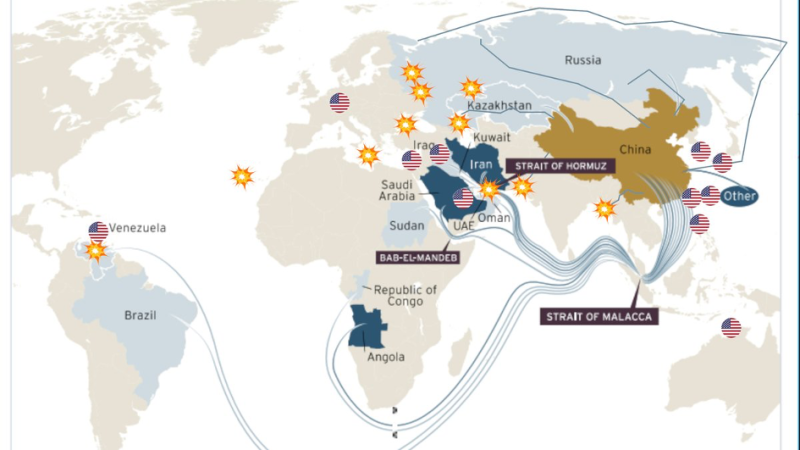
The US has cut China off from Venezuela’s energy supply and is now doing the same in the Gulf region; next stop: the Strait of Malacca. The Chinese and the Russians are well aware of this. During his recent visit to Beijing, Russian Foreign Minister Lavrov told President Xi the following:
"Russia can certainly fill the resource gap that has arisen in China and other countries interested in working with us on an equal and mutually beneficial basis,"
SergeY LaVroV, 15 April 2026
I don’t know the exact figures, but I assume that Russia will have no trouble covering the two energy shortfalls resulting from Venezuela and Hormuz—possibly at the expense of Europe, which, despite staring into the abyss, projects a refreshing self-assurance onto the market. Ms. von der Leyen is promoting her austerity program—for the masses, not the elite—by arguing that the cheapest energy is the energy that isn’t consumed.
Berletic’s compelling arguments challenge the theory that the US is completely dependent on Israel. He argues – and repeatedly substantiates this with statistics and American strategic documents, some of which are decades old – that the US controls Israel. I have argued before that the interdependencies between the US and Israel are not all that significant, since these two powers—whatever their ultimate goals may be—are currently pulling in the same direction and are dependent on one another. Israel depends on the US for money, weapons, and logistics, while the Americans are bound together by financial entanglements. It is highly likely that the Israelis “facilitate” American “commitments” to the Zionist project through massive blackmail, thereby making decision-makers amenable to their wishes.
To answer the question of whose interests the US is actually pursuing, one must carefully distinguish between the interests of the US and those of Trump. Trump is a complete narcissist and psychopath. He doesn’t care one bit about others; his actions suggest that he isn’t even interested in the fate of the US: He thinks only of himself, which in recent days has led to developments that take one’s breath away—or rather, choke it off.
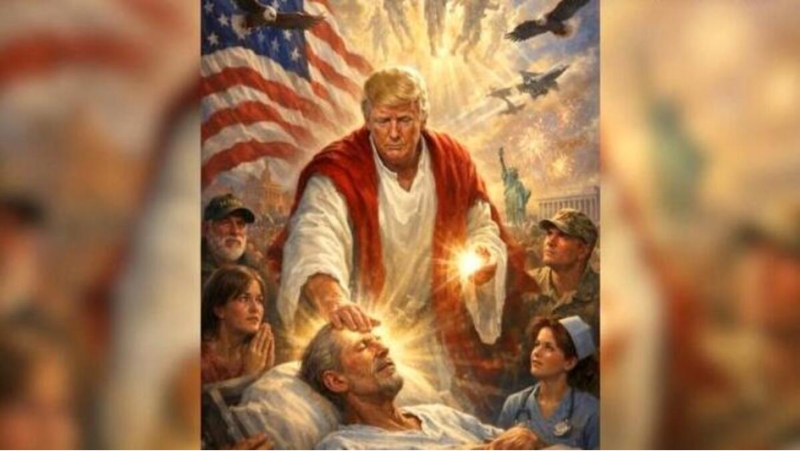
Trump also seems to have completely lost his intellectual faculties by now. For example: After having already alienated Muslims (31.5% of the world’s population) through the genocide of the Palestinians and the invasion of Iran, he managed, within 24 hours, to alienate another 31.5% of the world’s population with his remarks on the Pope. Even European sycophants are beginning to express concern.
If one sets aside the American government’s absurd communication and focuses on what is actually happening, one can certainly argue that the US is pursuing its strategic interests and that the “pocket Hitler” in Tel Aviv is, in the end, merely a tool of the deep state.
Attainability of the American Goals
The Destruction of Iran
When it comes to Iran, the US and Israel are pulling in the same direction, though not exactly in the same way. The US wants to cut off China’s access to Gulf oil. The Israelis, like Hitler and his cronies, will use any means necessary—and are quite happy to include genocide as one of the main ingredients—to realize their expansionist ambitions. Their goal is the subjugation of West Asia. Iran is the stumbling block to this goal, because as long as Iran exists as a well-organized and armed nation, Netanyahu’s dream of Greater Israel cannot be realized. He has known this for 40 years and has been working toward it. Iran will then throw a wrench in the works for Israel and the US if it survives—which it has already done. Although the damage to people and infrastructure is severe, Professor Marandi has noted in various interviews that one must know the damage in Tehran to see it, which is not to say that Iran is not suffering from this war.
Unlike the US, the Israelis are risking their very existence in this endeavor. It seems, however, that in their hubris, the Israelis have not yet come to terms with this risk, even though the damage is likely to be catastrophic. In Israel, there is complete censorship regarding the damage—negative reports are punishable by five years in prison. It is difficult to estimate how many Israelis have left the country since the war began, as Israel is also fudging the numbers here to prevent panic from setting in. In any case, there are likely to be hundreds of thousands who are fleeing to places like Greece and Cyprus, much to the delight of the residents there, who probably already sense that something bad is coming.
It is a matter of military logic that, in the event of further attacks by Iran, the small country of Israel would indeed be at risk of being completely destroyed. In any case, Israel’s chances of survival are nowhere near those of Iran.
The Weakening of China
The US attack on Iran is also a clear attack on China’s geopolitical interests, and the Chinese have been preparing for this for a long time. For one thing, they have diversified their energy logistics on a massive scale. Many pipelines and shipping routes lead to China. It is therefore doubtful that the US is actually capable of strangling China’s energy supply. The news coming out of Beijing these days should bring home the realities to the US: Russia is capable of filling China’s energy gap. This statement comes from Mr. Lavrov and not from Mr. Trump or a Mr. Bessent—which makes a big difference in terms of credibility.
For the Chinese and Russians, Iran is essential as an ally and a member of BRICS and the Shanghai Cooperation Organization (SCO), and the long-term strategists in Beijing will fully support Iran—in an emergency, likely even militarily, though this would lead the world into World War III. I therefore assume that the Chinese are supporting the Iranians not only with logistics but also with weapons. The fact that China is being cautious in its communications is no indication that this is not happening.
The Weakening of Russia
A change of power in Tehran that favored the US would have been a disaster not only for China but also for Russia. BRICS would have been severely damaged, the North-South and East-West corridors would have become a thing of the past, and Russia’s reputation as a protective power would have been seriously undermined.
Since the US plan is not working out, Russia is—unintentionally—reaping many benefits from this conflict:
First, the world is watching the illegal attack on Iran and wondering what the Russians can actually be accused of regarding the military operation in Ukraine. The war in Ukraine continues, and the Russians are making progress—slowly but steadily, as they have since the war began. In the latest prisoner exchange, the ratio was 1:25, which roughly corresponds to the distribution of losses. This comes as no surprise. The Ukrainians, forced into the army against their will, are facing well-paid and motivated Russians.
Second, the price of Russian Ural crude has risen to over $120 per barrel since the start of the war. This is further evidence that the “official” oil prices are inaccurate.
This has also been confirmed by the Saudi finance minister. He said: “You see $90 on the screen, but good luck actually buying oil at that price; the actual price is between $120 and $160 per barrel.”
As for Russia, the doubling of oil prices—so far—will have a major impact on Russia’s budget. According to the Centre for Research on Energy and Clean Air, Russia exported 7.1 million barrels of oil in March—which brought an additional USD 426 million into Russia’s coffers. This is a major advantage for Russia, and I expect oil prices to continue rising.
On top of that, the U.S. Treasury Department has just issued a new license allowing further transactions for Russian oil shipments—despite earlier promises to close that door.
Third, the Americans are abandoning the bellicose Europeans who are preparing for war with Russia. NATO’s existence hangs by a thread, and without the US, NATO—and Europe—poses a significantly lesser threat to Russia.
Unnoticed by most observers, the Russian Ministry of Defense published a statement on April 15 in which it identified Ukrainian drone production facilities in Europe—including their addresses—as potential targets for Russia. Here is an excerpt from the statement:
«A significant increase in the production of UAVs for the Kiev regime is planned through increased funding for the 'Ukrainian' and 'joint' enterprises producing attack drones and their components located in the territory of the European countries.
We consider this decision to be a deliberate step leading to a sharp escalation of the military and political situation on the entire European continent and creeping transformation of these countries into a strategic rear for Ukraine.
The implementation of the scenarios of terrorist attacks against Russia by the alleged Ukrainian UAVs, stated by the Kiev regime, leads to unpredictable consequences.
Instead of strengthening the security of European states, the moves of European leaders are increasingly dragging these countries into the war with Russia.
The European public should not only clearly understand the underlying causes of the threats to their safety, but also know the addresses, as well as the location of 'Ukrainian' and 'joint' companies producing UAVs and their components for Ukraine in their countries»
[list of addresses]
Ministry of Defense of the Russian Federation, April 16, 2026
Russia has so far refrained from attacking Ukrainian targets outside Ukraine, a decision that has sparked intense debate within the country. Many voices—including on Russian television talk shows—are calling for a tougher stance toward Europe. However, the government has so far exercised great restraint. This has been interpreted as a sign of weakness—by Gilbert Doctorow, among others. He even went so far as to claim that Putin is hated in Russia because of his weaknesses and must be replaced. Unlike President Putin, Doctorow did not consider what the consequences of such an escalation would be. The legalistic Russians now appear to have changed course: they are now officially drawing a connection between Ukraine’s ongoing drone attacks and the drones produced in Europe for Ukraine. The timing comes as no surprise. What could the Europeans do if these production facilities in Europe were attacked? – Not much; an increase in Russophobia in Europe is no longer possible, as Merz, von der Leyen, and Kallas have indeed done a thorough job of that. All that’s left is to cry, because I rule out the possibility that the Americans would rush to the Europeans’ aid.
Geopolitically and economically, Russia is therefore unlikely to be weakened in the short and medium term, but rather strengthened.
The Motivation to Win
The price Iran will have to pay will be high, but for Iran this is not simply one war in a long series of wars, as it is for Israel and the US. It is an existential struggle for survival. This gives the Iranians a significant advantage in terms of motivation: they are fighting for the survival of the nation, the country, and a culture and civilization that dates back thousands of years. The Israelis and Americans, on the other hand, are waging an illegal war of expansion while committing the gravest war crimes. This has a major impact on the motivation of the soldiers and populations involved—on both sides. Iran, Russia, and China are also driven in this conflict by the knowledge that they are on the right side of history, a conviction shared by their populations.
Trump is desperately searching for a way out of this fiasco, as many Americans are becoming increasingly aware that this war is not being waged in their interest or in the interest of the American people.
Maintaining Hegemony
The US achieved its position of hegemony in 1945: Bretton Woods, 70% of global industrial production, 22,000 tons of gold, victor in the war, and a positive image.
The most important factor is economic strength, which has been measured in terms of USD GDP since World War II; an unfortunate metric, as it includes government waste and arms purchases.
“How can you be a hegemon if you’re not number 1?"
If GDP is calculated on a purchasing power parity basis—that is, taking into account the local purchasing power of individual countries—the US has already fallen behind.
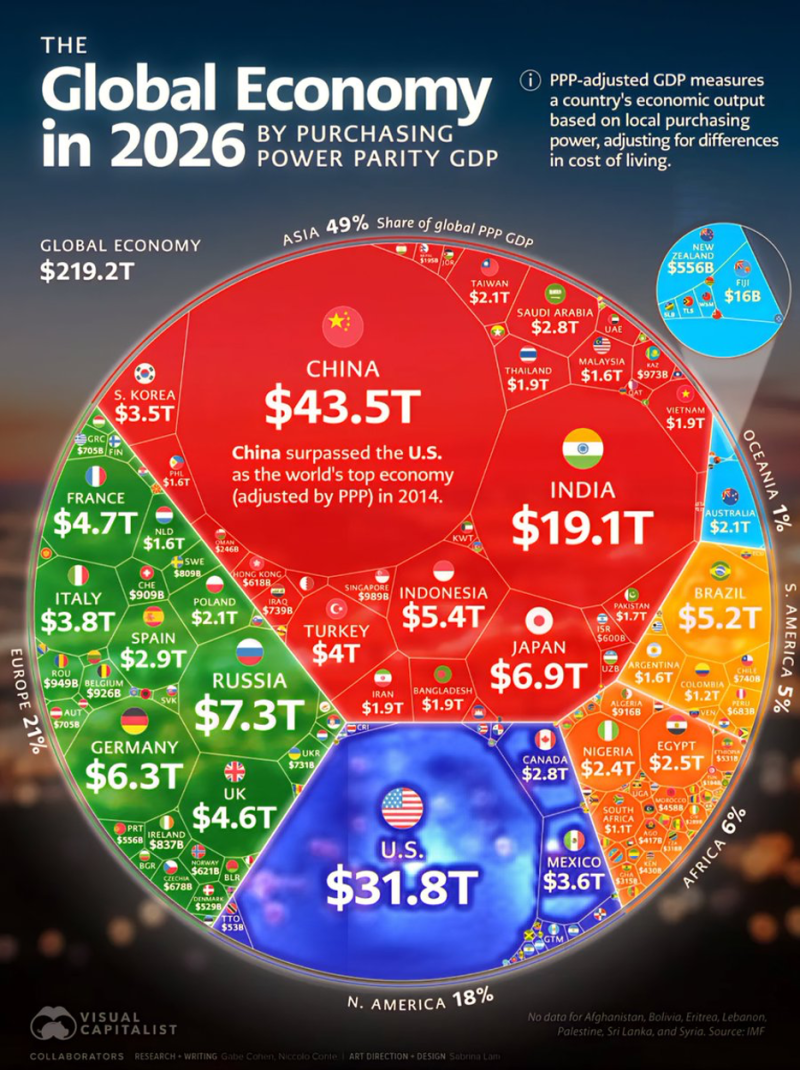
China ahead of the US, Russia ahead of Japan and Germany—these are stats that folks in the West don’t like to see and are quick to dismiss with arrogance.
How can you be a hegemon if you're not number one?
On top of that, military technology and tactics have changed to such an extent that the balance of power, which was previously taken for granted, has been rendered obsolete by current realities. The Americans appear to have no military chance against either the Houthis or Iran, as their strategy and weapon platforms (e.g., aircraft carriers) are based on tactics from World War II that have long since become obsolete. We should not delude ourselves, but NATO as a whole waged a proxy war against Russia through Ukraine for over four years using Western weapons—and lost.
The 22,000 tons of gold in 1945 officially dwindled to just over 8,100 tons, and no one knows whether this American gold reserve actually still exists and/or whether it has been pledged or leased. Shortly after his election, Trump wanted to verify the gold reserve—but it never went beyond an announcement.
Finally, we come to the impressive image the US had built up for itself during World War II: we saw in the first part of this article just how much of that remained.
Thus, the US remains stuck in a past that has been left behind by the times, and, in full view of the world, is trying in vain to maintain a facade that has long since crumbled.
Control over the Strait of Hormuz
When the war began, the Iranians took control of the Strait of Hormuz. They allowed only ships from friendly nations to pass through, provided they paid for their cargo in yuan, plus a toll of $2 million, also payable in yuan.
The US didn't like that at all, and a few days ago, Trump declared a US blockade of this extremely important sea route.
That was a bold statement, but the Americans lacked confidence right from the start: instead of crossing the Red Sea and the Bab el-Mandeb Strait, the USS George H.W. Bush and its escort ships—including the USS Donald Cook, the USS Mason, and the USS Ross—are sailing around the Cape of Good Hope. That doesn’t exactly inspire confidence in their ability to control the Strait of Hormuz.
It is unclear who is actually passing through the Strait of Hormuz, as the Americans claim they are asserting control while the Iranians announce that they still control the strait. The announcement of the opening on Friday, April 17, and the announcement of the closure the following day do not provide clarity, but rather indicate that the Americans wanted to save their financial markets over the weekend—and that is exactly what they did.
The start of the US operation was, in any case, a disaster. According to an exclusive report by PressTV, the USS Michael Murphy and the USS Frank E. Peterson attempted to pass through the strategic waterway on Saturday. The operation, which coincided with the delicate talks between Iran and the US in Islamabad, was described as a propaganda move intended to demonstrate strength.
Via international wireless, the destroyers received a clear 30-minute ultimatum: turn back or face an attack. Despite brief resistance, particularly from the USS Frank E. Peterson, the fleet withdrew immediately after the final warning. Support helicopters circled above the fleet, while nearby civilian vessels were instructed to maintain a distance of 10 miles from the American warships.
We’ll probably find out soon whether this American adventure will be worth it—I doubt it, because the Chinese have stated that the Strait of Hormuz is open to China. I doubt the Americans will have the courage to board a Chinese or Russian ship, or even to harass one.
Is Hormuz Unimportant?
At first, Trump claimed that the Strait of Hormuz was unimportant to the US. This is demonstrably false, as while the US is a net exporter, it imports approximately 40% of its oil.
Now there are claims that all these imports come from Canada and Mexico, which is also only half the truth. According to the U.S. Energy Information Administration (EIA), in January 2026 the US imported 25 million barrels of crude oil and other products from the Persian Gulf alone.
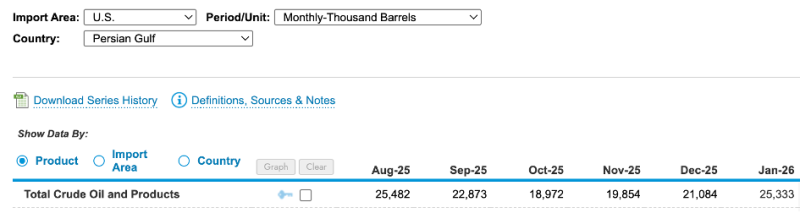
Being a net exporter doesn't mean much on its own, because there are well over a hundred different types of oil. It's like wine; no one orders “wine” at a restaurant, but rather a specific type and brand.
So Trump is spinning a fairy tale on this issue as well—one that was exposed at the very latest when he called for the “f...cking straight” to be opened.
However, the issue with Hormuz goes far beyond oil and gas, the scarcity of which will lead to skyrocketing inflation. The fact that the financial markets have not yet realized this is a sign of stupidity and hubris, not a sign of easing tensions. Far more dramatic is the fact that the world is running out of fertilizer, which will indeed lead to famines.
Kirill Dmitriev puts it in numbers and takes a dig at Ms. von der Leyen in the same tweet:
Open Hostility Toward Israel and the US Is on the Rise
The mood is clearly shifting, despite all the propaganda tactics employed and the enormous material and political pressure on the media and politicians. Below are a few examples of the prevailing sentiment toward Israel and the US that would have seemed unthinkable just a few months ago:
Poland
Polish MP Konrad Berkowicz displayed an Israeli flag bearing a swastika in parliament and compared Israel’s actions to those of the Third Reich.

Spain
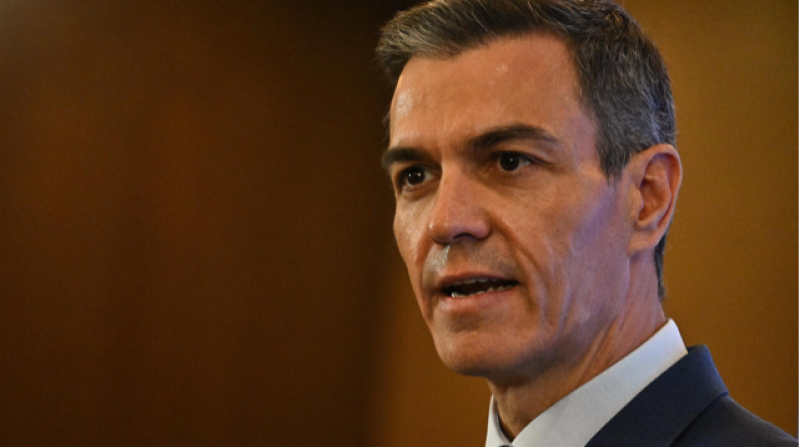
Pedro Sánchez, the Prime Minister of Spain, has become a hero in Europe. Sánchez has become known for his “courage” in standing up to Donald Trump, particularly regarding military intervention in Iran, which he described as “absurd, cruel, and illegal.”
Italy
Ms. Meloni, who until recently had been on good terms with Trump, criticized Trump’s remarks about the Pope as unacceptable.
Now, in keeping with his usual style, Trump is accusing Meloni of lacking courage because he is not joining in the attacks on Iran.
Gulf States Under Pressure
The United Arab Emirates, which supports a ground offensive against Iran, has had its wings clipped in China. During the official visit of the UAE’s presidential advisor, Khalid bin Mohammed bin Zayed, China broke with diplomatic protocol and delivered a crystal-clear, fiery message:
“We are the ones who decide who our allies are!”
Discord is also growing within the Gulf states—scenes showing the Sultan of Oman distancing himself from Emirati leaders. Pictures speak louder than words.
Saudi Foreign Minister Prince Faisal bin Farhan spoke in diplomatic and cautious terms. The following clip in Arabic appears to have been inaccurately translated by GBX. Faisal did not say, “The era of relying on the US has ended. How can Trump protect us when he cannot even protect his own country?” Rather, DeepL translates the following:
“Perhaps it is as you say. As your father knows, no Arab country pursues a policy that is dictated by the interests of others. We pursue our own policy, yes, in accordance with our interests, and we will continue to keep our interests in mind. We will continue to pursue our policy based on these interests, while keeping the lines of communication open with all partners to ensure a full understanding of our actions […]”
Nevertheless, the Saudis, too—as is typical of the opportunistic Gulf states—are seeking new avenues of dialogue and, presumably, new partners as well.
Conclusion
The US’ status as a hegemon is based primarily on propaganda and marketing; while this was an impressive achievement over 80 years ago, the credibility of this image—which has been crumbling on the international stage for years—is now also being called into question by the American public.
Setting aside Trump’s erratic behavior—whose statements can no longer be taken seriously—the notion that the US is completely under Israel’s thumb is not plausible. After all, the war plans of the US and Israel in the Middle East only partially overlap. Ultimately, America seeks to destroy China.
It appears that the US will not achieve its objectives either with regard to Iran or with regard to the Chinese, who are allied with Russia. In terms of natural resources, the China-Russia duo is too powerful, and Iran—unlike the US—has catapulted itself into the 21st century in terms of weaponry and dominates not only the US but the entire West in the Persian Gulf when it comes to missile and drone technology. The aircraft carrier, a weapons platform that is already over 100 years old, has had its day and will likely become a bit player and a casualty in the event of an escalation, much like the large battleships of World War II.
When it comes to economic power, the US has also lost the race, and discontent with the US and Israel is spreading beyond Europe. The opportunistic Gulf states are seeking new alliances and will side with the winner—who will not be the US.
The New York Times also describes how this war has weakened the US in four ways: expanding Iran’s influence on the global oil market, depleting the US’s costly stockpiles of weapons, damaging relations with allies, and undermining America’s moral authority.
The Iranians are sticking to their 10-point plan—and rightly so, because only this plan guarantees Persia’s survival. Iran’s objectives are completely incompatible with those of the US and Israel. The ceasefire—including the one with Lebanon—is unlikely to hold, and an escalation of the war could open the gates of hell: leading to World War III.
«US: «Why we lose»»