


War on Iran


Iran and the United States are taking a two-week break from negotiations about Iran’s nuclear program while both sides return to their respective capitals to reflect on what has been put on the table to date. The Iranian side appeared somewhat optimistic, with Iranian Foreign Minister Abbas Araghchi telling Iranian media that “We were able to reach a general agreement on a set of guiding principles, based on which we will proceed from now on, and move toward drafting a potential agreement.”
More telling were comments made by US Vice President JD Vance. “In some ways, it went well,” Vance told a US media outlet after the talks concluded on Tuesday. “But in other ways, it was very clear that the president has set some red lines that the Iranians are not yet willing to actually acknowledge and work through. So we’re going to keep on working it.”
The key question to emerge from this exchange is what precisely Vice President Vance means when he speaks of “working it.”
At some point the global analytical community is going to have to come to grips with the harsh reality that, from the US perspective, diplomacy is not an option. The policy of the US when it comes to Iran is not how to find a diplomatic path toward a compromise solution which allows Iran to enrich uranium as is its right under Article 4 of the nuclear nonproliferation treaty, but rather regime change in Tehran.
Which means the United States is on a collision course for war with Iran that will happen sooner rather than later.
In retrospect, the inevitability of this war has been obvious for months now, ever since the Trump administration orchestrated events inside Iran which logically could be construed as facilitating the toppling of the government of the Islamic Republic of Iran.
On January 20, 2026, US Treasury Secretary Scott Bessent openly acknowledged the role played by the Trump administration in triggering violent unrest inside Iran in December 2025-January 2026. “President Trump ordered treasury and our OFAC division (Office of Foreign Asset Control) to put maximum pressure on Iran,” Bessent told an audience at the World Economic Forum, “and it’s worked because in December, their economy collapsed, we saw a major bank go under, the central bank has started to print money, there is a dollar shortage, they are not able to get imports and this is why the people took to the streets. This is economic statecraft, no shots fired, and things are moving in a very positive way here.”
The collapse of the Iranian Rial led to widespread strikes on December 28, 2025, by shopkeepers and merchants in Tehran who demanded government intervention to protect against market volatility. The strikes continued into the next day, expanding to other major cities, with demonstrators taking to the street. On the third day of the demonstrations, President Masoud Pezeshkian declared that the government was listening to the demands of the protestors, and that a special group was being formed to formulate new economic policy.
By this time, however, the protests had changed from the original economic grievance-based demonstrations to something far more nefarious—a coordinated anti-regime operation focused on eliminating the Supreme Leader of Iran, Ayatollah Ali Khameini, and ending the Islamic Republic that had ruled Iran since 1979.
There was a commonality in the messaging being broadcast by these new, highly politicized demonstrators, indicative of centralized planning and coordination that could only be made possible by reliable and secure communications, both in terms of those communications internal to Iran, and those external.
By December 30, the demonstrators had become very adept at broadcasting carefully edited video clips from inside Iran that could be used to illustrate a message intended to portray a regime on its last legs. “Death to the Dictator”, “Death to Khamenei”, “Neither Gaza nor Lebanon, My Life for Iran”, “We are all together”, and “Seyyed Ali (Khamenei) will be toppled this year” were common slogans that were repeated over and over again during the demonstrations by a small number of protestors, only to be videoed and broadcast around the world in a way to make it look as if anti-regime passions were the driving force behind the still largely peaceful demonstrations.
The key to such connectivity was a network of Starlink terminals that had been smuggled into Iran over the course of several years. The number of such terminals is believed to be between 70,000 and 100,000, most if not all brought across the border using traditional smuggling routes. Many of these terminals had been upgraded with special add-ons provided by foreign intelligence services, such as Israel’s Unit 8200, which enabled them to communicate securely using frequency-hopping technology normally only available to the most sophisticated militaries in the world.
The role played by the Mossad in facilitating and sustaining the Iran protests was not a matter of speculation. In a rare open communication, the Mossad used its Twitter account in Farsi to encourage Iranians to protest against the Iranian regime, telling them that it will join them during the demonstrations. “Go out together into the streets. The time has come,” the Mossad wrote. “We are with you. Not only from a distance and verbally. We are with you in the field.”
One by one, Starlink-enable networks began to come online. One of the first was a network operated by the People's Mojahedin Organization of Iran (PMOI), also known as Mojahedin-e-Khalq (MEK) or Mojahedin-e-Khalq Organization (MKO). Former Iranian President Ebrahim Raisi, in 2019 when he was serving as the head of the Iranian Judiciary, linked the CIA to the PMOI. Israel’s Mossad has likewise used the PMOI to carry out targeted attacks against Iranian nuclear scientists. The involvement of the PMOI with Starlink-based information warfare activities provides a clear link between the weaponization of the demonstrations and foreign intelligence services. PMOI network activization was shortly followed by networks affiliated with the National Council of Resistance of Iran (NCRI), an adjunct of the PMOI, and the Human Rights Activists News Agency (HRANA), a CIA-front designed to collect data on Iranian security forces under the guise of documenting human rights abuses. These networks were involved in organizing mass protests in various cities in Iran and documenting the Iranian government’s security response to these protests.
By January 2, 2026, the protests began to take on a more violent nature, with the thematics of the protests transitioning away from the original economic grievances to themes, reinforced by photos and videos sent out of Iran by the Starlink-enabled opposition groups, showing protesters marching through streets, chanting anti-government, pro-monarchy slogans and violently clashing with security forces, resulting in reports of protestors killed.
On cue, President Trump posted words of support for the protestors on his Truth Social media page, declaring “If Iran shots and violently kills peaceful protesters, which is their custom, the United States of America will come to their rescue. We are locked and loaded and ready to go.”
The President’s words appeared to trigger a major surge in the scope and scale of the protests and, accordingly, the level of violence used by the protestors in targeting Iranian government facilities and personnel and, in a cause-effect relationship which appeared to be by design on the part of the protestors, the level of violence used by the Iranian government to suppress the protesters. The various opposition networks, using their Starlink connectivity, broadcast selectively edited footage to audiences outside Iran to manufacture the notion of widespread slaughter of protestors by desperate Iranian security forces.
This period was also marked by the increasing involvement of Reza Pahlavi, the eldest son of the last Shah of Iran, Reza Shah Pahlavi, in rallying support for American military intervention designed to bring an end to the Islamic Republic of Iran. Reza Pahlavi sits at the head of a monarchist revival front that closely coordinates its activities with both the CIA and Mossad. However, while Trump dispatched his trusted special envoy, Steve Witkoff, to meet in secret with Reza Pahlavi in Miami, the President ruled out any meeting between himself and the Iranian monarchist, ostensibly due to concerns that Reza Pahlavi lacked a viable support network inside Iran capable of governing the nation. Instead, Trump instructed his son-in-law, Jared Kushner, to begin assembling a group of Iranian-American business leaders who could facilitate the transitioning to power of a new government should the current leadership of Iran be removed from power.
On January 9 Trump again publicly commented on the growing violence inside Iran, noting that he was “following it very closely,” and openly hinting that the Iranian Supreme Leader’s days in power were numbered. The President, commenting on a suggestion that Ali Khameini was considering fleeing to Russia, responded “Or someplace, yeah. He’s looking to go someplace. It’s time to look for new leadership in Iran.”
Trump’s statement coincided with new CIA analysis of the growing unrest in Iran which, for the first time, assessed that the protests had the potential to bring down the Islamic Republic.
Trump’s fiery rhetoric came to a head on January 13, when posted the following message on his Truth Social platform: “Iranian Patriots, KEEP PROTESTING – TAKE OVER YOUR INSTITUTIONS!!! Save the names of the killers and abusers. They will pay a big price. I have cancelled all meetings with Iranian Officials until the senseless killing of protesters STOPS. HELP IS ON ITS WAY. MIGA!!!”
For a moment it looked as if President Trump might make good on his promise of support as Iran closed its airspace to all civilian traffic in anticipation of an imminent US attack. At that time, the US appeared to be supporting a very short, sharp air campaign designed to decapitate Iranian leadership targets while suppressing regime security forces to help the demonstrators topple the Iranian government.
But the assessment coming from the Pentagon showed that the US lacked the forces necessary to suppress Iran’s ability to launch devastating missile attacks on Israel, US military bases in the region, and the critical energy production facilities of America’s regional allies. Israel warned the Trump administration that it would be able to absorb a retaliatory strike by Iran of up to 700 ballistic missiles, but that to justify the damage that would be done, the US needed to guarantee that the result of any military campaign against Iran was regime change.
This required the United States to restructure its war plan against Iran and reconfigure its force structure to fulfil the new operational requirements of this plan. Which meant the President needed time to bring all the pieces together. Literally overnight, the President shifted gears away from an imminent military strike on Iran to the importance of diplomacy as a means of avoiding conflict with Iran.
The problem with the diplomatic track is that the US does not have a good record when it comes to negotiating in good faith with Iran about the primary issue at hand, Iran’s nuclear enrichment program. Back in June 2025, the Trump administration had entered negotiations with Iran on resolving the nuclear issue, only to use the negotiations as a means of having drop its guard on the eve of a surprise attack by Israel designed to decapitate the Iranian regime.
Given the maximalist position taken by the Trump administration regarding Iran’s nuclear program (i.e., zero enrichment), combined with other issues Trump had linked to Iran’s nuclear program (ballistic missiles and support for regional proxies/allies), the likelihood of a successful negotiation being concluded appeared to be slim to none. Iran, however, perhaps sensing a US lack of resolve to follow through on its military threats, agreed to the negotiations, which went through two distinct rounds—the first in Oman, and the second, which just concluded, in Geneva.
What Trump needed more than anything was time—time to move the military assets necessary to fulfil the objectives of a larger military operation designed not just to topple the Iranian regime but also suppress Iran’s ability to threaten Israel and the US’ Gulf Arab allies with its ballistic missile force. While the combined anti-ballistic missile capability of Israel and the US had been unable to prevent Iran from striking Israel at will during the 12-Day War of June 2025, the Pentagon’s new battle plan, which appears to incorporate a massive effort to proactively suppress Iran’s ability to fire missiles by seizing control of the airspace in and around probable missile areas of operation, which when combined with a major reinforcement of anti-missile defense capability, is designed to minimize the missile threat posed by Iran.
Steve Witkoff and Jared Kushner came through in the clutch, convincing the Iranian negotiation team, led by Foreign Minister Aragchi, that there was an acceptable framework for negotiations which the Iranians took back to Tehran for a two-week period where they plan on drafting the text of an Iranian position.
But the opportunity to deliver this Iranian text will more than likely never materialize. Because while the Iranians work to craft the language of diplomacy, the Trump administration was in the business of moving the machinery of war into place for an attack on Iran which will happen sooner rather than later, but in any case, happen. Sadly, the politics of logistics mandate such an outcome.
To beef up the missile defenses of US and allied forces and infrastructure vulnerable to Iranian missile attack, the United States had to strip away defenses from other strategic regions, like the Pacific and Europe. At least two THAAD batteries have been deployed to the Middle East (one to Jordan, the other the UAE), reinforcing the two already in place (one in Israel, the other in Qatar.) This means that 50% of the US military’s THAAD force structure has been deployed to the Middle East. It is estimated that up top 2/3 of the US Army’s 15 Patriot batteries may likewise be deployed in locations throughout the Middle East.
In April last year, a single Patriot battery was relocated from South Korea to the Middle East, a feat that required 73 separate C-17 missions. Since January 15, 2025, there have more than 142 C-17 missions flown into the Middle East area of operations—75 alone into Muwaffaq Salti Air Base in Jordan.
The deliberate weakening of regional air/missile defenses in strategically important regions of the world is not a sustainable model when it comes to global security posture, meaning that the ongoing redistribution of missile defense capability into the Middle East is not a long-term force posture, but rather one that can only be sustained for a limited period. Moreover, the costs associated with this relocation is prohibitively high; this is not an exercise the United States wants to be repeating on a regular basis, but rather a one-time deal intended to achieve a specific outcome—regime change in Iran.
With the ballistic missile shield in place (it will be enhanced further by the presence of several Aegis-class US Navy ships operating as part of two carrier battle groups currently deployed in theater — the USS Abraham Lincoln, operating in the Arabian Sea, and the USS Gerald Ford, operating in the eastern Mediterranean Sea), the US is not surging the final forces needed to execute the regime change operations in Iran — dozens of advanced fighters, electronic warfare, refueling, and intelligence collection aircraft which, when combined with the embarked air wings of the two aircraft carriers and the scores of combat aircraft already deployed in the region, will provide the United States with the ability to project sustained combat power over Iran for a period of several weeks.
This massive build up of American combat power will compliment Israel’s sizeable Air Force, which will most likely not be idle in any concerted strike against Iran involving US forces.
During Israel’s 12-Day War with Iran in June 2025, Israeli Special Operation Forces deployed on the ground inside Iran to conduct missile interdiction missions. It is highly likely that such operations will be part of the mission planning for the attack on Iran. It is also likely that separate missile “kill boxes” will be established in Iran for US and UK special operations forces, both of which have experience in counter-missile operations dating back to the Gulf War of 1991.
The movement of such a massive amount of combat power under conditions influenced by geopolitical realities requires the US military to employ processes which were previously known as Time Phased Force Deployment Data, or TPFDD. In Operation Desert Shield/Desert Storm, in 1990-1991, the complexity of the TPFDD set the timing for the initiation of the conflict. In 2003, the US military tried streamlining the TPFDD process with a new system known as Request for Forces (RFF). But the experience in executing Operation Iraqi Freedom shows that the deployment complexities and the subsequent RFF “deployment building” likewise defined OIF execution timelines.
The current practice of sequencing the deployment of forces, known as adaptive planning (AP) was intended to allow more flexibility for military and civilian leadership when it came to the question of how and when deployed US forces would/could be used in combat. But AP is not designed to be responsive to the kind of large-scale deployment of forces as is now taking place in the Middle East. This means that, in the current case, the US military has had to revive the past practices of TPFDD/RFF, with all that entails in terms of driving operational execution timelines. As things stand, the current phased deployment of US forces has more than likely passed the point of no return, meaning that even if President Trump wanted to turn off the switch, the momentum of the political and military forces that have been mobilized for the regime change mission in Iran would make that impossible to do without incurring unacceptable risk at home and abroad.
A war on Iran will result in a disaster for all parties involved. There is no guarantee of success on the part of the United States and Israel, or failure on the part of Iran. There is a huge risk that this war will result in massive disruption of critical energy production capability in one of the most critical energy production regions in the world, triggering a massive energy security crisis that could collapse regional and global economies.
So, the key question is why Donald Trump, a man who ran on a platform of peace, willing to risk losing his political base on the eve of critical mid-term elections by betting on the successful execution of a short war with Iran that achieves the regime change outcome desired?
The simple answer is because he simply has no choice. The combination of domestic political backlash to Trump’s deployment of an army of federal agents into the streets of American cities and the ongoing political fallout from the release of the Epstein files has severely diminished Trump’s ability to guarantee that the Republican Party would retain control of both houses of Congress this coming November. The loss of the House of Representatives would signal the end of the legislative viability of Trump’s remaining years in office as Trump would be facing repeated motions for his impeachment form office.
The only hope Trump has to offset the ICE/Epstein political disasters is to deliver an unprecedented military victory over Iran, something no American President since Jimmy Carter has been able to deliver.
And what if he fails? Trump’s deployment of DHS agents is seen by many observers as a dress rehearsal for the implementation of martial law, something that could be triggered by an economic collapse brought on by a global energy crisis manifesting itself from the consequences of Trump’s failed regime change gambit in Iran. Martial law would enable Trump to curtail elections altogether or implement them in a way that favored a Republican victory.
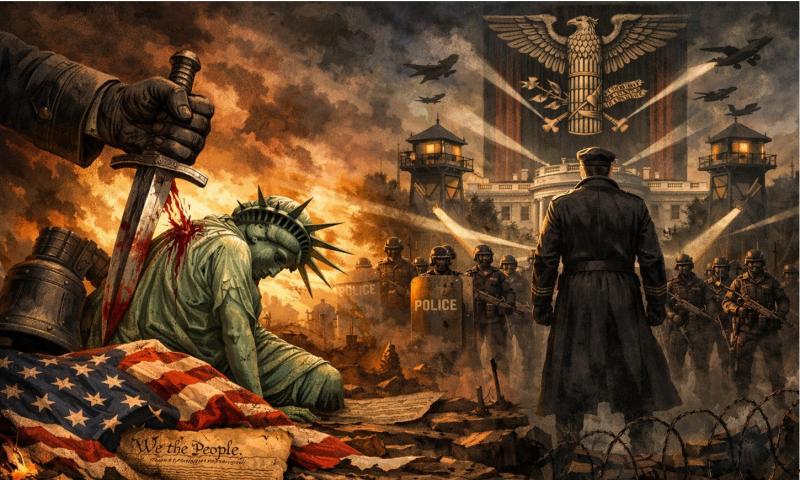
Either way, the Iran war will not be a war driven by legitimate national security concerns, but rather a war of choice driven by US domestic political considerations—in short, an illegal war of aggression that will make the 2003 invasion and occupation of Iraq pale in comparison. It will be the ultimate manifestation of the failure of the American people to elect responsible leadership, and the American Constitutional Republic to hold irresponsible executive power accountable to the rule of law.
It will be the death knell of the American democratic experiment, the final metamorphosis away from the vision the founding fathers had some 250 years ago of a land where freedom reigned supreme, and into the very type of tyrannical Empire the American people fought to liberate themselves from at the birth of their nation.
The American dream of a Constitutional Republic has survived nearly 238 years.
May any American Empire fail long before that.
Pray we find a way to keep the dream alive.
And that will only be possible if we find a way to stop the insane rush to war with Iran.
«War on Iran»