


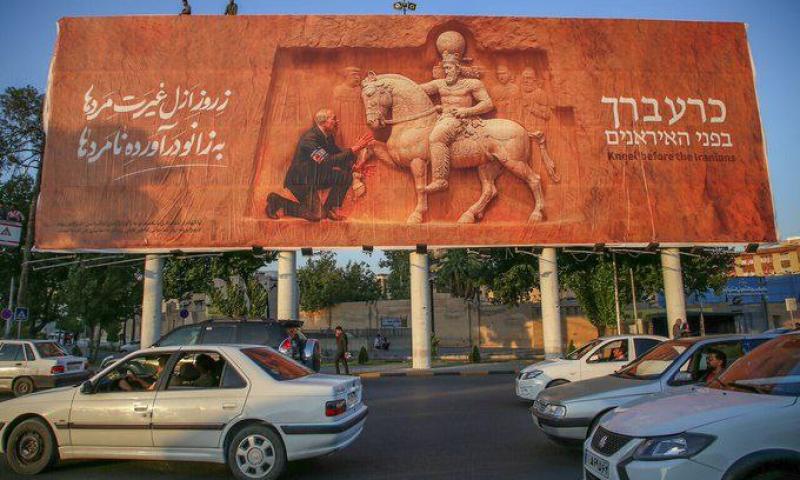
Why has Iran already won the war?


“God created war so that Americans would learn geography.” Mark Twain
Since the conflict began on Saturday, February 28, analysts such as Alastair Crooke, Larry C. Johnson, Douglas Macgregor, John Mearsheimer, Scott Ritter or Lawrence Wilkerson have already carefully characterized the stakes and issues at play in the ongoing war. The United States cannot win it, Iran cannot lose it; but the consequences of the conflict will make all countries in the region losers, not to mention the global economy, which will suffer to varying degrees from tensions in the Persian Gulf and beyond. Much has been said about the folly of this war, based on an almost unbelievable ignorance of Iran: the absence of clear objectives, an unplanned and lawless aggression, a worrying state of military unpreparedness, and a headlong rush with no way out. The lies that justified the attack on Iran, falsely accused of posing an imminent danger and being on the verge of acquiring nuclear weapons, are reminiscent of those that, in 2003, motivated the US invasion of Iraq, plunging the region into instability that has never ceased. The difference, however, is notable: Iran is not Iraq, and the contrast between the reality of war and the rhetorical sleight of hand of President Donald Trump and his entourage reaches a degree of schizophrenia unprecedented in recent history. More broadly, this conflict is a remarkable revelation of a global crisis in diplomacy, of a fractured international order, and of a dysfunctional or toxic media system.
For anyone familiar with Iran, this war is the result of decades of misinterpretation and ignorance of the Iranian situation. The 12-day war (June 13-24, 2025) had already shown that Israel's defeat, forced to request a ceasefire, was less due to military capabilities than to a lack of knowledge about Iran, its socio-cultural conditions, and its military power. One might have thought that the lessons of this war, which I experienced firsthand in Tehran, would be learned. This was not the case. The media and even “experts” still relay a constellation of prejudices, heard for decades, which any serious Iranologist can easily refute or correct: “Iran is weakened”, “the mullahs' regime is on its last legs”, “the Islamic Republic no longer has any legitimacy”, “Iranian society wants a free and secular country”.
In a context where Western actors in the conflict generally display an alarming lack of historical knowledge, the purpose of this article is to highlight the essential elements for understanding Iran.
The “mullah regime” and other prejudices
Firstly, Iranians are not Arabs. They are originally Indo-Europeans, like Western peoples, meaning that modern Iranians are closer to Westerners than they are to Arabs or Turks. The Indo-Europeans who were the ancestors of the Iranian peoples (Medes, Persians) arrived on the Iranian Plateau between the end of the 2nd millennium and the beginning of the 1st millennium BCE. From the Achaemenid Empire founded by Cyrus in the 6th century BCE, Iranians became the dominant culture in a Middle East that has always been a mosaic of peoples, religions, and cultures.
The product of a thousand years of history, contemporary Iran is animated by a triple identity:
Iranian, first and foremost, dating back to antiquity and fueling modern nationalism ;
Muslim since the 7th century, Shiite Muslim since the 16th century;
Western, especially since the 19th century, when European influence became increasingly strong.
This cultural complexity is reflected at all levels. Beyond the national unity established by the Pahlavi dynasty (1925–1979), Iran is a fundamentally multi-ethnic and multicultural country. While Persians make up about half of the population, the other half is composed of various Turkish or Turkic-speaking groups, Arabs, and peoples distantly related to Iranians, such as Kurds and Baluchis. Iran uses three calendars (Iranian, Muslim, and Western). Everyday culture blends Iranian traditions, Muslim values, and Western cultural elements. Even the Islamic Republic is a hybrid system: it is at once a Western-style nation-state and democracy, a republic that is the heir to the Constitutionalist Revolution of 1906, an imperial power rooted in a thousand-year-old tradition of governance, and a system of religious guidance (imamocracy rather than theocracy) with ancient roots.
Since the 16th century, Iranians have been mostly Shiites, but Iranian Islam is complex in its history and diverse in its lived experience. Muslim practices are at the crossroads of Shiism, mystical and Sufi movements, whose ideas have spread for centuries in Persian poetry (Nezami, Attar, Rumi, Sa'di, Hafez, Jami), militant and ideological Islam promoted by the state, and interactions between religion and culture that vary according to region and ethnicity. Contrary to secularizing and projective prejudices, the presence of religion in political life is a centuries-old, even millennial tradition, to the point that it constitutes an Iranian political archetype: in this respect, the Islamic Revolution of 1979 merely formalized an ancient structural principle within a modern political architecture.
However, reducing the Islamic Republic to a “mullah regime” is a mistake, because although clerics are found at various levels of power, the policies pursued are mainly linked to an imperial tradition. Since the Achaemenid Empire (6th century BCE), Iran has been the regional power and has built itself politically over centuries based on an imperial political, legislative, and administrative structure. Even after the arrival of Islam in the 7th century, it was Iranian viziers who, alongside the Abbasid caliphs or Turkish sultans, administered the empires or kingdoms. This resulted in traditions of governance that were partially Islamized after the revolution, but which in reality are rooted in a pre-modern or even pre-Islamic mode of governance, strategic approach, and identity horizon. In many respects, the politics of the Islamic Republic are less influenced by religion than in Israel, where ultra-Orthodox Jews justify colonial ambitions through historical myths and messianism, or in the United States, whose current pro-Israel policy is permeated by the Zionist messianism of evangelicals.
Iran also has centuries-old military traditions, underpinned by religious values (the martyrdom of Imam Hossein in Karbala) and heroic values (the epic tale of the Book of Kings by the poet Ferdowsi). Created in 1979 to protect the newly created Islamic Republic, the Revolutionary Guards have acquired multidimensional expertise over the decades in matters of revolution and counter-revolution, conventional warfare and asymmetric warfare.
Iran during the Islamic period was the central culture of the Middle East, extending its influence as far as Central Asia and northern India. It is therefore hardly surprising that, of all the countries in the region apart from Türkiye, Iran has the richest and most diverse cultural heritage, which is still alive and influential today. A source of identity tensions and political crises, the country's strong hybridity is also its strength and one of the reasons for its cultural supremacy in the region. Because of Iran's cultural complexity, Iranian society is as culturally diverse as it is politically divided. This was the case during the Islamic Revolution in 1979, and it is still the case today. While many mourn the death of the Supreme Leader, others blame him for Iran's political stagnation in recent years, cultural censorship, and geopolitical choices that have kept the country internationally marginalized.
There is also a gap between the elites and the population, which has multiple causes. Historically, there has always been a certain distance between the rulers (royal for millennia) and a strongly family-oriented, corporatist, or tribal society. Like any modern state, Iran also experiences a relative divide between the people and the elites, even though the Islamic Republic, unlike the Pahlavi monarchy, which had enshrined the solitary power of a single man, has succeeded in better integrating the population into the political process and nation building.
Nationalism, however, is the force that unites Iranians across all divisions. This was the case during the Iran-Iraq War (1980-1988), when Iranians united, despite socio-political divisions that could have led to civil war, to defend their country against foreign aggression. Today, Iranians are similarly presenting a united front against an imposed war. Nationalism, religious motivations, imperial strength, and the ideal of resistance: faced with this mental infrastructure, which is as important as ballistic missiles, Israel and the United States have already lost the war and may never be able to win the peace.
Why the idea of a “regime change” makes no sense
Experts from all sides have already pointed out that, apart from the illegitimacy of the Israeli-American aggression, bombing has never brought about regime change. Worse still, in the case of Iran, the petty and irresponsible assassination of Ayatollah Khamenei will only reinforce anti-American nationalism throughout the country, the sovereignist and anti-Western determination at the heart of the Iranian system, and fuel Shiite and, more broadly, Muslim anger against the West throughout the Islamic world.
It should also be noted that killing a man, even if he is the Supreme Leader, does not kill a system, let alone a political Idea; that Ali Khamenei, who died at the age of 86, had been raising the issue of his succession for more than ten years and that a power vacuum was in fact inconceivable; that the Supreme Leader is not isolated, but surrounded by a galaxy of allegiances and figures, both apparent and hidden, who constitute a deep and far-reaching apparatus; that the assassination of Ali Khamenei has made him a martyr and an icon, so that his death has made him even more powerful than his living presence. How, moreover, can we imagine for a single second that deadly and destructive bombings could bring about an Iranian government that is not hostile to lawless and ruthless aggressors? And how could anyone imagine that a population of over 90 million would collaborate with a regime imposed from abroad after a war whose first act was the massacre of schoolgirls?
Iran's political organization is both a vertical organizational chart and a mandala. The republican system, with its hierarchy of parliament, ministers, and president, is overseen by the Supreme Leader, a religious authority who is also the visible face of the deep state, the essential and central axis of power. The latter truly represents Iran's imperial-religious tradition, which dates back to ancient times for political and administrative practices, and to the Safavid era (16th century) for the current association between vertical power and a clergy that is both hierarchical and polycentric.
A priori, and in retrospect, the Pahlavis appear to have been a modernizing and secular interlude in contemporary history. The Islamic Revolution has been interpreted as a fundamentalist return to Islam, whereas it is above all a rebalancing of the Pahlavi policy, which was uniformly and unilaterally pro-Western and Iranophilic. Just as the Pahlavis were unable to completely Westernize Iran, the Islamic Republic has been unable to completely Islamize the country. Moreover, under the Islamic Republic, the Westernization initiated by the Pahlavis has continued in a thousand ways, often indirectly, despite Islamization policies and in defiance of revolutionary intentions. Paradoxically, perhaps, for those who operate solely with dualistic historical models, Iran under the Islamic Republic is more truly modern than it was during the Pahlavi era, when superficial Americanization gave a pseudo-modernist veneer to a largely archaic dictatorial regime.
For more than 20 years, nationalism, which was banned during the Revolution because it contradicted the transnational ideal of the ummah (the Muslim community), has become the cement that binds Iranians together. Even the Islamic Revolutionary Guard Corps have been presented for years, not as a praetorian army defending a revolutionary ideology or ideal, but as the national force protecting the Iranian nation. Although this nationalism is historically recent and European-inspired, it actually has ancient origins: it is Iranian identity, based on a territory that Iranians have dominated politically and culturally since the 6th century BCE.
The Islamic Revolution can be seen as a break with the past, but in reality it extended the Pahlavi era in many ways, while drawing on a centuries-old political identity—imperial and religious. The Islamic Republic continued the development of industries, infrastructure, schools, and universities initiated by the Pahlavis. Although Iran has incorporated a Muslim agenda into certain positions and strategic orientations, in practice its policy is more imperial than ideological, more nationalist than pan-Islamic, and more pragmatic than ideological. After the Islamic Revolution, politics was dominated for about 10-15 years by religious and revolutionary ideals, but today, the Islamic Republic is essentially positioned on a nationalist-imperialist axis, which was the main characteristic of the Pahlavi period and which in fact constitutes the essential continuity of an Iranian presence since ancient times.
This is what makes the idea of regime change problematic. Do we want to change the leaders? They will be replaced according to the arrangements provided for in the political system (elections or appointments). Do we want to change the system itself? We can undoubtedly modify certain provisions in the organizational chart or certain mechanisms in the political system, but we cannot touch the deep state, the fundamental structure of Iranian power, rooted in history. Do we want more democracy in Iran? There is no need to imagine the return of a king or opponents who, in order to control a vast and heterogeneous country, would undoubtedly be just as authoritarian as previous governments. Would it not be more appropriate, and more in line with social developments and debates in Iran itself, to consider strengthening the republicanism of the Islamic Republic, removing the political influence of unelected institutions and redefining the prerogatives of the Supreme Leader in a more moral than political sense? Do we want a more liberal society, less subject to public censorship? Since the era of reformist President Khatami, and with the emergence of new generations, thanks to the internet, following the “Woman, Life, Freedom” movement (2022), a liberalization—often half-hearted and discontinuous, but real nonetheless—has been taking place in Iran, although it is now compromised by the security measures put in place as a result of the war and its aftermath.
Let there be no mistake, however: for a long time to come, Iran will undoubtedly have a political system that is imperative and strongly hierarchical, because this mode of governance has its roots in the patriarchal structure of Iranian families, in the traditionalist mosaic of the country, and in the principle of religious or mystical guidance. Authoritarian tendencies are widespread across the political spectrum, from reformers to conservatives, who have been eager to impose nationalist, populist, developmentalist, or Islamist programs from the top down.
Furthermore, to those who consider Western-style liberal democracy to be the ultimate ideal and the “end of history,” it should be remembered that liberals in Iran are a minority, and always have been, and that liberal discourse is mainly characteristic of an Iranian diaspora that is too Westernized to understand a country it often knows very little about and which is not limited to the chic neighborhoods of northern Tehran. For many Iranians, who may well be critical of the Islamic Republic, what matters most is not necessarily or always our Western conception of freedom and our emphasis on liberalism, but rather traditional, cultural, religious, and identity-based values. Moreover, freedom in the West is relative, and Westerners, fed by mainstream media and commercial algorithms, do not even realize how conditional their freedom is and how formatted their view of things may be. The Islamic Republic's longevity stems from a combination of social transformation and cultural restoration: it has enabled the social advancement of individuals and social groups who were excluded or marginalized during the Pahlavi era and who now form the political, administrative, and intellectual backbone of the country; it has also defended values with which social groups that did not identify with the Pahlavis' selective Westernization and modernism can better identify.
As for Reza Pahlavi, heir apparent to the throne, he has no political influence, no networks in Iran, and no expertise. Some have suggested a scenario inspired by King Juan Carlos in Spain or Ayatollah Khomeini in 1979. In both cases, the comparison is irrelevant. Juan Carlos ensured a democratic transition in Spain because Franco had died and the question of the political future was open. In Iran, everyone is alive and well. Supreme Leader Ali Khamenei has been killed, but a council will temporarily replace him until the Assembly of Experts appoints a successor. If the president dies, the vice president will replace him until a new one is elected by popular vote.
Khomeini was able to seize power in 1979 thanks to a network of clerics in Iran, a political project defined as early as 1970, and a charisma that contrasted with the nepotistic wheeling and dealing of the Pahlavi court. Reza Pahlavi left Iran 47 years ago, so he and his entourage literally do not know their country. Even more importantly, in the eyes of many Iranians, Reza Pahlavi is associated with US imperialism, which seeks to subjugate Iran and reduce it to a satellite of Israeli-American interests. Collaboration with foreign powers is, in a way, part of the Pahlavi family's destiny: Reza Shah came to power thanks to the British; he was deposed in 1941 by the Allies, who placed his son Mohammad-Reza on the throne; the latter owed his return to power, after the coup against Mossadegh in 1953, to the United States and the British. Unlike his grandfather and father, who judiciously committed Iran to necessary industrial modernization, Reza Pahlavi called for war on his “fellow citizens” to satisfy an Israeli-American ambition of which he is merely a pawn.
Finally, we cannot fail to mention the cultural divide between Iranians in Iran and Iranians in the diaspora. There is some interaction between the two sides, but their different trajectories mean that they speak the same idiom but not (necessarily) the same language. It would be thus a dangerous illusion to imagine that Iranians in Iran, who have suffered for decades, would welcome with open arms a diaspora that, in the wake of a puppet government imposed from abroad, would take their jobs and positions and impose a political and cultural reorientation on them.
The success of the Islamic Revolution, which can be measured by the hostility of the United States toward Iran for more than four decades, is that it created a country armed against foreign interference. Admittedly, the Islamic Republic has paid a high price for this: internally, through often paralyzing ideological and political tensions between isolationists, who want to restrict diplomatic relations as much as possible and limit them to economic or scientific exchanges, and realists, who want to normalize international relations with the West; externally, through Israeli-American pressure, which intends, by hook or by crook, to bring Iran back to a state of (geo)political vassalage.
The Greater Game
The Great Game was the Anglo-Russian rivalry in Central Asia. The current situation calls for a broader perspective, encompassing Eurasia and Asia. To understand this, we must go back to the 16th century. The Spanish and Portuguese inaugurated the creation of European colonial empires, with the Portuguese arriving in the Persian Gulf in 1507. The following century saw the English, French, and Dutch carve out their own colonial empires, with the English driving the Portuguese out of the Persian Gulf in the early 17th century. Persia (Iran) gradually became a crossroads of foreign interference, mainly British and Russian, which intensified in the 19th century. In 1907, the British and Russians even divided their influence over Iran between them, the former claiming the south and the latter the north.
It was under the Westernized rule of the Pahlavis that Iran gained sovereignty, albeit relative: the British retained considerable influence until World War II, then the Americans interfered extensively in the administration and even the politics of Mohammad Reza Pahlavi until 1979. The overthrow of Prime Minister Mossadegh in 1953 by the CIA remains, for Iranians, a symbol of the United States' confiscatory control over Iran. The anti-Western sentiment of the Islamic Revolution was thus intended to free Iran from the political, economic and even cultural interference of Western powers since at least the beginning of the 19th century. This sovereignist axis is at the heart of the Iranian system and the basis for its protectionist and independence-seeking policies: governments may change, but this structural determinant remains.
The Western demonization of Iran since 1979 can therefore also be seen as the continuation of an imperialist policy and vision which, unable to influence Iran as before, seeks to control the narrative (Iran as a negative force) and justify measures (sanctions, pressure, subversion operations, now war) designed to contain it. Therefore, the desire to control Iran's nuclear program, which dates back to Mohammad-Reza Pahlavi, can also be understood as the continuation of a centuries-old imperialist policy in the region, which has created an inherently distorted diplomatic game. In this sense, Iran's nuclear program is only a pretext: the elements of negotiation and the rules of the game are biased, and European diplomats are either blinded by their Westernism and ignorance of history, or complicit in or exploited by Israeli-American manipulations. Iran's sensitivity to the Palestinian question, which Western countries want to reduce to ideology because of their bias, is part of Iran's acute awareness of Western imperialism, from which it has suffered for more than two centuries.
On the other hand, since the 1st century BCE, Iran has been a major link in what has been called the “Silk Roads”, land connections between the Mediterranean and the Far East. Geographically, it remains an essential link in the new Chinese Silk Roads launched in 2013. In a globalized world, Iran is once again the target of US neo-imperialism, which is reviving a five-century-old Western imperialist agenda and aims to achieve at least six key objectives:
Control the Middle East by destabilizing and weakening the central piece of the regional geopolitical puzzle, since Iran, heir to an empire, is the only safe and stable country in the region;
Preserve financial interests in the United Arab Emirates and Saudi Arabia, which are subject to the United States, by weakening the only country—Iran—that could be a decisive rival and hold supremacy that marginalizes all the countries and economies of the Persian Gulf;
Break the east-west (Mediterranean-Asia) and north-south (Russia-Iran-India) connections by striking the country—Iran—that constitutes their crossroads and fundamental link;
Attack Chinese interests by striking an essential oil supplier and a crucial link in China's new routes;
Counter Russian influence by weakening a partner that has become crucial in the emerging new geopolitical order driven by the BRICS countrie
Controlling the resources of a country immensely rich in oil (3rd largest proven reserves in the world) and gas (2nd largest proven reserves in the world).
What ancient history teaches us for the present day is that Iran is the secular regional power in the area and it will continue to be. When Islam arrived in the 7th century, the Iranian plateau had been Iranianized by more than a millennium of Iranian empires (Achaemenids, Parthians, Sasanians). In the Islamized East, even though the rulers were mainly Arab or Turkish, Iranian culture established itself as the central, referential, and influential culture. The Islamic Revolution gave the impression of a turbulent or fragile country, but this may be an optical illusion: the revolution changed the forms of power without altering the political archetypes, the secular practices of power, or the essential axes of identity. The political and religious structure of Iranian power is modern in form but ancient in substance: since ancient times, royal power has been backed by religious authority. The secularized reign of the Pahlavis is a relative exception, as Mohammad-Reza Pahlavi had a mystical sensibility common to many Iranian rulers.
Consequently, Iran, the axial civilization of the Middle East, will not collapse. First, it is too big to fall. Second, it is structured with a fundamental core-identity: regardless of changes in political organization or palace revolutions, this identity remains a decisive axis that constitutes a millennial continuity and guarantees the permanence of Iranian traditions (spirituality, practices of power, family, traditional transmission, etc.). Finally, Iran has been the master of its region for 2,600 years. The only country that can rival it is Türkiye, heir to an empire (the Ottoman Empire), but one that is less ancient. The Turks settled in Asia Minor from the 11th century AD, while the Indo-Europeans arrived on the Iranian plateau as early as the 2nd millennium BC. If one had to bet on the future of a country, it would undoubtedly be the one with the oldest roots and the strongest cultural heritage. With the exception of Türkiye, all the other countries in the region are recent constructs and are characterized by chronic instability or structural weaknesses.
Why the West doesn't understand Iran
Anyone familiar with Iran is struck by the inappropriate, sterile, or unintelligent nature of Western diplomacy toward Iran. Admittedly, the Islamic Revolution has generated mistrust, misunderstandings, and even systemic animosity between Iran, European countries, the United States, and Israel. Forty-seven years after this revolution, while Iranian society and even certain political aspects of the Islamic Republic have changed profoundly, Westerners still view Iran through a series of prejudices that are, at best, inadequate and, at worst, delusional. Apart from the era of reformist President Khatami (1997-2005), the only notable exception was the period from 2015 to 2017, when the signing of the JCPOA offered the prospect of lucrative investments in Iran. The European media then temporarily abandoned their demonization or caricatured portrayal of Iran in favor of promoting the country, its culture, and its potential, in order to pave the way for economic rapprochement.
The Iranian case is exemplary for understanding how the media constructs a reality disconnected from the real world, but also for studying the epistemological limits of academic studies and diplomatic analyses. Indeed, studies that are capable of considering Iran in all its diversity and offering a balanced, multilateral, and dispassionate view are extremely rare. A country as complex as Iran requires a multidisciplinary and “holistic” vision, yet the analyses produced by think tanks, diplomatic circles, and even universities are variously marked by unilateralism, corporatism, compartmentalization of specialties, or ideology.
Broadly speaking, the Western view of Iran is dominated by three levels of preconceived ideas:
Orientalist prejudices, well described by Edward Said for the Arab world, and largely relevant to Iran, which have entered the popular and media subconscious, painting a contemptuous picture of Eastern peoples as irrational, deceitful, cruel, belligerent, lazy, and outside of history;
Islamophobia, which has its roots in the Middle Ages and sees Islam as a religious, cultural, and military threat, always seeking to conquer the world and bring about the “great replacement” of Christians by Muslims;
Iranophobia, sparked by the Islamic Revolution and fueled ever since by opponents of the Islamic Republic (royalists, mujahideen, etc.), Israeli lobbies, and American politicians still scarred by the hostage crisis at the US embassy (November 4, 1979 - January 20, 1981).
To these three sets of prejudices must be added a neocolonialist or neoimperialist paradigm which, completely ignoring the history of decolonization in the 20th century, considers that, in the global order, Western or Westernized countries are the norm of civilization and the arbiters of good and evil. Countries that do not share this paradigm are devalued in terms of legitimacy, their sovereignty is minimized, and they are denied a full voice and status. This asymmetry has been blatantly evident in negotiations between Iran and Western countries since the 2010s. Donald Trump withdrew from the 2015 agreement (JCPOA), then the Europeans failed to comply with the agreement after claiming they wanted to maintain it, and finally, Iran was attacked militarily in 2025 and 2026: yet it is Iran that is systematically accused of betraying commitments, refusing to negotiate, and acting as a destabilizing agent.
The data accumulated on a country is merely a skeleton that must be fleshed out with practical and ongoing knowledge of the field. No matter how extensive it may be, information is useless without the right tools to interpret it. There is no point in knowing Persian if you do not understand what is being said and implied. Unfortunately, there are very few specialists on Iran currently present in Iran, or who have lived, direct, prolonged, and diverse experience there. These specialists are also rarely listened to, or are even excluded from the mainstream media, insofar as they disturb politicians and lobbies who are more interested in their fantasies than in reality. Studies and reports on Iran are most often written by people who do not know the country directly or who have a purely theoretical or outdated view of it, or by Westernized Iranians who adopt a “neo-Orientalist” view of their country and culture.
The Iranian diaspora readily presents us with clichés of a “dictatorial mullah regime.” However, sociologically speaking, this diaspora is made up of royalists, opponents, refugees, and economic immigrants who, often and for various reasons, take a critical stance toward a country they actually know only partially, of which they form an idealized and sometimes unrealistic representation, and which they readily judge based solely on their own, inevitably personal, experience. In the media and popular culture, there are also works that are constantly cited, such as Azar Nafisi's Reading Lolita in Tehran (2003) or Marjan Satrapi's graphic novels Persepolis (2000-2003), but which talk about Iran in the 1980s or early 1990s, as if Iran had not changed in thirty years.
The result is a country that everyone talks about but no one outside Iran really knows. The consequences of such ignorance are extremely serious, and Iran's victory in the 12-day war is also a defeat for Israeli-American intelligence, and more broadly for cultural knowledge of Iran. Four sets of fundamental errors ultimately forced Israel to call for an end to the conflict:
Military: underestimation of Iran's power and organizational strength, revealing a Western arrogance that disparages or minimizes the abilities of others;
Strategic: the Iranians did not hesitate to retaliate, forcefully and with a remarkably well thought-out and informed strategic approach, which also revealed an “Orientalist” contempt that underestimates the adversary;
Political: the Iranian state did not collapse, contrary to predictions that ignored Iran's deep-rooted structures;
Cultural: the Iranians stood together against the enemy, instead of revolting against their government, demonstrating a lack of understanding of the psychocultural mechanisms at work in the country.
The current war, as we have said, reveals exactly the same mistakes, and one wonders whether history and experience are not like a lantern hanging behind our backs: they only illuminate what we forget, not the reality before us. The same misunderstanding underlies the embargo against Iran, a veritable economic war that has been waged for 47 years.
Since the Islamic Revolution, Iran has been subject to sanctions that have become increasingly severe and widespread over the decades. While the Iranian economy is suffering and has been steadily deteriorating, especially over the past two decades, the embargo has not brought down or even shaken the Iranian state. It is true that embargoes are essentially a matter of political communication and marketing and often have little to do with diplomatic efficiency or real knowledge of the situation. They serve to satisfy public opinion or lobby groups, but have the flaw of not being accompanied by any efficient or competent policy.
The embargo against Iran is above all a ballet of hypocrisy and a display of cynicism. The United States, through front companies, has granted itself exemptions, while prohibiting other countries (European or Asian) from trading with Iran. The harmful effect of the embargo, moreover, is to affect the population, not a government or elites who have continuous access to oil, gas, or customs resources. It also creates a form of perverse solidarity between isolationists within the Iranian state, who want to cut off all relations with the West, and Western lobbies or politicians who want to isolate Iran on the international stage. It also locks in a self-serving complicity between state and parastatal organizations in Iran, which, thanks to the embargo, control the black market and a hidden economy, and business circles, especially in the US, which discreetly accumulate fortunes through parallel channels and exempt companies that trade with Iran. Finally, the embargo has instilled in Iranians a mentality that forces them to circumvent, lie, or cheat in order to access services that are denied to them, both on an individual and state level. These habits, which have been in place for decades, will be extremely difficult to eradicate in the event of future economic normalization between Iran and Western countries.
Some conclusions (pending the end of the war)
Forty-seven years of pressure, war, and propaganda on Iran by the West has ultimately produced results that are the opposite of what Westerners had hoped and wished for. They reinforced the isolationist and ultra-conservative axis in Iranian governance; militarized Iranian governance at the expense of political diversification; radicalized even the most moderate elements; provoked national unity in a politically divided country; damaged the economy to the detriment of the population and to the benefit of black markets and hidden or mafia-like economic circuits; and alienated from the West the Iranian population, which is generally favorable to Western culture and often Westernized.
Iran has never been given the time to develop in a peaceful environment. By placing Iran in an “Axis of Evil” in 2002, President George W. Bush undermined the policies of reformist President Khatami and strengthened those forces in Iran that want neither normalization nor even diplomatic contacts with the West. Donald Trump's unexplained abandonment of the JCPOA in 2018 ruined President Rouhani's economic policy and forced Iran to turn to China and Russia, further entrenching itself in the geopolitical reconfiguration evidenced by the rise of the BRICS countries. In June 2025 and then in February of this year, Iran was attacked even as negotiations were underway. These attacks, which were juridically illegal, morally treacherous, and militarily cowardly, combined with statements by key Western countries (Germany, France, and the United Kingdom) validating American lies and violations of international law, have long compromised any possibility of dialogue and even any prospect of a solution.
The current war will only strengthen anti-Western sentiment in Iran, harden sovereign nationalism, and definitively confirm the shift towards the East (Russia, China) that began after 2018. It will also push Iranians to consider manufacturing or acquiring nuclear weapons, even though Iran's doctrine of deterrence does not require them: missiles provide a sufficient and adequate response to aggression, but as the example of North Korea shows, nuclear weapons can deter the very idea of aggression.
In 2003, the US invasion of Iraq was motivated by a state lie relayed by complicit media outlets—Saddam Hussein's alleged possession of weapons of mass destruction. The ensuing American quagmire was caused less by a lack of military resources than by a structural inability to understand the history and culture of others and to adapt policy to that understanding. The result was that Iran was able to come out on top, and thanks to American mistakes, it succeeded in reinvesting in virtually every level of the Iraqi establishment. We can deduce that the same will be true of this war: Iran will emerge victorious, driving the Americans out of the Persian Gulf, offering non-aligned countries (the Global South, BRICS) a model of resistance and counter-power to Western neo-imperialism, and imposing a geopolitical rebalancing in the Middle East that will mark the coming decades. There is no doubt that, in certain Iranian circles that have been preparing for this confrontation for a long time, this war is also seen as an opportunity to establish a new geopolitical order in the Middle East. The Israeli-American mistakes appear to be a “providential” instrument for the reaffirmation of imperial Iran and to settle scores with all the players (obvious or hidden) in the region.
If in any conflict the advantage lies in a balance of power and knowledge, we can already see that Western countries have been victims of their military superiority complex as much as their Western-centric approach. Imbued with Israeli-American firepower, they cannot and will not see that it is their world, and their worldview, that is being consumed. This is not only a diplomatic defeat, but also a political, academic, and even epistemological failure. European and Western diplomats have been blinded by an American geostrategic paradigm that is incapable of understanding non-Western societies. Universities study Iran, but their knowledge has clearly had no impact on political decisions, revealing a dangerous gap between expertise and political decision-making. The problem also stems from certain academic circles and research institutes which, between pretentious claims and anecdotal work, are unable to provide a relevant and multidimensional view of Iran, or perceive it only through outdated, inappropriate, or narrow analytical frameworks, or worse still, simply follow partisan agendas and ideological dictates.
We live in paradoxical times. Never before has there been so much talk about intelligence (artificial or otherwise), and never before have we had so much data and information at our fingertips. At the same time, in most Western countries, leaders—political, military—and their advisors and diplomats have never been so dangerously ignorant, unaware, and irresponsible. Rarely, too, has hatred towards a country—Iran—built up by decades of propaganda disguised as information, so clouded judgment and swept the media and politicians into a form of irrationality. The balance of power and an exceptional alignment of planets (the Middle East after October 7, 2023, Donald Trump's follow-the-leader approach to Israeli policy) have made the current events possible. But before that, it would have been preferable for the various actors to have lived up to the moral standards of their positions: to produce a balanced and pluralistic view of Iranian realities in particular and Middle Eastern complexity in general, which forms the basis of any scientific approach; to respect international law, which is in principle the duty of any state participating in a certain world order; prioritizing responsible diplomacy based on comprehensive and relevant knowledge, which is a core requirement of international and intercultural relations.
War, in this case, is not the continuation of politics by other means (Carl von Clausewitz), it is simply the tragic conclusion of human failure. This is what we can learn from Iran's centuries-old culture, and in particular from Ferdowsi's Book of Kings (Shahnameh), the 11th-century Iranian epic: nothing is worse than the dimming of intelligence; knowledge is worthless without wisdom; those who want to live must know how to die; and the world cannot survive without justice.
«Why has Iran already won the war?»