


A Permanent Coup d'État – The Censorship Industry and the Exploitation Model of Digital War Capitalism (Part II)


“The lack of critical thinking among intellectuals” is particularly noteworthy in times of capitalist crisis. Antonio Gramsci wrote: “European intellectuals... no longer represent the cultural self-awareness and self-criticism of the ruling class; they have once again become direct agents of the ruling class...”[1] Their function is, particularly in the face of upheavals in the system of exploitation and problems of legitimacy, to “organize a group’s social hegemony and its state power,” especially “during those moments of crisis in command and leadership when spontaneous consensus breaks down."[2]
The Endemic Crisis of Capitalism
The underlying issue is the endemic crisis of capitalism. By this I mean, first and foremost, the growing lack of investment that has built up over the past few decades and stems from the problem of overaccumulation. There is, so to speak, too much capital. Overaccumulation means that capital owners can no longer find long-term investment opportunities to achieve the desired returns.[3] This leads to a prolonged downturn in the global economy, which, according to Robert Brenner’s analysis, is attributable to the downward trend in the rate of profit in developed industrialized nations. This has been well documented, particularly in the case of the United States and Germany.[4] Investors can counteract the decline in the rate of profit through a number of measures: cutting wages, streamlining production, sourcing cheaper raw materials, components, and inventory, and tapping into new markets. This is why the rate of profit fluctuates widely. However, no structural recovery is evident in terms of long-term trends.[5]
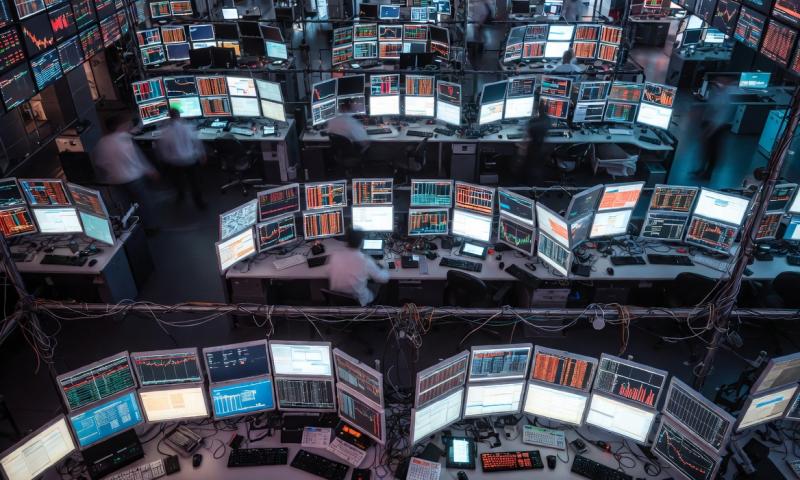
Neoliberalism in the 1980s brought about the internationalization and global deregulation of the financial system. Financial markets were the place where one could still make a quick buck in the face of falling profit rates in industry. Wall Street and the City of London became new centers of economic power because they gained massive leeway relative to nation-states. In the financial markets, value is not extracted through investment in means of production and labor to generate profit from the sale of goods, but rather through investment in financial securities with the expectation of selling them later at a higher price: money is meant to generate more money, without the production of goods. As early as 2016, the volume of transactions on financial markets exceeded the turnover in the goods and services sector by more than a hundredfold. Through the creation of derivatives—that is, derived and bundled securities—stock market bets can be placed on price fluctuations.[6] Financial capitalism emerged because profit rates in the real economy had fallen. Now it has itself become a cause of crisis.
The 2008 financial crisis triggered the most severe global recession since World War II and, shortly thereafter, led to the euro crisis, which remains unresolved to this day. With financial markets having largely collapsed, central banks opened the floodgates and flooded the system with money.
Financial Capitalism and Its Bubbles
During the COVID-19 crisis, the crisis spread to nearly all market segments, including the shadow banking system and the financial system as a whole. Once again, it was the central banks that prevented a liquidity crunch and responded effectively to the crisis. But the crisis itself has not gone away. Rather, the central banks’ monetary injections are creating an illusion of stability in the system: “Today’s global financial system and the capitalism of Western industrialized nations,” says Joscha Wullweber, “can no longer function without the permanent, highly unconventional, extensive, and in some respects very extreme interventions by central banks. If they were to cease these measures, the banking system, the global financial system, and economic systems worldwide would collapse."[7]
The example of Germany: The groundwork for the financialization of the economy was laid in 2002 when the Schröder-Fischer administration exempted capital gains from taxation. This allowed banks to sell their industrial holdings tax-free and invest the proceeds in structured securities. This had two consequences: First, German banks were very quickly swept up in the 2008 financial crisis, a fate they might have been spared in part had this reallocation not taken place. Second, the international financial industry was able to buy into German companies.
The financial crisis marked a turning point at which two crucial structural changes began to take hold in the financial system: a shift from bad loans to government bonds and from banks to the shadow banking system. According to the Bank for International Settlements in Basel, the bailout of banks with taxpayer money has led to a reduction in risks within the banking sector, while at the same time the debt burden of nations has risen to levels never before seen in peacetime. At the same time, fund assets have migrated off bank balance sheets, while they have risen dramatically among hedge funds, investment funds, pension funds, insurance companies, and financial investors. This increases risks, as investments in the shadow banking system are often leveraged using derivative mechanisms to optimally exploit price fluctuations while simultaneously reducing the burden on equity capital. This heightens the risk of procyclical fire sales and can destabilize government refinancing conditions.[8] As a result, Germany’s budget has also fallen into the Babylonian captivity of international financial investors operating within the largely unregulated shadow banking system—investors who are making billions off the war in Ukraine and can pressure any government seeking to break ranks with the warmongers by triggering a sell-off of its bonds.
Second, U.S. financial investors have been able to acquire stakes in German companies. Today, only about one-third of the shares in the 40 DAX-listed companies remain in German hands. Investors from North America, in particular, have increased their stakes to more than 25%. In more than half of the DAX-listed companies, foreign investors hold the majority of shares.[9] Germany is no longer in control of its own affairs; decisions are made elsewhere. The economic foundation has increasingly fallen under the control of U.S. financial investors. This is ultimately the basis for political dependence as well. This explains why the business community has also accepted the devastating sanctions policy without public protest.
These sanctions have backfired. By cutting off energy ties with Russia, the German economy has fallen into a recessionary spiral. Competitiveness is crumbling, deindustrialization is in full swing, companies are closing or relocating their production facilities, and job cuts are underway. This deindustrialization process has now reached the tipping point where it has become irreversible. Since the COVID-19 crisis, more than 341,000 industrial jobs have been lost—that is, one in every 17 jobs—and foreign direct investment reached a 17-year low in 2025.[10]
Digital Capitalism: When the Market Becomes Private Property
The transition to digital capitalism, which is now emerging “from the smoldering ruins of neoliberalism,” is bringing about sweeping changes in the financial markets and the manufacturing sector.
On the financial markets, the use of artificial intelligence is accelerating trading activity, thereby increasing risks. Blockchain technology is giving rise to new trading and speculation platforms that have so far eluded government oversight. However, this does not lead to the demise of capitalism, but rather to the radicalization of its fundamental mechanisms. It accelerates the concentration of capital and the emergence of social inequality.[11] Philipp Staab writes: “Digital capitalism is not only, from a systematic perspective, a machine for producing social inequality, but also, in a broader sense, a new form of social domination.”[12]
In the U.S., there are plans to use dollar-backed stablecoins to create new demand for U.S. Treasury bonds and reduce the risk of a failed debt auction. In fact, stablecoins such as Tether and Circle are now among the top 20 holders of U.S. Treasuries. The GENIUS Act of July 2025 quietly linked stablecoin reserves to the demand for U.S. Treasuries. Under this law, every issuer of stablecoins must back their coins with secure assets. According to the U.S. Department of the Treasury’s definition, these are U.S. Treasury bonds. This means that every dollar flowing into stablecoins is automatically directed into U.S. Treasury bonds. Every crypto investor thus becomes a forced lender to the U.S. government as soon as they use stablecoins. U.S. regulators have full access to the investments, and inflation in the dollar also devalues the digital assets.[13] This new form of control reinforces the dominance of the dollar.
Russia is referring to U.S. plans to address its immense debt burden—approximately $40 trillion as of the end of May 2026[14] - to devalue the dollar via stablecoins. The intention is to replace the debt with dollar-backed stablecoins, decouple the stablecoin from the dollar, and then devalue it massively—which amounts to an attempt to make the world pay off U.S. debt. Such a financial reset would allow the U.S. to reduce its debt burden while maintaining the dollar’s dominance as the reserve currency. It remains unclear whether this is actually feasible.[15]
Moscow is working on its own ruble-backed stablecoin called “A7A5,” which is set to be launched on the Tron blockchain. This is part of a strategy to reduce dependence on U.S. dollar-backed stablecoins such as Tether (USDT), which Russia has used in the past to settle oil transactions with China and India.[16]
In the digitized real economy, value creation and the circulation of goods are also undergoing radical changes. The focus is now on proprietary markets. Their leading companies are Google, Apple, Facebook, and Amazon—all of which are monopolies. “Traditional monopolies operate in markets,” says Philipp Staab, “but the leading players in digital capitalism ARE markets.”[17] The market itself is being privatized.
This is a fundamental difference from neoliberal ideology, which centers on neutral markets: the dominant markets are privately owned. What matters most to them is reach—that is, the size of their user base. To generate reach, services from other business areas are cross-subsidized. Consumers are lured in with ostensibly free offers, but they pay for them behind the scenes by handing over their data: If a product costs nothing, then the user is the product. Unlike traditional monopolies, the market owner’s power—and thus their profit model—manifests itself in four forms of control: first, in information, the central raw material; second, in discretionary access control; third, in the selection of services; and fourth, in price control—specifically, over producers and consumers.[18]
The key commodity in these proprietary markets is user data. Value creation hinges on the collection and aggregation of data. This, in turn, affects both producers and consumers. User data is harvested in both the production and consumption spheres. Users and producers think they are searching the web with Google; but Google is searching them. This enables not only behavioral and performance monitoring, but also predictive behavioral steering through the selection and ranking of search results.
Now that neoliberalism has already largely liberalized and made employment relationships more precarious, new risks and increased workloads are emerging: In manufacturing and sales, digitalization is being used to streamline operations and cut jobs. So while the cascades of data and profits flow upward to the platforms, the “cascades of risk” flow primarily downward.[19] Added to this is massive job loss triggered by the use of artificial intelligence. According to the report “Mercer Global Talent Trends 2026” by the consulting firm Mercer, 63 percent of the executives surveyed see artificial intelligence as an opportunity to automate work processes and increase returns.[20] In extreme cases, competition becomes self-destructive: companies use artificial intelligence to cut back on their workforce; but workers are also consumers, and if the lost income is not replaced, purchasing power erodes—and with it, demand for the products.[21]
The Economy of Resentment
On the consumer side, the internet and social media—Twitter, Facebook, Instagram—enable a quick, immediate response. This makes it easier for emotion to take precedence over a thorough examination and consideration of the issues. Reason-driven reactions and processing take a back seat to speed and emotionalization. Wolf-Dieter Narr observed a long-term shift in behavior years ago.
It consists “in a decline in the individual’s innate mechanisms of reflection and processing”: “Stimuli and expectations generate responses without the individual being capable of processing them, making choices, or offering resistance.” As a result, the criteria and information for control are lost; the individual can only reduce the complexity of the information overload by trusting it. As early as 1979, Narr warned of “the danger of a society of conditioned reflexes […] more precisely: a society of individuals devoid of resistance, drowning in the mire of their irrelevant subjectivity, capable at best of irrational outbursts".[22]
This prediction takes on particular significance in the transition from neoliberalism to digital capitalism. As Wolfgang Engler has pointed out: “In all societies upended by neoliberalism, there is widespread anger.”[23] It is directed against the ruling elites, who have increasingly put wage earners under pressure through cuts to social benefits, privatization, deregulation, and a shift in responsibility for life’s risks from the state to individuals.
If this anger remains bottled up for a long time amid the daily struggle for survival, the emotionalization and manipulation of emotions on social media become an outlet for the release of pent-up frustration. Mainstream media coverage and numerous social media channels engage in this practice of channeling and directing subliminal anger because it generates clicks, circulation, advertising revenue, and ratings.
For the monetization of resentment to work at all, it must stimulate an emotional demand among the audience. Both producers and consumers benefit superficially: the former through click counts, the latter through the satisfaction of their impulses: “Logical arguments,” says Heinz Abels, “are powerless against emotional interests. Even the most perceptive people behave like fools when a required insight encounters emotional resistance.”[24]
This has given rise to a new media monetization model. It is no longer primarily information-based, but rather driven by resentment. At its core, then, this is about monetizing resentment. Or, in short: generating hate as a business model. This monetization of resentment occurs primarily through proprietary platforms. Services like Twitter, where opinion-forming takes place almost exclusively among the chattering classes, drive this process. The brevity of these platforms forces the intensification and compression of emotional arousal curves.
Joseph Vogl precisely identifies the dangers looming in the political economy of resentment: “Thus, the economy of resentment fuels the system of competition; it supplies opinion markets and merges with automatic evaluation mechanisms; it creates limited spheres of experience, multiplies isolated pseudo-communities, and privileges plebiscitary figures of authority, and it transforms the anxiety caused by global markets, transnational interventionist forces, and economic dependencies into tangible formulas of denunciation, which can then apply equally to the border crossings of migrants, European bureaucrats, greedy investors, or conspirators in the financial industry. Criticism fermenting in resentment always takes a ‘police-like’ path; it investigates and suspects, and seeks out supposedly liable and concretely graspable surrogate objects to account for the effectiveness of abstract systemic processes.”[25]
This plays right into the hands of the power elites, who know that the anger they have stirred up must under no circumstances be directed at them. That is why they use propaganda to shift that aggression toward internal enemies—such as alleged conspiracy theorists, right-wingers, or COVID deniers—or external adversaries, for example by stoking anti-Russian sentiment and demonizing Putin.[26] The political economy of resentment fosters the mobilization of fear and the politics of exclusion, which the ruling elites exploit to control society and as a technique of governance. The political economy of resentment fosters the mobilization of fear and the politics of exclusion, which the ruling elites exploit to control society and as a technique of governance.
This political concept includes the populist “us-versus-them” approach and, with it, the promotion of identity-based thinking, which is based on declarations of allegiance rather than on insights:
“Debates on matters of faith,” according to Zygmunt Bauman, “do not aim for consensus, but rather to portray the opposing side as hopelessly deaf and blind to the ‘facts’ and driven by malicious intentions […] Under these circumstances, the recipe for success for populists is to keep the anger constantly simmering."[27] That harmony of hearts then turns into a chorus of hate speech.
Six Transformations of a Dying Capitalism
All in all, we are currently experiencing a multi-crisis, a kind of multiple sclerosis of the capitalist system: a crisis of overaccumulation and finance, a crisis of the nation-state, an educational crisis, a social crisis, a crisis of democracy, and a crisis of legitimacy. “The capitalist system,” according to Andrej Fursow, “is now facing a systemic, final crisis".[28]
Fursow points out that capitalism is an expansive system that spreads out, thereby externalizing crisis and exploitation. To counteract the falling rate of profit, capital appropriates peripheral regions rich in raw materials and cheap labor. With the collapse of the socialist bloc, however, these non-capitalist peripheral zones disappeared. Capitalism now encompasses the entire globe. Consequently, there are no further opportunities for expansion. Now, the intensification of capitalism is on the agenda.[29]
That is why we are stepping up our capital utilization efforts by focusing on four key areas:
First, capital is launching an attack on human health: there is growing evidence that the SARS-CoV-2 virus originated in a laboratory in Wuhan where research on biological weapons was being conducted on behalf of the United States.[30] The vaccination programs poured billions into the coffers of pharmaceutical companies and financial investors and served to acclimate people to the state of emergency. The classification of COVID-19 as a dangerous pandemic was not based on scientific assessment but was politically motivated.[31] The adverse effects of a gene therapy that has not been sufficiently tested are well documented, but have so far had no political consequences.[32]
Second, there is an attack on human reproduction: Andrei Fursov counts population reduction among the elite’s key projects: “It is much easier to control 2 billion people than 7 or 8 billion. The population project is funded by the same entities that have already funded the environmental movement, among other things.”[33] At the 2018 World Economic Forum, Bill Gates highlighted the alleged risks of population growth.[34] The billionaire explained that, in the age of artificial intelligence, most people are no longer needed to perform social functions.[35]
Third, the assault on the human brain: We are currently witnessing a process of de-rationalization and the “destruction of reason.”[36] The destruction of the education system is continuing. “Binge-and-purge” learning—cramming, regurgitating, and forgetting—for multiple-choice exams at universities prevents students from thinking in terms of broader contexts or analyzing issues; instead, it promotes fragmented thinking and reliance on authoritative guidelines.[37] The large number of children and young people from immigrant backgrounds in Europe makes it impossible, under current conditions, to maintain educational standards. The abolition of the GDR’s polytechnic education system following German reunification has made it more difficult to integrate theory and practice, thereby contributing to a decline in educational standards. Emmanuel Todd points out that Russia trains more engineers than the United States, despite having a population less than half the size.[38] In addition, the “economy of emotion,” NATO’s “cognitive warfare,” and the workings of the “censorship complex” are accelerating the shift toward a society of conditioned reflexes: “The hostility of all against all,” as Joseph Vogl puts it, provides “the catalyst for a new pre-war era".[39]
We are experiencing a crisis of transmission, which is also linked to the increasing presence of audiovisual media in everyday life and the decline of the written word. Every medium organizes its information according to specific principles. The written word requires linearity and discursivity. Visual media are characterized by a “breakdown of logocentric narrative structures and novel interweaving of linguistic, visual, and musical elements; that is, the linearity of the written medium is replaced by a ‘non-narrative logic of association’ that—if at all—can only be unravelled psychoanalytically.”[40] The media transformation therefore also entails a reshaping of information.
Writing is synonymous with a truth matrix that defines an era and serves as a guiding principle for human society. Yet its dominance appears to have waned in Western culture, while in other cultures, such as Islamic culture, its significance is actually on the rise. In our culture, writing is now merely one form of media expression among others, no longer the form of expression by which society is guided. For a certain way of thinking and representation, however, writing cannot be circumvented. In the present day, where visual media have become the dominant media in the Western hemisphere, this means that truth is coming to the surface, while the written word appears obsolete.[41] We are witnessing a process of de-illiteracy. But the visual surface is easily manipulated—if not technically reproducible—through the use of digital technology and artificial intelligence. The world of images is a post-factual world. For images have lost their mimetic function, at the very latest through the use of artificial intelligence. “Verifiable facts play no role. We live,“ says Colin Crouch, ”in the post-factual age".[42] This opens the door to historical amnesia and historical distortion.
The fourth sphere is the blood-and-bone mill. The mechanism through which capital is valorized—where the drive for expansion and intensification converge—is war. For crisis-ridden financial capitalism, in which the ratio of capital employed to profit deteriorates and the rate of profit consequently falls, war is a form of bloody bankruptcy postponement. If wars are waged successfully, new resources and minerals such as oil, gas, rare earths, or black soil, as found in Ukraine, can be seized, along with new cheap labor, new markets, and key geostrategic positions. In any case, war is a money-laundering machine in which money is flushed from the pockets of citizens into those of finance capital amid a flood of corpses. Essentially, capital is destroyed, and the process of primitive accumulation can begin anew. In short, it is not about winning wars. From the perspective of capital, it is about wars continuing because they are highly profitable. The politicians of the EU and the U.S. do not want war; they must want war because the house of cards built on financial speculation, corruption, and money laundering is collapsing.
In 2024, the volume of derivatives trading was estimated at more than one quadrillion USD—that is, 1,000 trillion, or a one followed by 15 zeros. If this bubble bursts, it will trigger a wave of bankruptcies that will force the fire sale of liquid assets.[43] To prevent this from happening, new assets—oil and gas reserves, coal and iron ore, minerals of all kinds—must constantly be injected into the system, serving as objects of speculation for future profits and thus as a new foundation for derivatives trading. The Donbas is rich in mineral resources such as coal, iron ore, and important minerals like lithium, manganese, titanium, cobalt, rare earth elements, graphite, and other metals that are crucial for the energy transition. 95% of Ukraine’s energy resources are located in the Donbas.[44] These resources are a major incentive for the war.[45] Shell, Exxon, Halliburton, and Chevron wanted to use fracking technology to extract these resources and export them to the EU.[46]
From the very beginning, the war in Ukraine was about pushing Russia out of the energy market and generating new profits.[47] This was urgently needed, as companies had financed their investments in new extraction technologies through high-interest loans. The investment bank JP Morgan estimated the financial bubble surrounding the fracking industry at approximately $550 billion. Should these high-risk bonds default, there is a risk of a scenario similar to the subprime mortgage crisis at the start of the 2008 financial crisis.[48] This means that it was imperative to generate profits through fracking exports and secure new collateral for loans.[49] That is precisely what the war in Ukraine is about; that is what the 2003 war against Iraq—which violated international law—was about; and that is what the 2026 invasion of Iran will be about: seizing resources, forcing markets to open up, controlling logistics routes, securing new collateral for new loans, and leveraging profits through derivatives trading.
This multi-crisis is giving rise to a series of trends that are transforming capitalism as we know it and hollowing out the structures of the nation-state and parliament. Amid the smoldering ruins of neoliberalism and behind the democratic facades of parliamentarism, a new form of elite rule is emerging, characterized by a radicalization of class division, the dismantling of democracy, and rampant irrationalism: “In ‘liquid modernity,’” writes Zygmunt Bauman, “the sedentary majority is under the rule of the nomadic, extraterritorial elite... In a remarkable reversal of millennia-old tradition, the great and powerful today develop a preference for the fleeting and the transient, while the losers desperately try to keep their junk running."[50]
I identify the following six transformation processes:
1. Deindustrialization and financialization:
Capitalism in European countries and the United States has largely lost its core industrial base. Manufacturing operations have been relocated to Asia, primarily to China, and in the microelectronics sector, also to Korea and Taiwan. The long-term decline in the rate of profit is leading to anti-growth. Economic stagnation is accompanied by a deterioration in living conditions, increasing precariousness, ecological strangulation, and overregulation. The environmental movement was organized by the Rockefeller Foundation and paved the way for deindustrialization.[51] Not a single new green technology is profitable on its own; they are all subsidized, right down to wind turbines and electric cars.[52] Financial capitalism increases systemic risks and fuels inequality. It accelerates the search for new collateral to cover old, bad loans. “Political and military emergencies coincide with economic crises.”[53] The financial elite are pushing for a major European war against Russia because they fear that the credit system will collapse unless they seize Russia’s mineral resources and thereby secure new collateral.
2. Market deregulation and digitalization:
The market, the central mechanism of capitalism, is falling into private hands among the leading companies of digital capitalism. Amazon, Google, Apple, and Facebook ARE the market. They thus exercise de facto control over access, products, prices, and information. Behind the superficial appearance of free offers—which are secretly paid for with the extraction of data—a new form of market power, as well as social domination and control, is taking root in surveillance capitalism.[54] Exploitation is intensifying to benefit the military and tech industries, while small businesses are being crushed. Digital capitalism is a driving force behind exploitation and is at odds with democracy. No sector today is as closely monitored and controlled as the internet. In the words of Palantir founder Peter Thiel: “I no longer believe that freedom and democracy are compatible.”[55] Digitalization enables the authoritarian manipulation of public opinion and behavior, as well as the manipulation of public emotions, in preparation for a new war.
3. De-nationalization and supranationalization:
We are currently witnessing the ossification of democratic institutions and the party system. The ruling party cartel represents the interests of the warmongers and financial capital, not the people. Andrei Fursov writes: "The more democratic the facade of Western society became in the 19th and 20th centuries, the less real power it had. Real power is shifting to closed clubs and supranational structures, etc."[56] - such as the WHO, the European Union,[57] NATO, the Bilderberg Group, and U.S.-controlled and U.S.-funded think tanks such as the National Endowment for Democracy, USAID, the Brookings Institution, the RAND Corporation, the Heritage Foundation, the Atlantik-Brücke, etc. Supranational organizations will play an increasingly significant role in the future. They are stripping the populations of nation-states of their remaining opportunities for participation and oversight and orchestrating the war and repression agenda of an extraterritorial elite. Public affairs are being privatized: A consortium led by BlackRock and JPMorgan aims to mobilize private capital for the reconstruction of Ukraine.[58] An inner circle around U.S. President Trump is said to be planning to turn the devastated Gaza Strip into a comfortable haven for the wealthy.[59]
4. De-democratization and autocratization:
Sanctions and censorship are being used to test a new form of control regime. These sanctions are a precursor to martial law and are apparently intended to accustom the population to a new regime of arbitrary rule, which can then be fully implemented with the declaration of a state of emergency. In this way, transatlantic-corrupted, transnational elites seek to consolidate their power while maintaining the facade of democracy. These elites fear losing control. That is why they are now going all out. Antonio Gramsci writes: “When the ruling class has exhausted its function, the ideological bloc tends toward disintegration, and ‘spontaneity’ is then followed by ‘coercion,’ in increasingly less veiled and indirect forms, up to outright police measures and coups d’état.”[60] This is the permanent coup d’état I mentioned, drawing on François Mitterrand’s remarks. Population control and reduction are intended to secure control and elite rule in the long term. In the long run, a transnational oligopoly will face a vast army of helots.
5. De-rationalization and de-literacy:
The dismantling of the education system, digitalization, and NATO’s cognitive warfare are contributing to the destruction of reason. The Enlightenment’s claim to universality and its focus on rational discourse are being replaced by identitarian thinking, which prioritizes the legitimacy of one’s own group and places this social unit above all others—a shift that leads to racism and its specific manifestation, Russophobia. The infantilization of politics also includes the falsification of history and attempts to reverse blame. Through the use of artificial intelligence, information gathering is confined to the mainstream; unconventional thinking is weeded out, and unwanted information is filtered out. AI thus serves not to unleash intelligence, but to enable administrative control of thought and behavior by the elites. This is leading to a new era of de-literacy, at least in Western cultures. For only stupid, resentment-driven people allow themselves to be driven into new wars.
6. De-civilization, militarization, and a relapse to barbarism:
Once again, the directives are coming from Washington. At the 26th meeting of the Ukraine Contact Group on February 12, 2025, U.S. Secretary of War Pete Hegseth pushed through a new division of labor. The European NATO member states must take a leading role in the war in Ukraine. This includes expanding arms production, preparing the public for higher military spending, and convincing them of the threat posed by Russia.[61] In other words, this order means: The population is to be prepared for war by instilling fear. This signals that Washington intends to militarize society. Once Ukraine has been bled dry, the U.S. proxy war against Russia is apparently set to be expanded to encompass all of Europe.[62] The destruction of civil society and its transformation by state-funded non-governmental organizations—“Government-Organized Non-Governmental Organizations”—is accompanied by the restructuring of social institutions and organizations into conduits for the power elites. Together, they disseminate propaganda narratives designed to shift blame for aggression onto specific social groups or onto external adversaries, in the service of a politics of division. With phrases such as: “The” Russians have a “different relationship” to violence and death[63] or “Russians are animals, pigs,”[64] by banning Russian flags and insignia on commemorative days, Russophobia—as a form of racism—is once again being made acceptable in everyday life and capable of gaining mainstream support. The “economy of affect” and the prevailing identitarian mindset are leading to a civilizational regression into resentment-driven provincialism, base instincts, and a resurgence of barbarism.
Toward a Bio-Fascist Technocracy?
So, from the smoldering ruins of neoliberalism, something new is emerging—something that the term “digital capitalism” may not adequately describe. Perhaps it is a “bio-fascist technocracy,” as Andrei Fursov puts it. New social formations emerge in wars. For with one exception—the Soviet Union—there is no hegemon that has voluntarily and peacefully stepped down. Dying world powers lash out and try to grasp at any straw, clinging to anything that promises to preserve their power and economic substance, and in this way drag their vassals down into the abyss.
The war in Ukraine and the invasion of Iran are two theaters of war in the West’s final battle. We find ourselves in a transitional period between a unipolar and a multipolar world, between dying neoliberal capitalism and a new social order that is still in its infancy.
First and foremost, everything depends on whether the forces striving for a multipolar world can prevail in their conflict with the United States, the hegemon. At present, it does not appear that they can achieve this through peaceful means, nor are there any signs of greater democratization on the horizon.
Second, it is crucial that people in Western countries regain their capacity to act and their autonomy in order to stand up to their warmongering and anti-democratic elites. This would require a popular front for peace and democracy and a two-pronged strategy combining parliamentary and extra-parliamentary initiatives.
At the moment, however, that doesn’t seem to be the case. The majority of people in Germany appear exhausted and resigned, as if by the ongoing state of emergency and the multiple crises. I see no sign of an uprising. The Germans are dozing their way into ruin. In the tragedy of King Lear, William Shakespeare has his character the Earl of Gloucester say: “Such is the curse of the times, when fools lead the blind!” Yet those who do not stand up to the warmongers end up on the front lines.
[1] Gramsci, Antonio: Gefängnishefte Bd. 3, Heft 5, Berlin1992, S. 659f.
[2] Gramsci, Antonio: Gefängnishefte Bd. 3, Heft 5, Berlin1992, S. 515
[3] Harvey, David: The Limits to Capital. London 2006
Harvey, David: The Enigma of Capital - and the Crisis of Capitalism. Oxford 2010
Callinicos, Alex: Bonfire of Illusions. Cambridge 2010
[4] Brenner, Robert: The economics of global turbulance. New Left Review H. I/229, 1998, S. 1-265
Brenner, Robert: Boom & Bubble - Die USA in der Weltwirtschaft. Hamburg 2002
Brenner, Robert: New boom or new bubble? The trajectory of the US economie. New Left Review, II/25, 2004, S. 57-100
[5] Norfield, Tony: Derivates and capitalist markets: The speculation heart of capital. Historical Materialism, H. 20/1, 2012, S. 103-132
[6] Nachtwey, Oliver: Die Abstiegsgesellschaft. Über dasAufbegehren in der regressiven Moderne. Berlin 2016 (3), S. 51-53, 61
[7] Wullweber, Joscha: Zentralbankkapitalismus. Berlin 2021, S. 17f.
[8] „For instance, with broker-dealer balance sheets having smaller heft in the financial system post-GFC, liquidity in sovereign bond markets increasingly relies on open-ended mutual funds, hedge funds and other asset managers. These entities often face signbificant liquidity mismatches, rely on short-term funding backed by government securities as collateral o rare either frequently highly leveraged or exhibit leverage-like behaviour. As a result, their liquidity provision is less stable and more likely to evaporate during periods of market stress. Hedge funds, in particular, have increasingly bevome a significant source of procyclical liquidity, especially in government bond markets. These investors actively pursue relative value trading strategies that seek to exploit small price differences between related financial instruments. To boost the returns on these small price differences they heavily leverage their positions. One method often used is to pledge government securities as collateral in the repo market to borrow more cash with which to purchase additional government securities. This practice has further evolved in recent years, with investors borrowing amounts equal to or higher than the market value oft he collateral provided… Hedge funds‘ relative value strategies are highly vulnerable to adverse shocks in funding, cash or derivate markets, as evidenced by some recent episodes. During the market turmoil of March 2020, for instance, margin calls in Treasury futures markets triggered fire sales, resulting in destabilising delevageraging spirals." Tooze, Adam: Chartbook 401: The dollar system in an age of market-based finance – financial globalization beyond banks, Substack, 25.07.2025, https://substack.com/home/post/p-169614598
[9] DAX-Konzerne überwiegend in ausländischer Hand. Ernst Young, Stuttgart, 31.07.2025, https://www.ey.com/de_de/newsroom/2025/08/ey-wem-gehoert-der-dax-2025
[10] More than 341,000 industrial jobs have been lost in Germany since 2019. Handelsblatt, 25.05.2026, https://www.handelsblatt.com/unternehmen/industrie/studie-seit-2019-mehr-als-341.000-industriejobs-in-deutschland-verschwunden/100227722.html
Stellenabbau in der Industrie hält an - mehr als 340.000 Jobs verschwunden. Die Welt, 25.05.2026, https://www.welt.de/wirtschaft/article6a13ce59350a34b38da83024/stellenabbau-mehr-als-340-000-industriejobs-seit-2019-verschwunden.html
Ausländische Investitionen in Deutschland erneut rückläufig - niedrigster Stand seit 2009. Ernst & Young, 21.05.2026, https://www.ey.com/de_de/newsroom/2026/05/ey-standort-deutschland-2026
[11] “Consolidated proprietary markets, on the other hand, perpetuate the transfer of economic wealth from labor to capital.”Staab, Philipp: Digitaler Kapitalismus. Markt und Herrschaft in der Ökonomie der Unknappheit. Berlin 2020(2), S. 275, 290, 301.
[12] Staab, Philipp: Digitaler Kapitalismus. Markt und Herrschaft in der Ökonomie der Unknappheit. Berlin 2020(2), S. 301.
[13] Der GENIUS Act: Wie Washington Stablecoins in Kriegsanleihen verwandeln will. Kanzlei Mount Bonnell, 17.08.2025, https://uskanzlei.com/blogs/aktuelles/genius-act-usa-stablecoin-schuldenfalle
[14] Stocker, Frank: Amerikas Schulden-Strudel - und die Gefahren für Sparer weltweit. Die Welt, 26.05.2026, https://www.welt.de/wirtschaft/plus6a11854dbe29d4b4607a47ba/geld-amerikas-schulden-strudel-und-die-gefahren-fuer-sparer-weltweit.html
[15] Wshingtons geheimer Krypto-Plan: Was bedeutet der Streit um Stablecoins? 21bitcoin, 09.09.2025, https://21bitcoin.app/news/washingtons-geheimer-krypto-plan-was-bedeutet-der-streit-um-stablecoins
[16] Schleu, Philipp: Washingtons geheimer Krypto-Plan - Putin-Berater warnt vor massiver schuldenentwertung. Der Aktionär, 09.09.2025, https://www.deraktionaer.de/artikel/krypto/washingtons-geheimer-krypto-plan-putin-berater-warnt-vor-massiver-schuldenentwertung-20386135.html
[17] Staab, Philipp: Digitaler Kapitalismus. Markt und Herrschaft in der Ökonomie der Unknappheit. Berlin 2020(2), S. 30
[18] Staab, Philipp: Digitaler Kapitalismus. Markt und Herrschaft in der Ökonomie der Unknappheit. Berlin 2020(2), S. 32
[19] Staab, Philipp: Digitaler Kapitalismus. Markt und Herrschaft in der Ökonomie der Unknappheit. Berlin 2020(2), S. 270
[20] Müller, Bernd: Mercer-Studie: Fast alle CEOs planen Stellenabbau durch KI-Einsatz. Telepolis, 25.05.2026, https://www.telepolis.de/article/Mercer-Studie-Fast-alle-CEOs-planen-Stellenabbau-durch-KI-Einsatz-11305624.html
[21] "Displaced workers are also consumers, and when their lost income is not replaced, each round of layoffs erodes te purchasing power all firms depend on. At the limit, this becomes self-destructive: firms automate theri way to boundless productivity and zero demand... Even if AI-driven layoffs sweep across industries, and even as every firm recognizes that vanishing paychecks mean vanishing customers, not ohne of them will stop. Each firm reaps the full savings of replacing its own workers yet bears only a sliver of the demand it desteoys; the rest lands on rivals. No firm can afford to be the one that holds back. This is the trap: an automation arms race that only intensifies as AI improves, that leaves workers and firm owners alike worse off, and that no market force can break." Falk, Brett Hemenway u. Gerry Tsoukalas: The AI Layoff Trap. The Wharton School Research Paper, Wharton University of Pennsylvania, 02.03.2026, S. 1, 30, https://papers.ssrn.com/sol3/papers.cfm?abstract_id=6448898
[22] Narr, Wolf-Dieter: Hin zu einer Gesellschaft bedingter Reflexe. In: Habermas, Jürgen (Hg.): Stichworte zur Geistigen Situation der Zeit. Frankfurt a. M.: Suhrkamp 1979, Bd. 2, S. 489–528, hier: 491, 523.
[23] Engler, Wolfgang: Die offene Gesellschaft und ihre Grenzen. Berlin: Matthes & Seitz 2021, S. 104
[24] Abels, Heinz: Triebabfuhr. In: Ders.: Wirklichkeit. Über Wissen und andere Definitionen der Wirklichkeit, über uns und andere, Fremde und Vorurteile. Wiesbaden: VS Verlag 2009, S. 257
[25] Vogl, Joseph: Kapital und Ressentiment. Eine kurze Theorie der Gegenwart. München: Beck 2021(2), S. 181f.
[26] Schneider, Michael: Der "böse Russe", die deutsche Geschichtsvergessenheit und die Blindheit der Berliner Außenpolitik. In: tkp – der Blog für Science und Politik v. 1. Dezember 2022. https://tkp.at/2022/12/01/derboese-russe-die-deutsche-geschichtsvergessenheit-und-die-blindheit-derberliner-aussenpolitik/
[27] Bauman, Zygmunt: Retrotopia. Frankfurt a. M. 2018(2), S. 84f., 88
[28] Fursow, Andrej: Die von Stalin gefürchtete Wiedergeburt. Mitte der 1960er Jahre gab die sowjetische Führung die Zukunft auf. 12.09.2024 (Андрей Фурсов: Перерождение, которого опасался Сталин. Советское руководство отказалось от будущего в середине 1960-х годов) https://dzen.ru/a/ZuLEESPl5UPFey63)
[29] Fursow, Andrej: Die gegenwärtige Weltkrise: ihre soziale Natur. Schiller-Institute, 14.04.2013, https://schillerinstitute.com/de/media/andrej-fursow-die-gegenwartige-weltkrise-ihre-soziale-natur/
[30] Wurde in Wuhan im US-Auftrag an Biowaffen geforscht? Transition News, 31.01.2026, https://transition-news.org/wurde-in-wuhan-im-us-auftrag-an-biowaffen-geforscht
Pohlmann, Dirk: Wuhan, Biowaffen und "Das große Abkoppeln". Free21, 14.08.2021, https://free21.org/wuhan-biowaffen-und-das-grosse-abkoppeln/?fbclid
[31] Feistel, Felix u. Dejan Lazic´: Der geheime Staatsstreich: Wie die Corona-Putschisten die Macht übernahmen. ZKP, 09.04.2024, https://tkp.at/2024/04/09/der-geheime-staatsstreich-wie-die-corona-putschisten-die-macht-uebernahmen/
[32] Mayer, Peter F.: Eine Flut von Impfverletzungen werden in Studien dokumentiert. TKP, 10.12.2023, https://tkp.at/2023/12/10/eine-flut-von-impfverletzungen-werden-in-studien-dokumentiert/
[33] Fursow, Andrej: Die gegenwärtige Weltkrise: ihre soziale Natur. Schiller-Institute, 14.04.2013, https://schillerinstitute.com/de/media/andrej-fursow-die-gegenwartige-weltkrise-ihre-soziale-natur/
[34] Bill Gates has a warning about population growth. World Economic Forum, 19.09.2018, https://www.weforum.org/stories/2018/09/africas-rapid-population-growth-puts-poverty-progress-at-risk-says-gates/
[35] Baxter, Dmitry: Bill Gates Declares Most Humans "No Longer Needed" in AI Era - "We'll Decide" Who Survives. The People's Voice, 27.05.2026, https://thepeoplesvoice.tv/bill-gates-humans-no-longer-needed-ai-era-decide-survives/
[36] Lukács, Georg: Die Zerstörung der Vernunft. Bd. 1-3. Darmstadt und Neuwied 1981(3), 1980(2), 1974
[37] Henn, Dagmar: Verlernt zu lernen. Peds Ansichten, 31.05.2026, https://www.kettner-edelmetalle.de/news/brussel-greift-nach-der-krone-wie-der-eugh-die-demokratie-der-nationalstaaten-begrabt-26-05-2026
[38] Todd, Emmanuel: Der Westen im Niedergang. Ökonomie, Kultur und Religion im freien Fall.Neu-Isenburg 2024
Altwegg, Jürg: "In diesem Krierg geht es um Deutschland." Der französische Historiker Emmanuel Todd sagte den Zusammenbruch der Sowjetunion voraus. Heute sieht er dei USA im NIedergang. Die Weltwoche, 07.09.2023, https://weltwoche.ch/daily/in-diesem-krieg-geht-es-um-deutschland-der-franzoesische-historiker-emmanuel-todd-sagte-den-zusammenbruch-der-sowjetunion-voraus-heute-sieht-er-die-usa-im-niedergang-frankreich-werde-au/
[39] Vogl, Joseph: Kapital und Ressentiment. Eine kurze Theorie der Gegenwart. München: Beck 2021(2), S. 182
[40] Schulte-Sasse, Jochen: Von der schriftlichen zur elektronischen Kultur. Über neuere Wechselbeziehungen zwischen Mediengeschichte und Kulturgeschichte. In: Gumbrecht, Hans Ulrich u. Karl Ludwig Pfeiffer (Hg.): Matreialität der Kommunikation. Frankfurt a. M. 1988, S. 429-453, hier: S. 433f.
[41] Wiegerling, Klaus: Medienethik. Stuttgart 1998, S. 24-29
[42] Crouch, Colin: Postdemokratie revisited. Berlin 2021, S. 243
[43] Webb, David Rogers: Die grosse Enteignung. Straßengel 2024
Brown, Ellen: All Wars Are Bankers' Wars: Iran and the Bankers' Endgame. Global Research, 13.04.2026, https://www.globalresearch.ca/all-wars-bankers-wars-iran/5922072?utm_source=substack&utm_medium=email
[44] Ford, Matt: Russia Is Crashing Ukraine's Hopes for Energy Independence. The Atlantic, 08.04.2014, https://www.theatlantic.com/international/archive/2014/04/russia-is-crushing-ukraines-hopes-for-energy-independence/360281/
[45] https://x.com/CarmenDres91754/status/2002420858384744911
[46] Krainer, Alex: All wars are bankers' wars. So was Kiev's 2014 anti-terror operation. Substack, 15.04.2026, https://trendcompass.substack.com/p/all-wars-are-bankers-wars-so-was
[47] Nye, Joseph S. Jr.: A Western Strategy for a Declining Russia. Project Syndicate, 03.09.2014, https://www.project-syndicate.org/commentary/joseph-s--nye-wants-to-deter-russia-without-isolating-it
[48]Ölpreis: Prognose von Morgan Stanley belastet. Boerse.de v. 09.12.2014, https://www.boerse.de/nachrichten/Oelpreis-Prognose-von-Morgan-Stanley-belastet/7522862
Daniljuk, Malte: Neue Energie für Europa. Telepolis, 17.01.2015, https://www.telepolis.de/article/Neue-Energie-fuer-Europa-3369425.html
[49] Ebinger, Charles K.: The Department of nergy's Strategy for Exporting Liquefied Natural Gas. Brookings Institution, 19.03.2013, https://www.brookings.edu/articles/the-department-of-energys-strategy-for-exporting-liquefied-natural-gas/
[50] Bauman, Zygmunt: Flüchtige Moderne. Frankfurt a. M. 2003, S. 21f.
[51] Fursow, Andrej: Die gegenwärtige Weltkrise: ihre soziale Natur. Schiller-Institute, 14.04.2013, https://schillerinstitute.com/de/media/andrej-fursow-die-gegenwartige-weltkrise-ihre-soziale-natur/
[52] Fursow, Andrej: Achten Sie auf ihre Hände. Was hinter der großen Annullierung steckt (Андрей Фурсов: Следите за их руками. Что скрывается за великим обнулением), 22.07.2023, https://dzen.ru/a/ZLtDh0DitEH-Zkig
[53] Agamben, Giorgio: Ausnahmezustand. Frankfurt a. M. 2020(8), S. 23
[54] Zuboff, Shoshana: Das zeitalter des Überwachungs-Kapitalismus. Frankfurt / New York 2018
[55] "Most importantly, I no longer believe that freedom and democracy are compatible." Thiel, Peter: The Education of a Libertarian. Cato Institute, 13.04.2009, https://www.cato-unbound.org/2009/04/13/peter-thiel/education-libertarian/
[56] Fursow, Andrej: Die gegenwärtige Weltkrise: ihre soziale Natur. Schiller-Institute, 14.04.2013, https://schillerinstitute.com/de/media/andrej-fursow-die-gegenwartige-weltkrise-ihre-soziale-natur/
[57] On April 21, 2026, the European Court of Justice issued a ruling in Case C-769/22 granting the European Commission broad authority to use the values enshrined in Article 2 of the EU Treaty—democracy, the rule of law, human dignity, and non-discrimination—as a basis for taking action against member states. Augsburg constitutional law expert Josef Franz Lindner sees the ruling as a fundamental shift in power. The Commission can now initiate infringement proceedings against member states in any policy area as soon as it alleges a violation of the general clauses. This would undermine the participatory rights of the European Parliament and national governments, circumvent unanimity requirements, and effectively devalue the constitutional identity of nation-states enshrined in Article 4 TEU. Economist Richard Werner described the commissioners as “dictators” and stated that democracy in the EU is at an end. S. Brüssel greift nach der Krone: Wie der EuGH die Demokratie der Nationalstaaten begräbt. Kettner Edelmetalle, 26.05.2026, https://www.kettner-edelmetalle.de/news/brussel-greift-nach-der-krone-wie-der-eugh-die-demokratie-der-nationalstaaten-begrabt-26-05-2026
[58] Meiritz, Annett: Blackrock und JP Morgan bereiten Investitionen vor. Handelsblatt, 21.06.2023, https://www.handelsblatt.com/politik/international/ukraine-wiederaufbaukonferenz-blackrock-und-jp-morgan-bereiten-investitionen-vor/29217966.html
[59] Kebir, Sabine: Ein Trump-Tower für Gaza: Wohlhabende Palästinenser dürfen bleiben. Der Freitag, 16.09.2025, https://www.freitag.de/autoren/sabine-kebir/us-plan-the-great-trust-wohlhabende-palaestinenser-duerfen-in-gaza-bleiben
[60] Gramsci, Antonio: Gefägnishefte, H. 1 §44, zit. n. Becker, Lia u.a. (Hg.): Gramsci lesen. Einstiege in die Gefängnishefte. Hamburg 2013, S. 22
[61] "A durable peace for Ukraine must include robust security guarantees to ensure that the war will not begin again. This must not be Minsk 3.0. That said, the United States does not believe that NATO membership for Ukraine is a realistic outcome of a negotiated settlement. Instead, any security guarantee must be backed by capable European and non-European troops. If these troops are deployed as peacekeepers to Ukraine at any point, they shou.d be deployed as part of a non-NATO mission. And they should not covered under Article 5. There also must be robust international oversight of the line of contact. To be clear, as part of any security guarantee, there will not be U.S. troops deployed to Ukraine... Safeguarding European security must be an imperative for European members of NATO. As part of this, Europe must provide the overwhelming share of future lethal and non-lethal aid to Ukraine. Members of this Contact Group must meet the moment. This means: donating more ammunition and equipment; leveraging comparative advantages; expanding your defense industrial base; and importantly, leveling your citizens about the threat facing Europe. Part of this is speaking frankly with your people about how this threat can only be met by spending more on defense... We're also here today and unambiguously express that stark strategic realities preventrthe United States of America from being primarily focused on the security of Europe. The United States faces consequential threats to our homeland. We must -- and we are -- focusing on security of our own borders. We also face a peer competitor in the Communist Chinese with the capability and intent to threaten our homeland and core national interests in the Indo-Pacific. The U.S. is prioritizing deterring war with China in the Pacific, recognizing the reality of scarcity, and making the resourcing tradeoffs to ensure deterrence does not fail... As the United States prioritizes its attention to these threats, European allies must lead from the front. Together, we cam establish a division of labor that maximizes our comparative advantages in Europe and Pacific respectively." Hegseth, Pete: Opening Remarks at the 26th Iteration of the Ukraine Defense Contact Group Meeting, 12.02.2025, https://www.americanrhetoric.com/speeches/petehegsethfirstnatoukrainedefensecontactgroup.htm
[62] Ukraine Is Being Ground Down. Europe Is Being Lined Up Next. Global Geopolitics, 01.06.2026, https://globalgeopolitics.co.uk/2026/06/01/ukraine-is-being-ground-down-europe-is-being-lined-up-next/
Berletic, Brian: Die USA bereiten Europa auf den krieg mit Russland vor. Diesen, Glenn: The Greater Eurasia, 30.04.2026, https://www.youtube.com/watch?v=5nMhGk-4Rqg
[63] Klöckner, Marcus: Entgleisung bei Markus Lanz. Nachdenkseiten, 14.04.2022, https://www.nachdenkseiten.de/?p=82944
[64] Alt, Franz: Friedenspreis für Russen-Hass. Telepolis, 23.10.2022, https://www.telepolis.de/article/Friedenspreis-fuer-Russen-Hass-7317325.html?seite=all
«A Permanent Coup d'État – The Censorship Industry and the Exploitation Model of Digital War Capitalism (Part II)»