


Five Key Takeaways from the US-Israeli War against Iran


In the midst of diplomatic negotiations in Geneva between the United States and Iran, American and Israeli forces launched Operation Epic Fury. One of the first actions of this attack was the assassination of Iran's Supreme Leader Ali Khamenei. For the past week, the world has been overwhelmed by a torrent of information, images, and speculation. Here are five observations that can already be made about this new war in the Middle East.
1. The United States is unable to justify this new war
The Trump administration has failed to produce a credible and coherent narrative to justify this new war against Iran. In 2003, the United States justified its invasion of Iraq by citing the existence of weapons of mass destruction. A carefully orchestrated communications campaign was put in place, based on fabricated evidence. Even though Washington had lied to the whole world, it made sure to present a simple and intelligible justification, repeated tirelessly to rally public opinion, both domestic and international. When going to war, it is crucial to shape public opinion to gain support for the conflict. However, American statements are inconsistent and amateurish. Washington is once again talking about Iran “racing toward the bomb,” even though the same officials assured us that the 12-day war in June 2025 had “obliterated” Iran's nuclear program. On March 25, 2025, Tulsi Gabbard told Congress that, according to US intelligence, Iran was not developing a military nuclear program. These same statements have just been confirmed by the director of the International Atomic Energy Agency, Rafael Grossi. On Monday, March 2, 2026, Secretary of State Marco Rubio explained to reporters that the United States had carried out a preemptive strike because it knew that Israel was preparing to attack Iran and that this action would inevitably trigger an Iranian retaliation against US forces in the region. The next day, Donald Trump publicly contradicted this version: “No. Maybe I forced their hand,” claiming that it was Iran—not Israel—that was preparing to strike first.
2. Without achievable goals, the United States will lose this war
Washington's stated objectives can be summarized in three points: bring about regime change, permanently destroy Iran's nuclear and ballistic capabilities, and sever all ties with the Axis of Resistance (Hamas, Hezbollah, Houthis, and other proxies). However, virtually all military experts agree that these objectives cannot be achieved through air strikes alone. These goals require ground troops, which the US administration has ruled out (for now). In the case of Iraq in 2003, it took more than six months to mobilize some 150,000 to 200,000 troops before launching the invasion of the country. With an area of 1.65 million square kilometers, Iran is much larger, 2.7 times the size of Ukraine. Its nuclear and military infrastructure is widely dispersed, buried, and fortified throughout the country, which is predominantly mountainous.

Even though it has been greatly weakened, the government appears capable of surviving for a long time, and the killing of the Supreme Leader does not seem to have fractured the regime as hoped. On the contrary, his death is likely to unite the population (rally-around-the-flag effect) for the duration of the war. Although vastly inferior from a military standpoint, Tehran is waging an asymmetrical war: swarms of drones, cruise and ballistic missiles, regional militias ready to open multiple fronts, and maritime harassment in the Strait of Hormuz.
3. The longer this drags on, the greater the risk of the conflict spreading globally
Located between Iran and Oman, the Strait of Hormuz is a strategic maritime passage connecting the Persian Gulf to the Gulf of Oman. In some places, its minimum width does not exceed 33 kilometers. It is one of the most critical passageways in the world: approximately 20 to 21 million barrels per day pass through it, representing nearly 20% of global oil consumption, as well as nearly 20% of liquefied natural gas. By disrupting the flow of hydrocarbons through this strait, Iran has the power to choke off the artery through which the global economy's lifeblood flows. A prolonged rise in energy prices would trigger a new wave of inflation, which could lead to higher interest rates and destabilize financial markets. In Europe, gas prices have already surged by 25% to 50% within days, forcing the European Union to call emergency meetings on energy stock management. Brussels is also urging Ukraine to maintain the transit of Russian oil through its infrastructure, notably the Druzhba pipeline, while Vladimir Putin is openly discussing the possibility of suspending what remains of gas exports to the European Union. The longer this conflict with global repercussions continues, the more likely it is that a growing number of players will be encouraged to take part. China, which buys 90% of Iran's exports, will not stand idly by in the face of the loss of a BRICS ally, just a few months after Maduro's removal in Venezuela.
4. The “special relationship” between the United States and Israel is openly debated
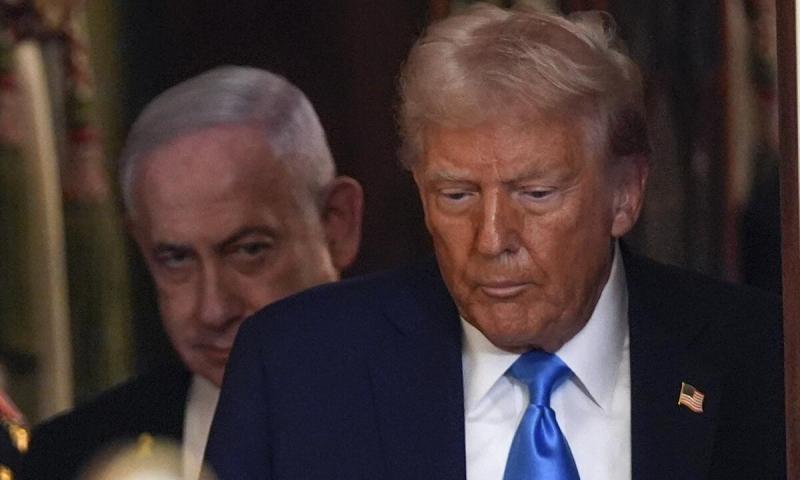
Donald Trump was elected on a promise to end “endless wars,” a position that strongly mobilized his MAGA base, which is largely committed to an isolationist vision of the United States. As Trump betrays his campaign promises and Israel's role in triggering the conflict becomes increasingly clear, many voices are being raised to denounce the Jewish state's influence on US foreign policy. As a reminder, it is Israeli Prime Minister Benjamin Netanyahu who wants a war against Iran and who has been accusing it since 1992 of being on the verge of acquiring nuclear weapons. Under an arrest warrant from the International Criminal Court for the genocide that Israel is perpetrating in Gaza, his stated desire to “liberate the Iranian people from the mullahs' regime” has left many observers stunned. Journalist Tucker Carlson and political scientist John Mearsheimer openly discuss the theory that Israel may have been involved in the death of John F. Kennedy. They both point out that he was the last US president to openly oppose the Jewish state when it was seeking to acquire nuclear weapons illegally. The fact that this theory is now being discussed publicly by influential figures is in itself a sign that certain taboos in American public discourse are crumbling.
5. NATO continues to crack
Spain categorically refuses to allow its military bases to be used for offensive operations against Iran. Madrid denounces the strikes as a violation of international law and calls for de-escalation and a return to diplomacy. Turkey, also a NATO member and neighbor of Iran, has adopted an even more critical stance: it refuses to allow the use of its airspace or territory, describes the strikes as “aggression,” calls for international mediation, and is keen to preserve its relations with Tehran. These positions contrast with the tepid endorsement of the United Kingdom, France, and Germany. Emmanuel Macron, Friedrich Merz, and Keir Starmer condemned the Iranian attacks as “indiscriminate and disproportionate” against countries in the region, while emphasizing that their countries had not participated in the US-Israeli offensive strikes. They affirmed their willingness to “defend their interests and those of their allies,” including through “necessary and proportionate defensive actions” aimed at neutralizing Iran's missile and drone capabilities “at the point of origin.”
This war, launched without a broad coalition or clear justification, exposes US strategic weaknesses and accelerates the shift toward a multipolar world order. Energy and human costs continue to rise, and the fissures within NATO are widening. What happens next will depend on Tehran's ability to resist through asymmetric means—and on Donald Trump's willingness to escalate the conflict or negotiate.
«Five Key Takeaways from the US-Israeli War against Iran»