


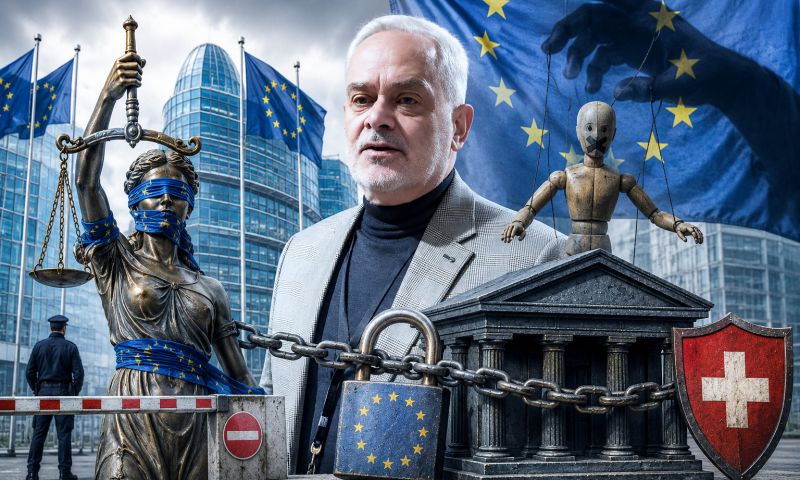
Jacques Baud, censored by the EU in the name of fighting misinformation


During a Kontrafunk broadcast aired on June 5, 2026, four panelists—Professor Michael Geistlinger (Salzburg), attorney Dr. Valentin Landmann (Zurich), Professor Darius Schindler (Karlsruhe), and Swiss politician Claudio Zanetti—analyzed the Jacques Baud case from its legal, institutional, and political dimensions. Their findings point in the same direction: the sanctions imposed by the European Union constitute a serious breach of the principles of the rule of law.
Sanctions Without an Offense
Jacques Baud is a former colonel in the Swiss General Staff and a renowned strategic analyst. He has worked for Swiss intelligence services, various federal authorities, as well as EU and UN organizations. For several years, he has been publishing analyses of the Ukrainian conflict that diverge from the dominant Western narrative—notably in his book Operation Z (Max Milo, 2022) and during various public appearances, including a speech in Winterthur in May 2023.
On December 15, 2025, the European Union placed him on a sanctions list on the grounds that he serves as a spokesperson for pro-Russian propaganda. In practical terms, this means: a complete freeze on his assets, a ban on travel to EU member states, and a prohibition on anyone providing him with economic resources—including a salary or pension.
“At first, his account was even completely frozen,” explains attorney Valentin Landmann, who represents Baud. “He couldn’t even buy a sandwich. He couldn’t withdraw anything. He couldn’t access his pension. ”
What makes this case particularly serious in Landmann’s view is the total lack of a criminal basis: “They don’t even claim that he’s saying anything false. The question is simply whether Jacques Baud goes against the EU’s mainstream. And if he does, sanctions are imposed on him. In Landmann's view, a person can only be sanctioned for statements that fall under criminal law. Yet Baud has committed no offense—‘absolutely nothing, zero.’
A minority position, legally defensible
To understand why Jacques Baud was sanctioned, we must first outline what he says and what he bases it on.
Baud’s thesis: 2014, not 2022
Baud’s starting point is chronological. Contrary to the dominant narrative, which places the start of the war in February 2022, he traces it back to 2014 and the Maidan Revolution. In his view, everything that followed stems from this: the ouster of President Yanukovych under conditions he describes as a constitutional breach, interim President Turchynov’s declaration of an anti-terrorist operation against the populations of eastern Ukraine, and then eight years of bombardment in the Donbas. According to statistics from the International Committee of the Red Cross that he cites, approximately 10,000 civilians were killed during this period; the majority of these deaths are attributed to strikes by Ukrainian government forces. In March 2021, Zelensky’s decree ordering the military recapture of Crimea and the Donbas, followed by an intensification of the bombardments, constitutes, in his view, the direct trigger for the Russian intervention of February 2022.
The legal arguments invoked
Baud structures his thesis around three distinct legal arguments.
The first is the principle of responsibility to protect (R2P), adopted by the UN in 2005. This principle establishes that a state has not only the right, but the obligation to protect a population exposed to mass violence when its own government fails to do so. R2P itself is based on a three-step logic: first, the government in question is responsible for protecting its own population—which Kyiv failed to do by bombing its own Russian-speaking citizens in the Donbas; second, third-party states must provide political support to resolve the conflict—a role that France and Germany refused to play by failing to enforce the Minsk agreements; finally, a neighboring state may intervene when the first two steps have failed—which is what Russia did in February 2022. It is precisely this mechanism that Baud invokes to characterize the Russian intervention as legitimate under international law.
The second argument concerns the legal status of the Donetsk and Luhansk People’s Republics. Baud analyzes them as distinct political entities that seceded in 2014, adopted their own constitutions, and declared their independence—in a situation comparable, in his view, to the Kosovo precedent, which was recognized by many Western states despite a Security Council resolution affirming Serbian sovereignty.
The third argument concerns the bad faith of the Western parties to the Minsk agreements. Baud emphasizes that these agreements—intended to provide a political solution to the conflict—were deliberately sabotaged. Angela Merkel’s revelations, in which she publicly acknowledged that these negotiations were merely a means of buying time to rearm Ukraine militarily, constitute, in his view, a decisive factor: they establish that the diplomatic path was knowingly closed off, leaving Russia with few alternatives to intervention.
What Geistlinger says
Professor Michael Geistlinger, a specialist in international law at the University of Salzburg, does not fully endorse Baud’s reasoning—but he does not refute it either.
Regarding R2P, he is critical: this principle can only justify military intervention with a mandate from the UN Security Council, which Russia did not obtain. On this specific point, Baud’s argument does not hold up under positive law.
On the other hand, Geistlinger concedes several key points. The period from 2014 to 2022 must indeed be classified as a non-international armed conflict—a civil war within the meaning of humanitarian law. The use of force against the Donetsk and Luhansk People’s Republics, which he analyzes as de facto regimes under international law, constitutes, in his view, a violation of the prohibition on the use of force under the UN Charter—a violation that the Security Council should have condemned. In this regard, he cites Bruno Simmer’s commentary on the UN Charter. Finally, he acknowledges that the Kosovo precedent weakens the position of those who deny any status to the Ukrainian secessionist entities.
His conclusion is unambiguous: “What I have told you here would be torn to shreds by my colleagues in Germany. But I have conducted thorough research while committing myself to objectivity. Jacques Baud’s analysis may be considered a minority opinion, but by no means a completely erroneous one.”
This observation is enough to raise the real question: if Baud’s arguments can be contradicted but not refuted, if they are based on existing texts and actual precedents, then the EU is not sanctioning disinformation. It is sanctioning an academic position with which it disagrees. These are two radically different things.
A sanctions regime contrary to fundamental rights
Professor Darius Schindler (Karlsruhe) draws on an expert report commissioned by members of the European Parliament to analyze the legal basis of the sanctions. His conclusions are damning.
The regime is based on two legal acts of the Council of the EU dated October 8, 2024, targeting individuals accused of “manipulating information” on behalf of the Russian government. Forty-seven people have been sanctioned under this regime, including German journalists (Alina Lipp, Thomas Röper, Hussein Dogu) and Jacques Baud.
According to the expert report, this regime violates several fundamental rights enshrined in the EU Charter:
Freedom of expression (Article 11): the regime does not clearly distinguish between what constitutes disinformation and what constitutes a minority opinion, nor does it demonstrate a link to Russian destabilization activities. Without this dual criterion of clarity, the infringement on freedom of expression is disproportionate.
The right to good administration (Article 41): neither the Council decision nor the regulation provides for a hearing of the persons concerned before they are placed on the list. No right to a prior defense has been respected.
Freedom to exercise a profession (Articles 15 and 16): The regulation prohibits the payment of a salary to any person on the list. The German Federal Ministry of Economics has confirmed that a newspaper is not permitted to pay a sanctioned journalist. According to the report, this constitutes a violation of the very essence of these fundamental rights—not merely a restriction.
The report also raises an issue of compatibility with international law. Article 19 of the International Covenant on Civil and Political Rights imposes three conditions on any restriction of freedom of expression: a sufficiently precise legal basis, a legitimate aim, and necessity in a democratic society. However, terms such as “manipulation of information” or “interference” are not defined in the texts, which grants the Council unlimited discretionary power—contrary to the principle nullum crimen sine lege scripta et stricta (“no crime without a written and strict law”).
Schindler finally notes a fundamental difference from the anti-terrorism sanctions from which this regime historically originated: in the case of terrorism, asset freezing was designed to cut off its funding—to deprive a network of the money it needs to operate. Applied to an analyst or a journalist, it loses all preventive logic. You do not prevent someone from writing by freezing their bank account. You simply reduce them to poverty to silence them. In the case of disinformation, the tool is speech—and this is a fundamental right of a qualitatively different democratic importance. The report quotes the UN Secretary-General on this point: disinformation is combated through media literacy and societal resilience, not through censorship measures.
The report’s conclusion is unequivocal: with this regime, the EU is crossing a Rubicon. Until now, individual sanctions targeted property rights and freedom of movement. Now, they are attacking freedom of expression—a fundamental right central to the very identity of the EU as a community of law.
Switzerland’s Absence
Claudio Zanetti asks the obvious question: what is Switzerland doing for one of its citizens?
According to Valentin Landmann, when Swiss politicians or journalists asked the Federal Department of Foreign Affairs (FDFA) about the Baud case, the response was invariably: “We do not know Mr. Baud.” ” A colonel in the Swiss General Staff, who had worked for Swiss intelligence services and international organizations, allegedly unknown to his own foreign ministry. It later emerged, Landmann notes, that this was an excuse: Bern did not want to upset the EU under any circumstances.
Zanetti points out that the Swiss Federal Constitution defines the state’s primary mission in these terms: “The Confederation protects the freedom and rights of the people and ensures the independence and security of the country.” In the case of Jacques Baud, neither of these missions was fulfilled.
He draws a revealing parallel with the Max Göldi affair: in 2009, when Libya had arrested a Swiss executive from ABB, the federal government had feigned outrage and had even dispatched an army detachment to prepare secret exfiltration operations. In Baud’s case, nothing of the sort was considered. “Is Brussels perhaps more dangerous than Tripoli?” asks Zanetti. Or have governments simply lost all sense of their own sovereignty in the face of the EU?
Conclusion
The Jacques Baud case illustrates a troubling trend: the shift from a sanctions system designed to combat terrorism and organized crime toward an instrument for controlling public opinion. Those sanctioned have committed no criminal offense. They were not given a hearing before being placed on the list. They are deprived of all financial resources and any possibility of practicing their profession.
As Valentin Landmann summarizes: “The EU is flouting the European Convention on Human Rights. Here, the ECHR is simply crumpled up and thrown in the trash.” "
What this case highlights, beyond the individual instance, is the question posed by Professor Schindler: if the Court of Justice of the European Union does not put an end to this trend, will the German Federal Constitutional Court be called upon to redefine its relationship with European law in a potential “Solange III” ruling?
Want to dig deeper? Listen to the full interview in German on Kontrafunk, or read the complete transcript below.
Interview
Michael R. Moser: Hello and welcome, dear listeners.
I welcome you to Kontrafunk, the voice of reason from Switzerland, for today’s episode, “The Rule of Law.” My name is Michael Moser. It’s great to have you with us. In the European Union, politically incorrect opinions are being punished. As seen in the case of Jacques Baud, this even applies to minority views that are academically debatable.
In today’s program, we will examine a failure of the executive branch in the rule of law on multiple levels. Professor Michael Geistlinger from Salzburg, attorney Dr. Valentin Landmann in Zurich, Professor Darius Schindler from Karlsruhe, and my colleague Claudio Zanetti from Switzerland paint a grim overall picture that gives us much to discuss.
George W. Bush, the 43rd U.S. president, caused a stir worldwide in May 2022 when he sharply criticized the unilateral decision to launch a “completely unjustified and brutal invasion of Iraq.” He was referring to Ukraine and corrected his Freudian slip. Jacques Baud placed this slip of the tongue by the 43rd U.S. President—who served from 2001 to 2009—at the beginning of his book “Operation Z”.
The two major Iraq wars took place during the terms of George H.W. Bush and George W. Bush. When comparing the U.S. military intervention in Iraq in 2003 and Russia’s in Ukraine, there are several parallels. Both are obviously lacking a so-called UN mandate, which then leads the prevailing opinion to view them as a violation of Article 2, Section 4 of the UN Charter—the socalled prohibition on the use of force. Both the U.S. and Russia seek to justify the military intervention in the wars they initiated, citing, among other things, the existence of weapons of mass destruction and biological laboratories. From the U.S. perspective, the 2003 intervention in Iraq was a war of prevention, a preemptive war based on a supposed threat. The war in Ukraine is viewed by prevailing opinion as a war of aggression with territorial annexation goals. Russia itself speaks of a “special military operation,” which is overwhelmingly understood as a propagandistic and political euphemism.
Jacques Baud is a former colonel on the General Staff and a strategic analyst who has repeatedly taken public positions that diverge from the prevailing view under international law. Not only in his book “Operation Z”, published by Max Milo, Paris, in 2022, but also in his speech in Winterthur on May 7, 2023, and in various other public appearances—which ultimately led to sanctions by the European Union in December 2025, based in part on the grounds that he served as a mouthpiece for pro-Russian propaganda.
Today, I am pleased to discuss this topic—and, above all, whether Jacques Baud’s views are legally flawed under international law, a minority opinion, or simply a minority view—with Michael Geislinger, Professor Emeritus of International Law, Comparative Constitutional Law, and Eastern European Law at the University of Salzburg. Welcome back to our program.
Michael Geislinger: Thank you for the kind invitation.
While preparing for our conversation, your name came to mind, because there aren’t too many international law scholars who critically examine different positions. Perhaps let’s take a look at this speech by Jacques Baud, in which he offers a different perspective on the causes of the conflict, since it dates back to 2014 and he argues that the Russian Federation was, in effect, almost forced to step in as a protective power.
Jacques Baud (voice-over): It has been estimated that there were approximately 10,000 civilian deaths in the eight years between 2014 and 2022, the majority of them caused by the Ukrainian government. Then, in March 2021, we saw this decree or order from Zelenskyy regarding the recapture of Crimea and the Donbas, along with an initial intensification of shelling against the Donbas population, and in February, a second intensification of this shelling against the Donbas population. These are the factors that prompted Vladimir Putin to act. And to put it simply, Putin applied a UN principle. And that is the principle of the responsibility to protect. The responsibility to protect. This has been a UN principle since 2005, which allows a state—and, incidentally, not only allows but even obligates it—to protect a state and its population. There are three pillars to this principle.
The first pillar is the government itself. It should be responsible for protecting its own people. We saw that this was not the case in Donbass, because Kyiv actually fired on its own citizens.
The second pillar is that other states must provide political support to the state. That was the role of France and Germany. And we saw that these two states simply did not want to respect the Minsk Agreements, i.e., the political solution.
And the third pillar is the intervention of a neighboring state. And that is exactly what Russia did. And that is the principle of legitimacy.
What are we to make of this concept—known as the “Responsibility to Protect”—that Jacques Baud cites here as justification?
Michael Geislinger: Well, the Responsibility to Protect was an attempt to justify relatively far-reaching interventions involving military force to protect against fundamental and serious human rights violations. This initiative originated in Canada and has been used extensively by the United States and Western nations, but it has not gained acceptance in international law. The Responsibility to Protect is only justified under international law if there is a mandate from the United Nations Security Council. In my opinion, this approach cannot serve the interests of the Russian Federation, and I do not agree with Mr. Baud on this point.
However, it does encompass the protective function that flows from minority rights—specifically, the minority rights provisions of the United Nations and the Council of Europe. While this is not directly the “Responsibility to Protect,” it is an approach that, historically, can be invoked to some extent in favor of Mr. Baud, but also in favor of the Russian Federation, and should be invoked from the perspective of international law.
In his speech in Winterthur, Jacques Baud also cites figures from the OECD. He says that artillery attacks on the predominantly Russianspeaking population in the Donbass at the time had increased dramatically. The so-called Minsk talks also took place, about which, as Baud quotes Ms. Merkel among others, it later became clear An article in “Die Zeit” reportedly revealed that these talks were merely a smokescreen to buy time to further arm Ukraine militarily. Do such considerations play a role in the classification of a measure under international law?
Absolutely. And in that respect, Mr. Baud is right. We really do need to start with 2014 and not wait until 2022. In 2014, the Maidan revolution took place in Ukraine. And a revolution implies a constitutional amendment not covered by the existing constitution. This already involved the so-called trilateral group, which had negotiated with President Yanukovych at the time and reached an agreement stipulating that the constitution—which had previously been annulled by the Constitutional Court—should be reinstated, and that a government of national reconciliation should be established. And Yanukovych ultimately signed this agreement together with the others, although the others—some of them, however, through death threats—had ultimately provoked Yanukovych’s flight from Ukraine that very night.
From there, things progressed step by step, and the real starting point for assessing the situation under international law lies in the so-called declaration of the anti-terrorist operation, which was issued at the time by Acting President Turchynov—a move that lacked constitutional basis and was therefore already rooted in revolutionary principles. And if you break that down legally, it was an attempt to enforce this revolutionarily altered constitution throughout the entire territory of Ukraine.
This attempt entailed the use of military force against those who opposed this constitution. And these were not only people in eastern Ukraine, but people spread across the whole of Ukraine, though predominantly in the socalled Russian-speaking regions of Ukraine.
And you must not overlook the fact that, at that time, out of a total population of 50 million, approximately 37 million Ukrainians spoke Ukrainian, while approximately 11 million spoke Russian or identified as Russian. In other words, a significant number of the inhabitants of this entire territory—which eventually seceded from the Soviet Union as the Ukrainian Soviet Socialist Republic.
Given the violence that took place during this period between 2014 and 2022, it must be described as a phase of non-international armed conflict—in common parlance, a civil war. And Mr. Baud was not yet able to say this in his 2023 lecture. But today we know from statistics from the International Committee of the Red Cross that the total number of victims during this phase was approximately 10,000, all of whom were civilians. That means people who were not engaged in military activities, neither on the side of the Ukrainian army and the Ukrainian private armies that were subsequently formed, nor on the side of the armies of the Luhansk People’s Republic and the Donetsk People’s Republic—the two that had seceded. In that respect, it must be said that the trigger was the use of force against these two People’s Republics, which under international law would have to be classified as socalled de facto regimes. The use of force against these two regimes is something the United Nations Security Council should have already condemned. For that was indeed the use of force. You can read about this, for example, in Bruno Simmer’s commentary on the United Nations Charter. That, too, was clearly classified under international law as a violation of the prohibition on the use of force.
You just mentioned that the Donetsk and Luhansk People’s Republics later seceded. Were they even able to secede in a manner that is valid under international law? The prevailing view is still that this is Ukrainian territory.
So, of course, that is possible, and this is by no means the only instance in which so-called de facto regimes have emerged. The only difference is how they are treated. A very similar situation occurred in Kosovo, and Kosovo enjoys broad international support—despite a United Nations Security Council resolution that still affirmed the sovereignty of the former Yugoslavia and present-day Serbia, a point that must be taken into account here. This means that the Donetsk People’s Republic and the Luhansk People’s Republic have been unjustly deprived of this right to establish an independent republic, without taking into account the relevant precedents in international law.
What made the difference was that, because of the two Minsk Agreements, the Russian side still believed throughout the entire period between 2014 and this declaration of independence—that is, from 2014 to 2022— they declared independence in May 2014 and adopted a constitution in September 2014— that the Minsk Agreements would be implemented. And the Minsk Agreements would ultimately have led to the two People’s Republics reaching an agreement with Ukraine and forming a single state.
According to the Ukrainian interpretation, a decentralized state; according to the interpretation of the two People’s Republics and their representatives, a more federalized state. These were differing interpretations regarding the Minsk Agreements. But in any case, as long as people believed in the implementation of the Minsk Agreements, they also held the view that the People’s Republics would ultimately find a common path forward with Ukraine again.
Is Article 51 of the UN Charter as far-fetched as the prevailing view suggests?
That is not the case. But I must say that Russia has set a precedent for military intervention to protect its own citizens in another country. I have been unable to find any comparable example in the history of international law. As I have already pointed out, the situation of the Russian-speaking population in Ukraine was ultimately a matter of minority rights.
There are relevant standards at the United Nations level, and there are relevant standards at the Council of Europe level. These standards say nothing about the possibility of using force. Historically, there is essentially only one example where things went in that direction. And that actually concerns Austria and Italy. In the 1960s, if you recall, when there were terrorist attacks in Italy, in South Tyrol, and the so-called agreement between Austria and Italy from 1946 had still not been implemented. At that time, there were attacks on power poles, on posts of the Italian Carabinieri, and on shooting clubs, in which Austrian supporters—Austrian citizens from North Tyrol—were involved. These attacks led to a sabre-rattling between Italy and Austria, which ultimately did not result in an open military conflict, but rather to the United Nations General Assembly explicitly recognizing Austria’s status as a protecting power and calling on both states to resolve their disputes peacefully through negotiations, with the International Court of Justice also being placed in charge of overseeing the process, so that these negotiations ultimately dragged on from the 1960s until just before Austria’s accession to the European Union. A formal declaration on the settlement of the dispute was then issued in 1992.
If we take this example, then it is true that we must concede to Russia that, if the population in the other part is being so brutally mistreated that 10,000 or more people are killed here, massive violations of other human rights are occurring, property is destroyed, and there have been countless injuries not included in the death toll, then one must conclude that we are dealing with at least the same precedent as existed in the cases of Austria and Italy.
And from a global perspective, what took place in Ukraine between 2014 and 2022 is certainly comparable to the situation involving the Hutus and Tutsis in Rwanda and Burundi, as well as to the treatment of the Rohingya minority in Myanmar—all of which represent extreme examples of violence against minorities in recent international law history.
So far, no state has ever reached the point of declaring that the threshold of tolerance it has set has been definitively crossed and that it will therefore intervene militarily. Therefore, I don’t think Article 51 would really help, but it will certainly be necessary to state that this is not a war of aggression, and it will certainly be necessary to state that serious mitigating factors can be invoked in Russia’s favor; so if these cases were ever subject to judicial review —which I rule out with virtually 100% certainty—then mitigating factors consistent with the prohibition on the use of force would have to be invoked here. As a result, this reasoning brings me close to Mr. Baud’s position, but I would not uphold his line of argument.
Of course, for obvious reasons, I cannot endorse the argument that this was not a war of aggression, but it is a view that is at least worthy of discussion under international law. All in all, Professor Geislinger, what I take away from our conversation is that Jacques Baud’s assessment under international law may be considered a minority opinion, but by no means a completely misguided one.
Well, you’re right about that. What I’ve told you here would be torn to shreds by my colleagues in Germany, but I’ve researched it thoroughly and done so with a commitment to objective analysis and research—as an international law scholar is obligated to do according to the relevant standards of our profession.
First of all, I would like to thank you very much for today’s discussion and your insights. Thank you very much.
Thank you for your time.
______________ /// ______________
Michael R. Moser: Today’s program focuses on Jacques Baud and, of course, the tension between freedom of speech, the imposition of opinions, and sanctions by the European Union. I’m here today at the law office of Dr. Valentin Landmann in Zurich to speak with him directly, as he is part of Jacques Baud’s legal team. Valentin, it’s great to have you back on our show.
Dr. Valentin Landmann: I’m very pleased to have you back with us today. That’s correct; I am one of Mr. Baud’s attorneys. I have power of attorney from Mr. Baud, and I represent him in general matters and also advise him on a general basis. There are other attorneys who are now advising him on how to proceed with European bodies and so on.
What is your assessment of the European Union’s sanctions in general, as they pertain to so-called “crimes of opinion”? After all, that is the reason why Jacques Baud has been subject to massive sanctions by the European Union since December 15, 2025.
Generally speaking, it is permissible to say anything that is not prohibited under criminal law or by a civil lawsuit. So if something someone says is not prohibited under criminal law, then they are allowed to say it. The question that keeps coming up today—whether someone said something false or whether it constitutes fake news—is actually completely irrelevant from a legal standpoint and has no bearing whatsoever on sanctions. In our view, someone in Europe may only be punished if they say something that is criminally relevant. So if they say, for example, that Dr. Moser from Kontrafunk is an idiot, then that is a criminal offense. It could also be clearly demonstrated that this is not the case.
Thank you very much, but from the European Union’s perspective, the issue is about curbing so-called disinformation and Russian propaganda. Of course, this conflicts with freedom of expression on the part of Jacques Baud, and on the other hand, naturally, with citizens’ freedom of expression and information. Why is Jacques Baud being sanctioned? What is your personal assessment of this as a lawyer?
The biggest problem the EU has, in my opinion, is that it is imposing the most severe punishment on someone who has not committed the slightest offense under criminal law. Absolutely nothing, zero.
He has presented his research. One can say of any research findings, “We disagree.” That’s fine; we can do that. But that’s not the point at all. It’s not even being claimed that he’s saying anything wrong; the issue is simply whether Jacques Baud is going against the EU mainstream. And if he goes against the EU mainstream, then the response is to impose sanctions. Then they take away all his financial resources. He can’t even buy a sandwich with his account. He can’t withdraw anything from his account. He can’t receive his pension. He can’t do anything at all. At the beginning, it was even completely frozen. The EU is completely disregarding the European Convention on Human Rights. Here, the ECHR is simply crumpled up and thrown in the trash.
Now Jacques Baud is a distinguished Swiss officer. He retired with the rank of colonel on the General Staff. So, naturally, the critical observer wonders: what is Switzerland doing for its citizen, who is now stranded abroad? You say he can’t even buy a sandwich; he can’t even buy a ticket for public transportation. He wouldn’t have been able to leave Belgium at all under the current circumstances.
Wouldn’t it then be the duty of Switzerland or the FDFA (the Federal Department of Foreign Affairs) to use diplomatic means to try to bring him back home to Switzerland?
We also asked Mr. Baud whether he had contacted the Foreign Ministry directly. It appears—though we have no proof of this—that he did so. And the response was, “We don’t know Mr. Baud.” Mr. Baud is a colonel in the Swiss General Staff. And whenever any politician or journalist inquired, they would say, “We don’t know Mr. Baud.” Later it became clear that this was a lame excuse; they didn’t want to upset the EU in any way. So they simply wanted to kowtow to the EU and avoid making any statement that might contradict something the EU is doing. That is an outrage.
It’s also the fact that Switzerland didn’t lift a finger for Mr. Baud, especially after a proceeding that threw all the principles of the ECHR out the window. If they had only made an effort to say that the man should be given the opportunity to respond—either through a lawyer or on his own—and then decide? Nothing. The Swiss Federal Department of Foreign Affairs buried its head in the sand and acted as if they didn’t know Baud. Later, it became clear that, of course, they knew Mr. Baud. And he is a highly respected scientist who has also worked for the Swiss Intelligence Service, for various Swiss authorities, and for organizations of the EU and the UN. So something appalling has been done to this Mr. Baud. But this is also done regularly to anyone sanctioned by the EU. It is not a legal proceeding; it is an arbitrary decision. It is a decision like that of a king or something. Ms. von der Leyen decides, boom.
From the perspective of an experienced lawyer, what are we to make of the fact that a media professional is subjected to such measures for expressing an allegedly false opinion—or an unpopular opinion?
Look, what’s happening to Mr. Baud is what happens when you no longer base your actions on what is actually a criminal offense. Not at all. That is to say, no one will accuse Mr. Baud of having said or written anything that is a criminal offense; rather, he simply wrote or said something that the EU Commission doesn’t like. That’s all. And for that, he’s being punished with a sanction that’s tantamount to a death sentence. That could happen to you, too. After all, you’re not someone who only says things that align with the mainstream.
Yeah, and just wait—maybe it’ll be in the mail tomorrow. I mean, you wouldn’t actually get any mail; it would be in the Official Journal of the EU. Mr. Moser has been sanctioned. From now on, no one is allowed to read his writings, no one is allowed to print his material, and no one is allowed to broadcast what Mr. Moser says. And no one is allowed to give him food either. This is the Middle Ages in its worst form. And it’s an outrage, especially for Switzerland, which presents itself as a staunch defender of the ECHR; it’s appalling that no one here cares when a Swiss citizen is practically declared an outlaw and they simply try to silence him.
This is something that is taking hold in the EU. And now, with Switzerland facing this problem, if we were to sign the accession treaty and make all EU regulations in these areas applicable to us from now on, then Switzerland would also have to apply these sanctions without any legal recourse. Switzerland simply isn’t doing anything. It’s not taking any action against the sanctions. The Federal Council has at least said, “Yes, yes, we know that. And yes, we wish Mr. Baud all the best.” But that’s it.
Valentin, thank you very much for your firsthand report. And we will continue this conversation.
Thank you very much as well.
______________ /// ______________
Michael R. Moser: The European Union has introduced a new sanctions regime and is making active use of it. Forty-seven individuals have now been sanctioned for alleged disinformation as part of Russian destabilization strategies. We’re discussing this in detail based on an expert report commissioned by members of the European Parliament, which has now reached a damning conclusion. I’m discussing this with Prof. Darius Schindler, a colleague from Karlsruhe. Darius, welcome to “Rechtsstaat” on Kontrafunk.
Prof. Darius Schindler: Dear Michael, thank you very much for the invitation.
Darius, what is this report about? What kind of sanctions are we talking about exactly? What is the legal basis for these sanctions?
Yes, specifically, the report concerns two legal acts of the Council of the European Union dated October 8, 2024. Both legal acts target natural and legal persons accused of being involved in information manipulation on behalf of or for the benefit of the Russian government. Specifically, the sanctions consist of two measures: first, a travel ban to all EU member states, and second, a complete freeze on assets—what we call an “asset freeze”—and a prohibition on providing economic resources, known as the “provision ban.”
And among those subject to sanctions are EU citizens, including, for example, German journalists and bloggers. These are names familiar to Kontrafunk readers: Alina Lipp, Thomas Röper, who lives in St. Petersburg; the Berlin-based journalist Hussein Dogu, who has been the subject of discussion here on Rechtsstaat; and Swiss Colonel Jacques Baud.
The problem lies in the fact that the most severe civil law measures—namely asset freezing, a ban on providing funds, and a professional ban—are being used against individuals who are essentially disseminating opinions and information. And this is, quite systematically, something entirely different from counterterrorism, where such sanctions have their historical origins.
Now you’ve touched on the core issue: essentially, a form of property seizure combined with severe restrictions not only on personal freedom of movement but also on the freedom to engage in economic activity.
In the opinion of the two professors, which European fundamental rights do these sanctions violate?
The expert opinion actually lists several. I would like to mention only the most important ones.
First, a violation of freedom of expression and information. This is enshrined in Article 11 of the Charter of Fundamental Rights of the European Union. The sanctions regime is not limited to obvious cases of disinformation, as two crucial restrictions are missing. The information in question must be clearly disinformation, and it must also clearly contribute to Russia’s destabilization activities. And without this double threshold of clarity, the infringement on freedom of expression is completely disproportionate.
Second, there was no right to a fair hearing before the individuals were placed on the list. The expert opinion notes that neither the Council decision nor the regulation provides for a hearing of the individuals concerned prior to their inclusion on the sanctions list. This violates Article 41(2) of the Charter, namely the right to good administration. And this procedural error then leads to further violations, namely of the right to property under Article 17 and the right to private and family life under Article 7 of the Charter.
These are significant violations, or at least conflicts, with European fundamental rights. The right to a fair hearing is a fundamental principle of every constitutional state. What does the expert opinion emphasize in particular here?
The report examines the right to a fair hearing in great depth and identifies three key differences. In the case of terrorism, funds are the means to carry out the act; weapons cost money. In the case of disinformation, the tool is not the weapon, but the word. And financial resources play a significantly lesser role here. Furthermore, in a 2023 report on foreign information manipulation, the European External Action Service itself defined this as a predominantly non-illegal pattern of behavior—that is, not illegal.
Furthermore, in the context of terrorism, property rights were primarily affected—specifically, asset freezes and prohibitions on the provision of funds. Here, however, the issue is additionally and centrally about freedom of expression, a fundamental right of paramount democratic importance.
That makes sense, because you need money to finance terrorism. If I have weapons that could be used as tools for committing crimes, then they can be confiscated. All of that makes sense. But imposing sanctions on people for expressing their opinions—on journalists and media professionals— that really comes very close to a professional ban. Can you elaborate a bit more on that aspect of the professional ban?
Oh yes, the report actually illustrates this very clearly, because the regulation —like any sanctions regime—prohibits providing listed individuals with funds and economic resources. And that includes wages. And the Federal Ministry of Economics confirmed, in response to an inquiry from a German newspaper, that a newspaper is not even allowed to pay a listed journalist a salary as an editor.
And that amounts to an outright ban on practicing one’s profession. The expert opinion finds this to be a violation of Article 15 of the Charter—which concerns the freedom to choose one’s profession—and of Article 16, which concerns the freedom to conduct business. In both cases, therefore, the opinion finds not merely a restriction, but a violation of the very essence of these fundamental rights.
Is such a sanctions regime even compatible with international law?
Article 19 of the International Covenant on Civil and Political Rights does indeed play a role here; all European member states have acceded to this covenant, and the European Court of Justice consistently refers to it in its case law. This covenant requires three conditions for any restriction on freedom of expression: a legal basis with sufficient precision, a legitimate aim, and necessity in a democratic society. And it is precisely this sufficient precision that is a requirement we are also familiar with from criminal law. The legal opinion now concludes that even the first requirement is questionable because terms such as “information manipulation” and “interference” are not defined, effectively granting the Council unlimited discretion to sanction individuals.
And international and regional human rights bodies have consistently emphasized that vague laws restricting freedom of expression are incompatible with international standards.
This also brings to mind the old Latin principle “nullum crimen sine lege scripta et stricta”—no crime without a pre-existing, written, and precise law. Who can take action against this sanctions regime? Those affected could certainly file an individual lawsuit, but at the legislative level—we are now at the EU level—who can take action there?
So, first and foremost, the sanctioned individuals whose rights have been violated can take action against this. We’ve seen this happen quite often in the past. In those cases, various sanctions imposed on different individuals were also overturned by the European Court of Justice.
At the European level, the European Parliament—that is, our assembly of delegates—could challenge this. However, this is only possible to a limited extent, because judicial review by the ECJ is largely precluded when it comes to Council decisions—and the Council decision constitutes an element of the Common Foreign and Security Policy. This means that the Parliament could, at most, allege a violation of Article 40 of the EU Treaty—that is, an impermissible overlap between the competence of the Common Foreign and Security Policy and other Union competences. But the legal opinion sees little chance of success in this regard.
The situation is different, however, with regard to the regulation, which is based on Article 215. In this case, the European Parliament may indeed bring a full action for annulment under Article 263 and rely on all the grounds for invalidity that have been presented. And the legal opinion explicitly considers such an action to be admissible.
But what, then, is the central or overarching message of this paper by the two professors?
The opinion concludes with a statement that I consider incredibly significant. With these measures, the EU is crossing a Rubicon. And I will explain why in a moment. Until now, individual sanctions have essentially targeted property rights and freedom of movement. Now, however, sanctions are being imposed on freedom of expression, a right that is fundamental to the EU’s identity as a community based on law and values. At the same time, the ECJ exercises a rather restrained level of oversight in cases involving Russia. And the opinion reminds us that, since the well-known Kadi ruling of 2008, full judicial review has been regarded as an indispensable constitutional counterweight to the Council’s sanctioning powers. In this context, the opinion quotes the UN Secretary-General: “Disinformation is combated effectively by strengthening media literacy and societal resilience, not through censorship measures.”
And this oversight by the European Court of Justice is, for me, the Rubicon, because, incidentally, I believe that the sun revolves around the Earth. And that, my dear Michael, you must allow me to believe, because when I get up in the morning and look out the kitchen window, I see the sun rise in the east and set in the west. So clearly, the sun revolves around the Earth. And the crucial point now is that Article 5 of the Basic Law—at the German level, since we are leaving the EU—protects freedom of expression: opinions, not facts, not truths. The opinion is protected. And of course it is scientifically incorrect for me to claim that the sun revolves around the Earth, but the opinion is protected. And Article 5 protects freedom of opinion, not freedom of truth. And there is no censorship. Because—and this plays a major role here—the essence of freedom of opinion is the expression of views within the context of intellectual debate. And the value, correctness, or rationality of the opinion is irrelevant. It is also irrelevant whether the opinion is worthless, correct, false, or rationally grounded.
And this is precisely where—as the expert opinion at the European level points out—this development conflicts with the German Constitution, for the Federal Constitutional Court stated in the “Solange II decision” (BVerfGE 73, 339 from 1986), the Federal Constitutional Court stated that as long as the European Community—at that time still the EC—and the case law of the Court of Justice guarantee protection that is essentially equivalent to the protection of fundamental rights in Germany, the Federal Constitutional Court will no longer exercise its jurisdiction. It will step aside. And in a 2000 decision, the Federal Constitutional Court, through its Second Senate (“Banana Market Organization,” 2nd Senate, BVerfGE 102, 147)—which, amusingly enough, concerned the market organization for bananas—it stated that a constitutional complaint is inadmissible unless it is demonstrated that European developments have fallen below the required standard of fundamental rights.
And now the question naturally arises as to whether we have reached that point. This brings me to my final question: Does the European Commission actually consider EU citizens to be “in need of care” in this regard? Allow me a bit of irony, because not only do we have a Digital Services Act, but we now also have sanctions for expressing opinions, so the question really has to be asked: do we perhaps now need a “Solange III decision”?
So we have reached a turning point. My family is from Silesia; my parents came from Poland in 1970. I grew up here in a culture of constitutionalism. During our studies, we examined these fundamental rights. If the European Court of Justice does not stop this trend—sanctions for expressing opinions —the Federal Constitutional Court will be called upon to redefine its relationship to European law in “Solange III.”
Then, with this impressive closing statement, there remains the hope that these words may also be heard in the not-so-distant Schlossbezirk. Darius, thank you very much for your insights today.
Thank you.
______________ /// ______________
Michael R. Moser: Please listen now to Claudio Zanetti’s commentary.
Claudio Zanetti: The EU’s sanctions against Swiss citizen and renowned military analyst Jacques Baud, coupled with the Swiss Federal Council’s passivity in the matter, invites us to reflect on some fundamental questions regarding the meaning and purpose of states. Why does a certain group of people living in a specific territory come together and organize themselves by establishing rules?
After all, a state must be more than just the address where we send our taxes. And we do not need it to dictate to us, down to the smallest detail, how we are to live. A state must protect individual interests. It is in this—and not necessarily in the majority opinion—that the common good lies. This is precisely why the Swiss Federal Constitution, in its so-called “purpose clause,” defines the state’s primary duty as follows: “The Swiss Confederation protects the freedom and rights of the people and safeguards the independence and security of the country.” In the case of Jacques Baud, the Swiss federal government neither protected the rights and freedoms of the law-abiding citizen nor safeguarded the independence and security of the country.
All of this apparently becomes a mere footnote as soon as the EU enters the picture. Yes, even Switzerland’s own motto is then rendered meaningless. Beneath the dome of the Federal Palace, which connects the hall between the two chambers of the Swiss Parliament—the National Council and the Council of States—the motto “One for all, all for one” is emblazoned in large letters. More precisely, it reads “Unus pro omnibus, omnes pro uno.” Latin was chosen so that everyone would be sure to understand.
As early as the 1830s, the phrase had become an unofficial motto of the Swiss Confederation. So, quite some time before Alexandre Dumas’s Musketeers. This historical motto encapsulated the federal alliance policy, as laid out in numerous Federal Charters, and culminated in the founding of the federal state in 1848. “One for all, all for one” was therefore meant to be more than just an ordinary advertising slogan.
The Constitutional Convention of Herrenchiemsee also held this view of the state, opening the draft of the Basic Law with the sentence, “The state exists for the sake of the people, not the people for the sake of the state.” In the final version of the Basic Law, this became “Human dignity is inviolable; to respect and protect it is the duty of all state authority.” Both formulations clearly express that the state must serve the people and that they possess rights of self-defense should the state become overbearing.
In the case of Jacques Baud, the state apparatus has overstepped its bounds. Instead of using the monopoly on the use of force granted to it to defend a citizen’s right to express his opinion—particularly criticism of the system and its representatives—freely and without fear of state reprisals, Baud has been subjected to measures that largely make a life of dignity impossible for him.
No trial before an independent court preceded this. The right to a fair hearing, guaranteed by the EU Charter of Fundamental Rights, was also not granted. The powers that be in Brussels agreed that this is now sufficient. Just like in the days of the Sun King.
The so-called community of values presumes to punish a citizen of a neutral third country for his professional assessments. This is a clear act of intimidation and is intended to silence a critical, independent spirit. Anyone who deviates from the politically dictated narrative is no longer refuted through argument, but is instead directly destroyed economically and in terms of reputation.
The next step will be prison sentences.
And what will those in power do when they realize that even this has not brought about the shift in public opinion they had hoped for? When Libya kidnapped Swiss ABB manager Max Göldi and 68-year-old Rachid Hamdani, a dual citizen from the Wattland region, on September 18, 2009, and put them on trial in a show trial, the Swiss government in Bern still feigned outrage. Army Reconnaissance Detachment 10, which was established specifically for the purpose of rescuing and freeing individuals abroad, was tasked with preparing top-secret rescue and exfiltration operations. These ultimately failed due to leaks. Why was nothing similar even considered in the case of Jacques Baud?
Why did Bern initially declare itself not responsible and then settle for an extremely weak démarche? Is Brussels perhaps more dangerous than Tripoli? Or have governments simply lost all self-respect when dealing with the EU? In any case, the people of Europe have nothing good to expect from this EU.
______________ /// ______________
Michael R. Moser: That was our program, “The Rule of Law.” We are all called upon to fight for justice and freedom of expression. As Valentin Landmann pointed out, this can happen to anyone who holds an opinion that deviates from the mainstream. This is extremely troubling and unlawful. However, a system that makes itself known through continued unlawful actions, such as the European Union, must be overcome. After today’s program, I dare to doubt whether we will succeed in putting a lead weight in the hands of those responsible.
Support the fight for freedom of expression and a vigorous yet peaceful discourse, and help spread the message of this program to the world.
My name is Michael Moser. Goodbye for now on Kontrafunk.
«Jacques Baud, censored by the EU in the name of fighting misinformation»