


The Military Oath


Introduction
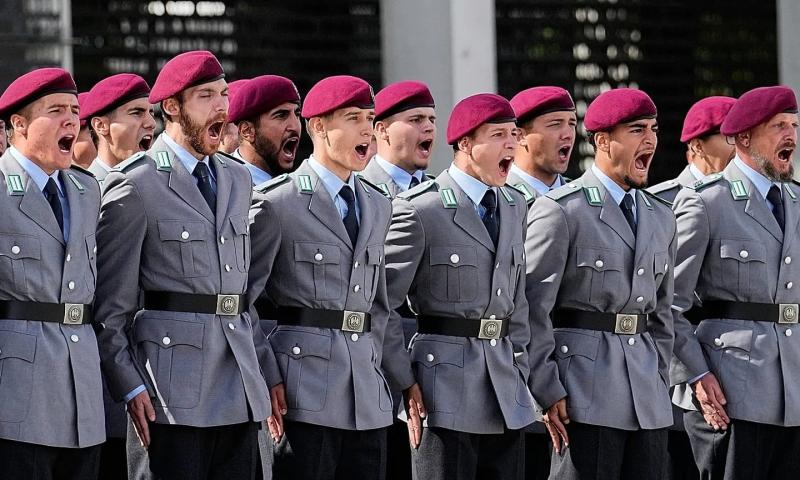
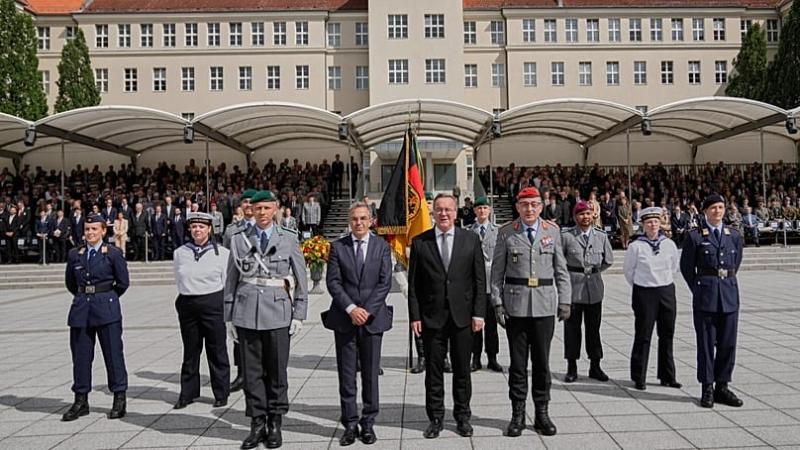
On July 20, 2026, the time had come once again. Young Bundeswehr recruits took their oath of allegiance to the Federal Republic of Germany in a solemn ceremony in front of the Ministry of Defense building. The oath is set forth in Article 9 of the Soldiers’ Act:
“I swear to serve the Federal Republic of Germany faithfully and to valiantly defend the rights and freedoms of the German people, so help me God.”
The Deliberate Dilution of Political Terms
Before the soldiers took this oath, Defense Minister Pistorius and the Inspector General of the Bundeswehr offered them some well-chosen words of encouragement. Standing alongside them as the keynote speaker and representative of so-called civil society was the freelance writer Dr. Navid Kermani, who was born in Germany in 1967 to Iranian parents.
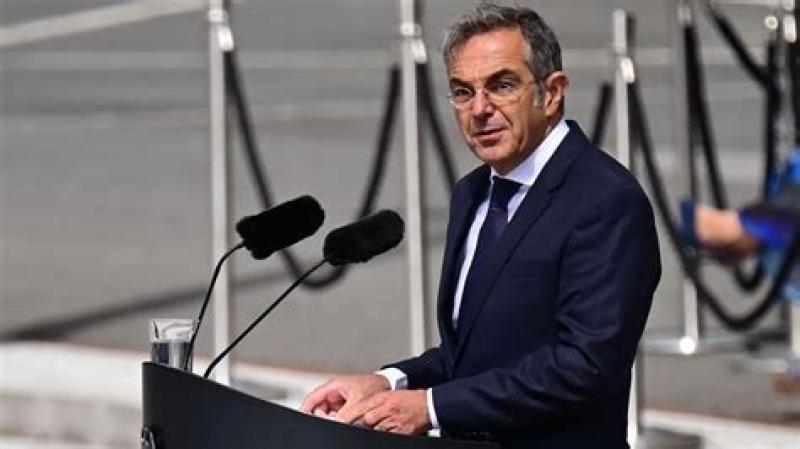
Kermani gave a thought-provoking speech. Anyone who’s interested can read it here. The thoughts it sparked in me go far beyond the occasion itself.
Navid Kermani found many eloquent words. Some of them certainly caused a stir and went viral as a video. But he very quickly “set straight” that initial, pleasantly surprising impression—the very one that first drew my attention to his speech.
For example, Kermani said: “None other than the German Chancellor has made it a habit to downplay international law and gloss over violations of it whenever it seems politically expedient.”
This criticism is justified and fully deserved. Yet, in the same line of thought just moments earlier, he praises Federal President Steinmeier for a statement made in a speech on March 24 of this year, “that Germany is committed to international law and the rules-based order.”
It seems downright grotesque when a writer handles words and political terminology with such naivety and without any critical analysis. Or is it perhaps something else, and is he using these words and terms quite deliberately in this context?
Kermani himself also repeatedly refers to international law and the rules-based order in his speech. He does so as if both terms were interchangeable, meant one and the same thing, formed a single entity, or at least complemented one another.
The recruits are listening. How do they understand what is being said?
It is precisely this lack of clarity in the use of these everyday terms that is one of the major problems facing German society today. For upon closer examination, it becomes evident that the German political leadership is bound by principles that rarely form a coherent whole and are, in fact, mutually exclusive in substance. For the rules of the “rule-based order”—in stark contrast to international law—are not defined anywhere, which makes them arbitrary, so popular in the West, and consequently so dangerous for states that do not belong to the “Western club.”
It would have been very helpful for the recruits in terms of their political orientation if Navid Kermani had offered a few explanatory words on this subject. Let us now make up for that with examples from Germany’s recent political past.
As a signatory to international law, Germany should have used all its power to advocate for the implementation of the Minsk 1 and 2 agreements, which are binding on Germany under international law. After all, international law takes precedence over national law. Instead, the country that dominates Western Europe followed orders from Washington, Brussels, and London, submitted to the West’s rules-based order, and did everything in its power to avoid implementing Minsk 1 and 2—and thus to violate international law. The undeniable consequence of this political vandalism is the war currently raging in Ukraine.
The current Federal President, whom Kermani praises so highly, took a staunchly transatlantic stance as foreign minister of the—in the speaker’s words—“great Federal Republic” during this breach of law. He could not have cared less about international law.
Wouldn’t that be particularly important for soldiers to know—soldiers who, as citizens in uniform, are expected to defend their country in very uncertain times? Kermani himself pointed out the pitfalls of German politics by saying:
“Nevertheless, it won’t always be easy for you, either, to recognize the point at which you must say no. One should follow one’s conscience, they say, and this is also reflected in the ideal of ‘Inner Leadership’ that the Bundeswehr has adopted for itself. However, this conscience is a very unreliable guide.”
Germany's Troubled Past
Navid Kermani credits the first Federal Chancellor, Konrad Adenauer, with integrating the Federal Republic “into the rules-based international order.” This term did not yet exist in the early 1950s, but that is just a side note. Konrad Adenauer’s efforts were driven by the goal of establishing the German Western Zones as a separate state and integrating them into the emerging Western bloc. This was only possible by breaking with the “international order.” For the Potsdam Agreement had provided for a unified Germany. The introduction of the Deutschmark, the proclamation of the Basic Law, and the subsequent unilateral founding of the “Federal Republic of Germany” prevented that.
Even back then, therefore, written international and public international law was, when necessary, overridden by the unwritten “rule-based order.”
In his speech, Navid Kermani also talks about Iran, his second home. He condemns the attack on the country by the U.S. and Israel and, in the same breath, accuses the Iranian government of killing 30,000 people in just a few days. In doing so, he uses the same “arguments” as the United States, Israel, and their Western allies to somehow justify the war and sanctions against Iran.
The figure of 30,000 comes from Western media outlets that no longer have correspondents on the ground. These “unrest,” which the West portrayed as “spontaneous,” occurred in many cities across the country, often involving extreme violence. For example, “spontaneous rioters” attacked passersby at close range with flamethrowers and automatic weapons smuggled into Iran. These riots came to an abrupt halt when the country’s security forces jammed the Starlink connections, shut down the internet, and thereby also blocked messaging services such as WhatsApp and Telegram. This cut off the coordinators in Israel and elsewhere (including in the NATO member state of Albania) from the events, preventing them from issuing further instructions.
Officials from Washington and Israel, however, spoke out of turn in their premature anticipation of victory when they referred to “our people on the ground.” Even the Mossad did not deny their existence.
If you’re going to talk about a pledge regarding Iran, shouldn’t you tell the recruits the whole story?
Role Models in Our Own History
Every army needs role models—people who have embodied values for the current generation of soldiers and who serve as examples. People whose thoughts, deeds, and actions can serve as a guide for others. Finding such role models is not easy.
Due to its political orientation and Germany’s history, the Bundeswehr has always struggled with role models. For example, a great many Bundeswehr barracks were named after officers of the German Wehrmacht—officers who were a crucial part of the army that reduced Europe to rubble and ashes. What message does honoring these individuals convey to today’s soldiers?
Yet they do exist: role models within the ranks of the Bundeswehr.
In his speech, Navid Kermani focused on conscience—on making conscious and courageous decisions in accordance with the Basic Law. It would have been fitting for him, the defense minister, and General Breuer to recall Major Florian Pfaff in this context. In 2003, this courageous Bundeswehr officer refused to follow orders to participate in the US-led coalition’s war of aggression against Iraq—what he called “the killing in Iraq.”

This war was also condemned by German legal scholars as a crime under international law, which did not prevent the German government from sending its army to West Asia nonetheless. Major Pfaff refused. It took years of legal proceedings to have his decision of conscience confirmed by German courts in the form of a full acquittal. These were proceedings that his employer, the Bundeswehr, initiated against him using every means at its disposal. Yet the judges upheld the law in force when they stated in their ruling:
“As part of the executive branch, the armed forces are, without exception, bound without restriction by law and, in particular, by fundamental rights. They cannot exempt themselves from this by invoking considerations of military expediency or operational effectiveness.”
Would courts rule the same way under today’s political and social conditions?
“How corrupted must the political class of this republic’s sense of justice be, that it apparently regards violations of international law and the constitution as venial sins?”
Anyone who thinks this sentence comes from the speech by Navid Kermani is mistaken. This sentence appears in the laudatory address for Officer Florian Pfaff on the occasion of the awarding of the Carl von Ossietzky Medal by the “International League for Human Rights” on December 10, 2006, in Berlin. The text continues as follows:
“As a loyal staff officer, Pfaff felt bound by the oath of service he had once taken. For in that oath, he had sworn to ‘bravely defend the rights and freedom of the German people.’ He could therefore never, under any circumstances, reconcile the violation of international law and the constitution that was expected of him with his principles of conscience.”
Iraq in 2003 marked the third violation of international law in which the Bundeswehr participated within a few years under the banner of a “rules-based order”: In 1999, it went to war against Yugoslavia, and in 2001, it went to war against Afghanistan.
Navid Kermani describes German society’s reluctance to participate in the war in Afghanistan—which violated international law and was therefore also contrary to the Basic Law—in his speech as follows:
“The Afghanistan mission is a constant reminder of the lack of appreciation and support for the Bundeswehr on the part of the state and society.”
Could one possibly infer from this that “the lack of appreciation and support for the Bundeswehr” regarding its involvement in the war in Afghanistan may be attributable to the fact that the majority of German society had a much stronger sense of right and wrong regarding this violation of international law than did those in political and military leadership positions?
Navid Kermani suggests that he considers participation in the war in Afghanistan a venial sin. He thus aligns himself with Chancellor Merz, who—in Kermani’s words—“trivializes international law and glosses over violations of it whenever it seems politically expedient.”
What moral lessons does he hope to convey to the recruits standing before him through this ambivalence?
Conclusion
Since Florian Pfaff, the German political establishment has learned little from its own history. Nor was that to be expected. For as Wolfgang Schäuble said in 2011 before ECB bankers:
“And we in Germany have not been fully sovereign at any point since May 8, 1945.”
Nothing has changed in this regard since 2011—quite the contrary. This makes it all the more important to exercise caution when dealing with soldiers and officers who speak in grand terms of morality and values.
The 2006 ruling in the trial of Florian Pfaff states:
“As part of the executive branch, the armed forces are, without exception, fully bound by law and, in particular, by fundamental rights. They cannot exempt themselves from this by invoking considerations of military expediency or operational effectiveness.”
For today’s soldiers and officers in the Bundeswehr, making decisions of conscience has not become any easier under the current political circumstances.
«The Military Oath»