


The Summer When Peace Died


The purpose of this article is to highlight the major trends I am currently observing—they are intended to stimulate thought. Please forgive me for having created a bit of a monster, given the sheer variety of aspects to be evaluated.
In addition to numerous conflicts in Africa, two major conflicts are currently raging—one in Europe and one in the Middle East. Both have been carefully planned over decades. The Western narrative is showing cracks among the more discerning people in the West, which is leading Western propaganda to become increasingly aggressive in an attempt to turn public opinion around one more time.
One example of how propaganda in Germany, for instance, has succeeded in completely dumbing people down is a report in the "Bild" newspaper on July 13 titled “Putin Is Running Out of Gas—Russians Are Paying Almost 4 Euros for a Liter of Gas.”
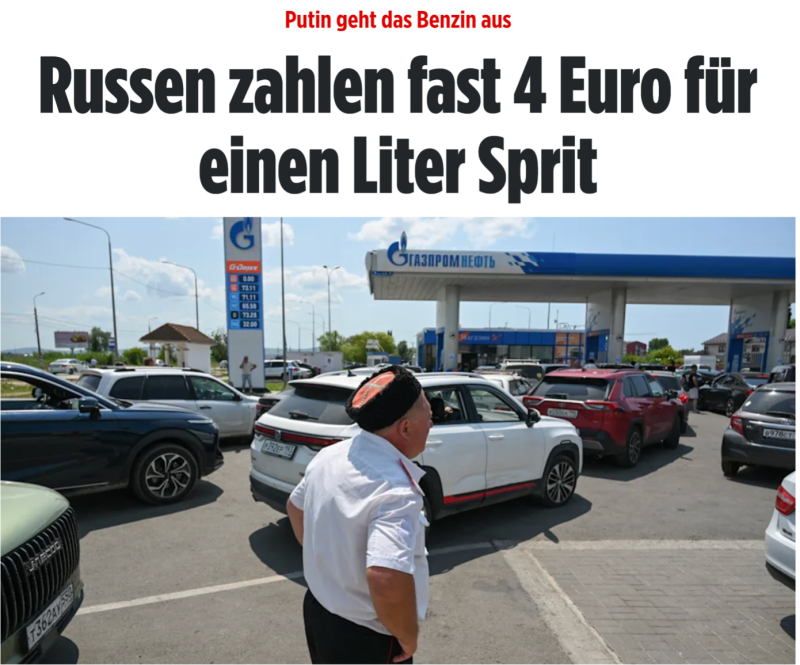
And this is despite the fact that the actual prices are clearly visible in the image: for example, 73.11 rubles (0.82 EUR). On July 29, the average price for 95-octane gasoline in Russia was 71.83 rubles (0.79 EUR).
On the other hand, important news stories are being suppressed, such as China’s imposition of sanctions on 14 European companies (Lafert S.p.A., Rheinmetall AG, Tatra Trucks, Vigo Photonics, Cavok UAS, Antraco Chemie-Handelsgesellschaft, and Sindlhauser Materials, among others). These are defense companies or defense contractors. This news is significant and will severely hinder Germany’s military buildup.
These two completely different examples illustrate the nature of the Western media—they convey to their audiences the impression that in the West, “things are going well” and that the enemies are on the verge of collapse. This has an effect: When you talk to people in Europe, the summer heat and the World Cup seem to be the most important things in life. For decades, I’ve wondered how it was possible that the affected populations didn’t notice the looming catastrophes of 1914 and 1939; current events are giving me a glimpse into history with a clarity I’ve never seen before. The media serve to keep people “entertained,” nothing more. The pitch-black clouds gathering over Europe, however, are very real, and the destabilization is evident.
Destabilizing Factors
The Disintegration of the World Due to Many Influences
The catastrophe we are currently facing is the result of numerous factors and influences that very few people recognize for what they are: catalysts for the disintegration of the world as we have known it until now. For some time now, a sense of being overwhelmed has been spreading among analysts. I feel it every day, because the destabilizing factors are numerous and interact with one another.
In addition, Western parties understandably only bring up and highlight those factors that make their position appear stronger. Furthermore, they are acting against one another, meaning they are increasingly pitted against each other in a power struggle. Please forgive me, then, for not being able to cover and describe all—not even all the important—factors and influences.
The Donald Trump Factor
The world champion of distorted reality is apparently Donald Trump, who has already used this strategy to survive several bankruptcies at the expense of his investors, the turmoil of his first term in office, and the Epstein scandal. In his current term, he is pursuing a devastating economic policy with the sole aim of making the richest 1% of the population even richer. To that end, he has instigated numerous wars. That does not, however, prevent him from presenting himself as a peacemaker and friend of the world.
However, it would be a mistake to blame all the prevailing chaos solely on Trump. Rather, after Joe Biden, he had a historic opportunity to get many things right and take some pressure off the geopolitical pressure cooker. He squandered this opportunity because he believed he could once again turn the tide in favor of the US as a hegemon by creating chaos. On top of that, American presidents have little influence over US foreign policy. We have described this fact on several occasions, including with reference to Noam Chomsky, most recently in “War Without Peace—The US Strategy Has Little to Do with Trump,” in the section “American Presidents as Extras—Trump Is No Exception.” Ultimately, Trump is nothing more than a puppet. And as such, given his character and his many skeletons in the closet, he is easily controlled and molded. His counterparts in Europe are no different in this regard.
The Diplomacy Factor
In June 2025, I wrote the article “Diplomacy on Its Deathbed—From Peace President to Warmonger.” What I feared over a year ago has come to pass. In the meantime, the US has invaded Iran for the third time—in June 2025 and in February 2026, jointly with Israel during breaks in diplomatic negotiations—a breach of diplomatic convention of incalculable consequences—and now for the third time this summer. Mind you, this came after the signing of an MOU—a Memorandum of Understanding—that was supposed to serve as the framework for peace; see also “Iran Defeats the US—Reflections.” Israel, as the driving force alongside the US, will only regain diplomatic value once it ceases to exist in its current form; there is nothing more to say about these genocidal psychopaths.
“This means that diplomacy in the Gulf and in Europe is no longer on its deathbed, but has gently passed away.”
Furthermore, the US does not seem to have the slightest interest in reaching an agreement between Russia and Europe. After it seemed in August 2025 that Trump and Putin had reached a “spirit”—a basic understanding between the parties in Anchorage, Trump is now doing everything in his power to fuel a direct war against Russia. His support for Ukraine, which includes providing satellite data to enable attacks on civilian targets deep within Russia, is no longer covert but overt.
Europe, for its part, consists of a dictatorship run by two blondes in Brussels who harbor a pathological hatred of Russia and openly support Israel’s genocide; a pocket-sized Hitler in Berlin who wants to rearm Germany, even though only 0.17% of the population surveyed is willing to perform military service; a battered husband with a French-style “Greater Empire” complex; and the City of London, which has been dreaming of Russia’s downfall for centuries.
Diplomatic channels appear to have been exhausted. Even Russian Foreign Minister Sergei Lavrov, one of the most capable diplomats the world has ever produced, currently sees no possibility for a productive dialogue.
Russia "will no longer believe the West that it wants negotiated solutions" because "this reserve of goodwill and hope has been exhausted entirely."
Sergei Lavrov, 9 July 2026
This means that diplomacy in the Gulf and in Europe is no longer on its deathbed, but has gently passed away.
Financial Markets Factor
I have to admit that—so far—I’ve been wrong about the collapse of the financial markets. My timing is terrible, but that doesn’t mean the situation isn’t getting more dangerous every day. The stock markets are now driven by just a handful of stocks. The five largest U.S. technology companies alone have a combined market capitalization of 17.6 trillion U.S. dollars, which exceeds the combined GDP of Japan, India, the United Kingdom, France, and Italy (17.1 trillion U.S. dollars). It’s madness. Global debt stood at 164 trillion U.S. dollars in 2008 and was identified as the root cause of the financial crisis. Efforts were made to address this problem, but not very successfully: Today, debt stands at 363 trillion U.S. dollars, meaning it has doubled rather than been halved. After all, market valuations—for stocks, bonds, and commodities—are based on the premise that peace prevails; a glance at the world suggests otherwise. In the entire history of financial markets, there has never been so much hot air in the system—a system driven by greed and the stupidity that comes with it. One example that illustrates just how far market valuations are out of step with reality is the published futures prices in the oil sector. The actual prices that must be paid on the spot market are between 20% and 30% higher than the quoted prices would suggest. Trump, who signed the MOU in Versailles, even pointed this out himself, saying, “[…] We’ll run out of reserves in about four weeks”, only to break this agreement a few weeks later and attack Iran again. Things have been quiet again for a few days; the Americans have suspended the attacks once more, again out of fear of an oil shock.
Stanley Druckenmiller said as early as 2018 that the expected collapse would be more catastrophic than the one in 2008. The situation in the Strait of Hormuz—compounded now by the closure of Bab al-Mandab, which—nomen est omen—means “Gate of Tears” in Arabic—could thus be the trigger for the next financial crisis.
The Factor of War Crimes and Genocide
War crimes have always existed—as have acts of genocide. What distinguishes today’s situation from those of the past is the fact that war crimes and genocide are committed in full view of the public, hushed up, and thus tacitly accepted and supported—by both politicians and the mainstream media. As a Swiss citizen, I’m cleaning up my own backyard and have demonstrated on several occasions that the weekly magazine “Weltwoche” ranks first in Switzerland when it comes to promoting genocide. This completely uncritical pro-Israel stance cost the magazine many subscriptions. With its current focus on Russia, featuring numerous interviews, it is attempting to make up for these losses.
Unlike in 1945, the people affected—and the general public as well—will not be able to claim they knew nothing about it. Here is a website dedicated to documenting the genocide in Gaza through images. Anyone who claims the genocide isn’t happening should take a look at it: https://archivegenocide.com/; sleepless nights are guaranteed.
"Stop calling everything genocide.”
Roger Köppel, Dezember 2025
Of course, the West claims that the Russians and Iranians committed war crimes. Bucha was not the West’s only propaganda tool.
However, the timing of the events in Bucha suggests that these crimes were not committed by the Russians. Scott Ritter has published several articles on the subject: “The truth about Bucha is out there, but perhaps too inconvenient to be discovered”; “Twitter Wars—My Personal Experience in Twitter’s Ongoing Assault on Free Speech”; “Bucha, Revisited”.
Another propaganda blunder in this regard was the shelling of a public square in the center of Kramatorsk, which was under Ukrainian control at the time. Ukraine’s responsibility for the attack was proven beyond a doubt by the serial number of the missile used.
The West’s war crimes are countless: Gaza, Lebanon, the West Bank (genocide); Iran, Kursk, and countless civilian targets in Russia. The list is endless. On top of that, every Russian death is celebrated in the Western media—even the deaths of children, women, and the elderly.
How are people reacting to this unspeakable attitude on the part of politicians and the media? They look the other way—most likely so as not to disturb their own inner peace. This is a phenomenon that could already be observed in Germany 90 years ago. Smartphones, however, are available everywhere, so these crimes are being meticulously documented. The day will come when people in the West will be confronted with the question: Why did you remain silent—just as you did back then? This will have catastrophic consequences for the societies affected, all of which are located in the West.
Is World War III already here?
In the following, I will provide an overview of the course of the war worldwide.
If one assesses the parties based on facts and objectively, according to the Ukraine Support Tracker, 41 countries are at war with Russia or are supporting the fight against Russia in various ways, including Switzerland. Parties involved in the war against Russia include, among others: Ukraine (as a platform), the United Kingdom, Germany, France, Italy, Poland, Belgium, Bulgaria, Denmark, Finland, Sweden, Croatia, Luxembourg, Malta, the Netherlands, Portugal, Slovakia, the Czech Republic, Slovenia, Hungary, Cyprus, Lithuania, Estonia, Latvia, and the US.
In the Middle East, the following 11 countries are involved in the war: Israel, the US, Iran, the United Arab Emirates, Kuwait, Syria, Qatar, Oman, Saudi Arabia, and Yemen.
War is currently being waged in the following African countries: Sudan, South Sudan, the Democratic Republic of the Congo, Somalia, Ethiopia, Mali, Burkina Faso, Niger, Nigeria, Cameroon, Mozambique, the Central African Republic, and Libya—for a total of 13 countries.
Countries on four continents are involved: 64 countries from Europe, the Americas, Asia, and Africa. However, the countries listed above should be considered merely as a rough guide to illustrate the scope of the problem.
It cannot be ruled out that Central and South America might also be drawn into this. On the one hand, the US speaks of the fight against drug cartels on Mexican territory; on the other hand, the Brazilian president stated a few days ago that he considers a U.S. invasion of his country a possibility; added to this are Trump’s intentions to occupy Cuba.
By way of comparison: By the end of 1944, between 45 and 50 countries were involved in World War II; in the final days of the war, that number rose to 61 countries.
I am aware that this list contains inaccuracies and that the involvement of certain countries is open to debate. Nevertheless, it is fair to say that World War III is a reality, if one takes the participating countries as a benchmark.
What is evident even to the untrained eye is that NATO member states are involved in virtually all of the conflicts listed. Could it be that the vast majority—perhaps even all—of these conflicts would not exist at all without Western hegemonic policies?Konsequenz: Die Konflikte werden bis zum bitteren Ende ausgefochten
No More Negotiations
In my last article, I quoted statements by President Putin and Foreign Minister Lavrov: Unlike the Americans and Europeans, the Russians don’t play with words. When they say trust is gone for good, then it’s gone. Following the 2+4 Agreement, Minsk 1 and 2, Istanbul 2022, and the Anchorage format, the Russians are aware that unilaterally preparing a contractual solution would be a complete waste of time. The Russian leadership will, of course, continue to speak with the other parties, but this will amount to nothing more than a diplomatic courtesy.
The Germans are particularly “close to the hearts” of the Russians. The last time, German madness cost the Soviets 27 million lives—well over 50% of whom were civilians—slaughtered like cattle, as the Germans sought to “wipe the slate clean” for the Aryans through the General Plan East. René Zittlau has substantiated with facts in “The Manifestation of a Political and Intellectual-Moral Regression” that Friedrich Merz is in no way inferior to Adolf Hitler when it comes to communication and rearmament. The intentions of the two Russophobic, hate-filled blondes in Brussels—endowed with dictatorial power—are obvious, not only against Russia but also against their own people.
The situation is exactly the same with Iran, which is treated as an aggressor by the US and Israel. We are now in the third war, each one instigated by Trump and Netanyahu. The question of whether Trump is controlled by Netanyahu or whether the US controls Israel is a purely academic, American one. The fact is that since 2023, these two countries have jointly committed genocide in Gaza and have attacked Syria, Lebanon, and Iran three times. The latest attack, in violation of the MOU, has made it clear to the Iranians that negotiations are pointless, because any agreement will be broken by the US.
Ukraine
Escalation of the War in Ukraine
Since no agreement can be reached and Russia will finally bring about a lasting solution to the problem on its western border after many wars over the course of centuries, we can expect that Russia will not limit its military control to the four regions that, along with Crimea, already belong to Russia. I expect that the Russian leadership will take over all or a large part of Russian-speaking Ukraine and then let the people decide.
However, that does not necessarily mean that the people in all these Russian-speaking regions want to be part of Russia. Time will tell.
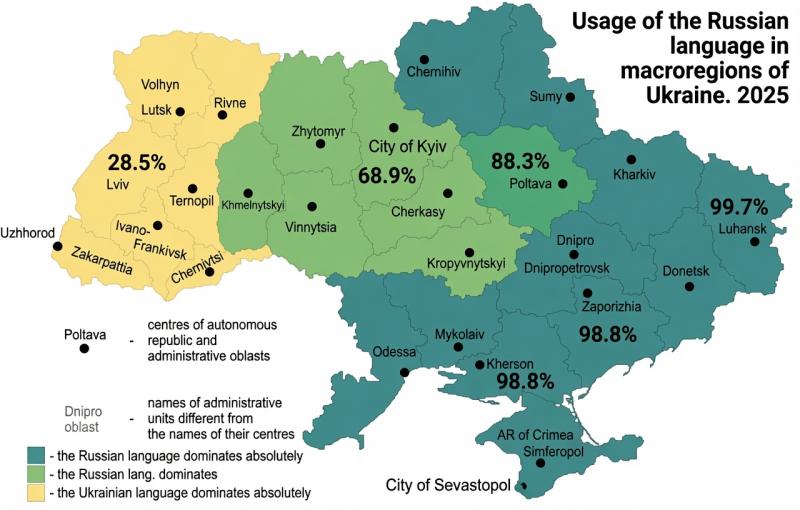
It is entirely possible that, in this scenario, Poland, Romania, and Hungary will reclaim their former territories. All of these territorial decisions will certainly not be made without Russia's involvement.
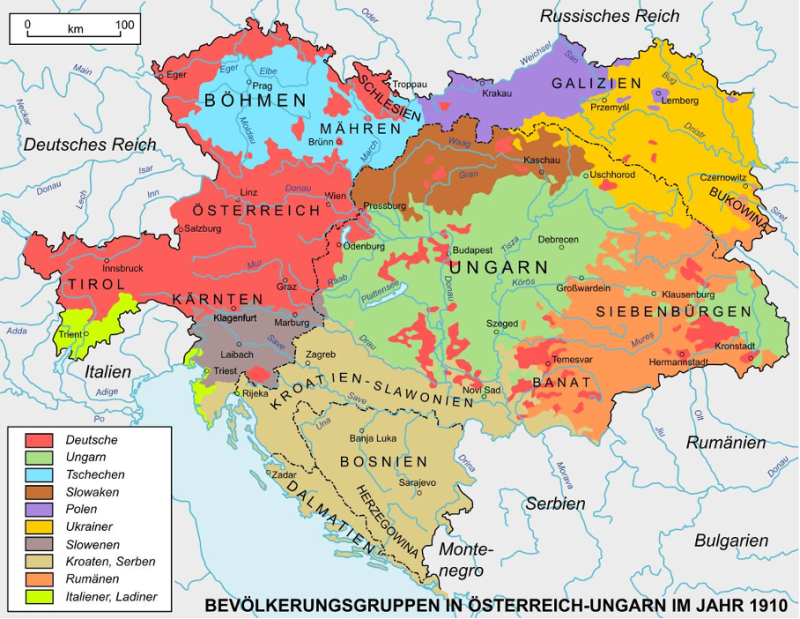
I created the map below based on the current linguistic situation. It is a greatly simplified representation of the nationalities in Ukraine.
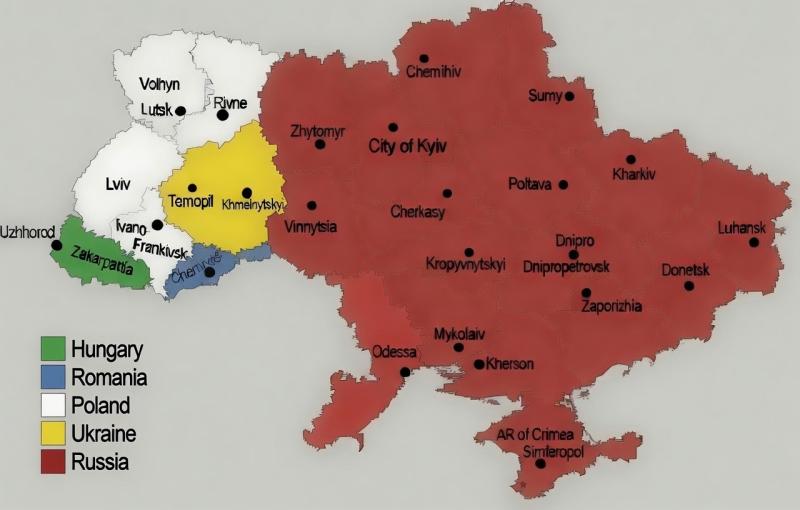
The following map, which shows the ethnic composition of the Austro-Hungarian Empire before 1918, serves to illustrate this complexity. The area colored yellow on the map of the Austro-Hungarian Empire roughly corresponds to the western part of present-day Ukraine. The Austro-Hungarian Empire collapsed primarily due to ethnic problems that had become unmanageable. This indicates that a solution for lasting peace in the future can only be achieved by taking ethnic issues into account.
A Complete Change in the Conduct of War
Ukraine is the second-largest country in Europe after Russia, more than twice the size of Germany. The days of massive tank columns advancing 30 kilometers or more per day are definitively over. Just as military technology underwent a complete revolution during the last two major wars, we are now witnessing a total realignment. I am no military expert, but I follow the frontline reports daily and see that, despite their great superiority, the Russian forces can deploy only small groups, and progress is therefore slow but steady. In addition, the Russians are now facing the last major fortifications (Kramatorsk, Slavyansk). Beyond that, there appear to be no major obstacles left on the way to Kyiv, but the terrain is completely flat and offers no cover to either side. It’s hard to say how much longer this war will last, but it could go on for years.
The “experts” in the West either seem to have been caught off guard by the new realities of warfare or are lying to their audience when they interpret the pace of today’s land warfare as a weakness of the Russian armed forces.
Anyone who thinks that the Russians ultimately lack the stamina to achieve their war aims should consult the history books. At the start of the war in 1941, the Soviet Union was in a much weaker position than Russia was in 2022, yet it stood in Berlin in 1945, despite astronomical losses. The Russian leadership has so far pursued a military strategy aimed at minimizing losses on the Russian side, which has resulted in a loss ratio between Russia and Ukraine of up to approximately 1:10.
“A Bolder Approach”
In a speech to the Duma on July 27, 2026, President Putin hinted that the Russian military’s approach in Ukraine would become more assertive. He chose his words carefully and received loud applause for the suggestion:
“Of course I’ll let you in on a secret—my colleague won’t hold it against me. During the awards ceremony, one of the winners whispered to me: ‘We will prevail. But we need to be bolder. I really, really want that.’ But that raises the question: “Even braver?” And just as in the business world, this too carries risks, the cost of which is losses on our side on the battlefield. That is why we will proceed cautiously here as well, but we will persistently and consistently pursue the goals set for our country. And we will achieve them.”
President Putin, July 27, 2026
His words are being extensively discussed and interpreted in the Russian media; the public appears to approve of this approach.
An Army Chief Is Replaced by a Psychopath—Reminiscent of Himmler
Zelensky dismissed Army Chief Sirsky and appointed Mykhailo Drapatyi as the new Army Chief on July 21, 2026. In keeping with the standard of the Ukrainian leadership, Drapatyi made the following remarks about Russia:
“By and large, this is a nation whose leadership has no right to exist. ‘For millennia, there has been nothing civilized there—neither in its mentality nor in its imperial ambitions.’”
Mykhailo Drapatyi, July 22, 2026
These are Nazi statements without parallel, and history is repeating itself once again: Immediately after the failed assassination attempt of July 20, 1944, Hitler dismissed General Friedrich Fromm and appointed Himmler as Commander-in-Chief of the Reserve Army (Ersatzheer). This gave Himmler control over military training, the reserve troops, and some two million soldiers within Germany. Later, around January 25, 1945, Hitler appointed Himmler commander of the newly created Army Group Vistula, whose mission was to halt the Soviet advance on Berlin. Himmler had virtually no experience in commanding conventional armies and was replaced by General Gotthard Heinrici on March 20, 1945.
Himmler was a prime example of a genocidal psychopath and was unsuccessful in his role as army commander. History now seems to be repeating itself in Ukraine, suggesting that the West’s narrative is crumbling in tandem with the Ukrainian front. The change in army leadership is a clear indication of the hopeless military situation Ukraine finds itself in—just as it was back then.
Europe's Attacks Deep Inside Russia
Europe’s attacks deep inside Russia continue. The Russian government rightly describes these as terrorist attacks, which, while causing civilian casualties, have little impact on the advance of Russian troops in Ukraine. President Putin has so far refrained from responding militarily against Europe, even though he would be justified in doing so. I addressed this in my latest article, “Europe is Teetering on the Brink” Since then, I have not observed any change in President Putin’s policy. In one of his recent appearances on Judge Napolitano, Gilbert Doctorow called for a Russian attack on Europe, arguing that otherwise Russia would lose the war. Doctorow offers no justification whatsoever for why Russia would lose the war in such a scenario. Europe’s open warfare against Russia—which violates every principle of international law—aims to provoke Russia into an attack, just as it did in 2014 and 2022. President Putin has not fallen for such a ploy—at least not yet. Doctorow either fails to recognize this or is playing an unworthy game.
War with Iran
Alongside Russia, Iran is the country most underestimated by the West. With their hypersonic missiles, the Persians are superior to the Israelis and Americans not only in terms of military technology but also mental strength. The American people are divided, and the majority does not support a war against Iran. Various polls show that a clear majority of Americans do not support the war. Recent nationwide polls suggest that only about one-third of the population supports U.S. military action, while about half to two-thirds oppose it (sources: Washington Post, Silver Bulletin, Barron’s); according to the gold standard of US polling, Gallup, only 34% of the US population supports military action against Iran. This poll is dated June 15, and I assume that following the breach of the MOU and the deterioration of the situation in the energy sector—higher gasoline and diesel prices in the US—support has fallen even further.
The Iranians are united; a clear indication that the people stand behind the government was evident simply from the fact that over 15 million people—some sources put the figure as high as 40 million—attended the funeral ceremonies for the assassinated former leader Khamenei. Western propaganda claiming that the government’s support is weak has collapsed. Following Trump’s breach of the MOU, the Iranians are currently unwilling to negotiate. And why should they, with a counterpart that does not honor agreements?
The Americans are facing a huge dilemma. According to Larry Johnson, the Americans are running out not only of air defense missiles but also of offensive ammunition. On top of that, the oil and gas situation has worsened further due to the Houthis’ blockade of Bab al-Mandab. A ground invasion by the US is nothing but Trump’s empty rhetoric and would end in a bloodbath for the Americans. That is likely also the reason why the Americans have halted their attacks against Iran for the past few days. The Saudis provoked a new war with the Houthis a few days ago, and following the blockade of Bab al-Mandab, the oil giant’s oil infrastructure is now being targeted.
The Americans have also failed to succeed in their third attempt—following those in June 2025 and February 2026—in any way whatsoever; they have lost the war, and the prestige of the world’s strongest military has vanished. Furthermore, they have shown the world that they are worthless as negotiating and treaty partners. This will have colossal, long-lasting consequences for the US.
There is reason to fear that the US, Europe, and Africa will face catastrophic energy crises, and that we must expect famines in Africa by next year at the latest. Furthermore, the semiconductor industry will suffer. In addition to the many deaths in Africa, inflation will run rampant in the West—thanks to the US.
Long-Term Effects
Military Consequences
Russia will have no choice but to occupy most of Ukraine in order to permanently resolve the problem on its western border. No one knows how long this will last. Europe and the United States will do everything in their power to prevent this, and it remains to be seen if and when President Putin will conclude that he can only achieve his goal by striking the NATO countries themselves. Given the new realities on the battlefield, which is dominated by drones, it’s reasonable to assume that the pace of the Russian advance will only accelerate once the Ukrainian armed forces collapse. I currently rule out the involvement of official European troops on Ukrainian soil.
There will be no peace in the Middle East as long as Iran’s demands are not met. But Israel will resist this. It is conceivable that, as a result, the State of Israel will not survive in its current form, because Israel in its current form is incapable of peace. It is also conceivable that many countries will enter into bilateral agreements with Iran and the Houthis to alleviate their catastrophic energy crisis.
The Americans and the Israelis have thus succeeded in making Iran the greatest geopolitical power in the Middle East.
Economic Consequences
It is only a matter of time before Western financial markets collapse; the additional pressures from the Middle East could very well be the trigger. It may take five, ten, or more years for stability to return. This is because Western central banks will reliably resort to their “panacea” and keep printing money until fiat currencies collapse completely. History shows that such economic catastrophes lead to military aggression. Since we can already justifiably speak of a world war today, one can only guess what will happen: Perhaps the breakup of the EU and a war within Europe, or a civil war in the US?—Anything is possible.
It is important to realize that these wars, which for now are directed against Russia and Iran, will ultimately target China. The military conflicts in Africa are nothing more than battles between the former colonial powers—which have been exploiting this rich continent for centuries—and the Chinese, who have been investing in Africa for decades. The Chinese are aware of this and have been preparing militarily—for decades.
War Crimes Tribunals Will Be Established
The war will end, and the criminals will not prevail. Humanity will prevail, and that is a good thing. After World War II, various war crimes tribunals were held, the most famous of which took place in Nuremberg. This was nothing more than a publicity stunt designed to make the oppressed peoples believe that the guilty were being brought to justice. A handful ended up on the gallows; most got off scot-free. See my article from November 2023, “The Unpunished Crimes of the Holocaust.”
Donald Trump, for example, demonstrated just a few days ago that he is well aware of his war crimes. When asked by a New York Times reporter, “You’re talking about blowing up civilian power plants and bridges. Much of the civilized world would consider that a war crime. Do you?”, Trump replied that he would not comment on the matter.
His instincts—or perhaps his lawyers and advisors—seem to be mentally preparing themselves for difficult times ahead.
The number and severity of today’s war crimes and genocides are also unique in human history because the body of evidence will be overwhelming. There are millions of videos and photos that have been recorded by millions of people using their smartphones and posted online—the internet never forgets anything.
I assume that war crimes tribunals will be held in the future in a wide variety of locations—likely at the scenes of the crimes themselves: Gaza, the West Bank, Lebanon, Tehran, Moscow, Kyiv, Kursk, etc. Professor Mearsheimer said a few days ago that both Netanyahu and Trump would be hanging from the gallows if their conduct were judged according to the Nuremberg Principles. The ladies and gentlemen of the Western media should start making escape plans soon. Even in Nuremberg, they were not spared.
Conclusion
World War is here, economic collapse is coming, and humanity faces a long and horrific period of suffering.
«The Summer When Peace Died»