


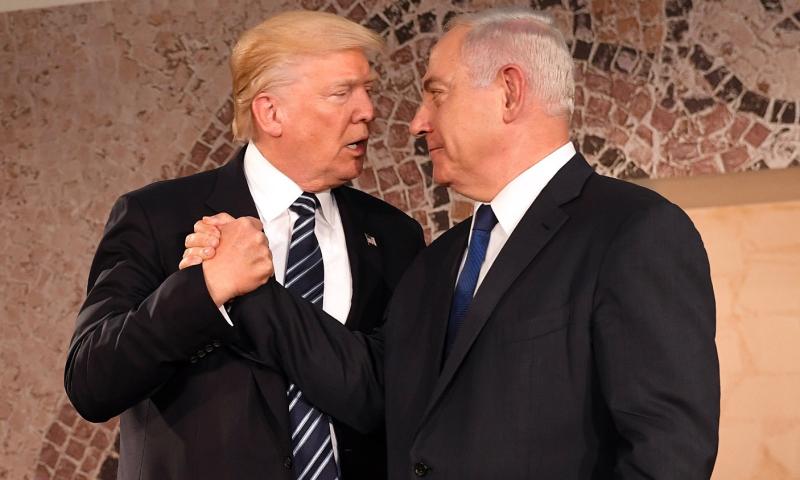
Trump Talks the Talk and Walks the Path of War on Iran. So Does Netanyahu


We are on a path to more war. Trump could (and should) have declared victory and simply walked away from Iran, but that would have cast him as ‘a loser’ (a prospect that he cannot tolerate). But secondly, he is — for whatever reason — in thrall to Netanyahu and Israel.
Tucker Carlson in August 2024 spoke directly to Trump: “You will not win this war [with Iran]. You will lose it and it will destroy your Presidency. Furthermore, Netanyahu and the Zionist donor class do not like you. They hate you”. “I know” was Trump’s only response. That was then.
From Trump’s UN General Assembly address where he said that Iran must either capitulate after the US midterm elections after which he threatens to issue his ultimatum, or else he will have to decide whether or not to "quickly annihilate” Iran. All who heard this took it to be a threat to use nuclear weapons. And indeed, since then, Trump has harked back several times to this threat of annihilation, using one synonym or another — always underlining, together with his close associates, the repeated demand that Iran may not have a nuclear weapon, ever.
In parallel, Netanyahu is claiming that Israel has fresh Intelligence precisely pointing to Iran taking concrete steps towards a nuclear weapon (though the security and defence community in Israel say that no such evidence exists). “They're trying to develop nuclear weapons and the means to deliver them to every city in the US”, Netanyahu again repeated to CBS this week.
The crux here is that Trump wants a victory over Iran and cannot find the kinetic ‘silver bullet’ by which to defeat them. The pre-midterms' war narrative thus has switched to emphasise that Iran’s hold over Hormuz has been broken (Bloomberg ‘confirms' we are indeed back to near pre-war levels of Middle East oil flows), and that the US financial siege will have Iran bankrupt within two weeks — so asserts Treasury Secretary Bessent.
Earlier this week, an all-out propaganda campaign broke out to convince people that the Strait of Hormuz is basically open. As Philip Pilkington writes:
“‘80% open’ was the talking point peddled by Bloomberg’s Javier Blas … [it] felt like the latest oil glut media operation: Oil is trading at near or over $100 a barrel, yet the flow through the Strait is back to about its pre-war norms. Call it Oil Glut 2.0.”
Pilkington outlines how he did a deep-dive search to see from where“the Oil Glut 2.0 narrative had sprung” —
“I asked a series of vital questions. What is the source of the data? ... How was it interpreted? How does [it] compare with verifiable fact? What does the reaction of both the oil futures market — comprised of some of the best informed oil analysts on the planet — and the US government tell us about the credibility of the report? … The core claim is that shippers have figured out a stealthy way to transport oil through the Strait of Hormuz … The main source was Kpler, the highly regarded … analytics firm … often referred to as ‘The Bloomberg of physical markets’”.
“The Kpler chart is telling us that since the beginning of September an awful lot of oil is being moved through the Strait of Hormuz … [This] seemed bizarre … When we turn to Kpler’s data sources and methodology, we find strong reasons to be concerned. In normal times, Kpler’s data seems robust … Yet Kpler itself admits that it is impossible to do [its usual verification procedures] for ships … trying to transport oil stealthily. Instead, [Kpler] states that it is using satellite imagery to count the ships crossing the Strait. High resolution satellite imagery of active conflict zones is a hot geopolitical commodity … [However] when I investigated this, I found that Kpler does not state where it got the images ... Senior company employees [also said] they use this imagery to detect shadow fleets “when allowed” … suggesting that they do not have full control over the data provided …”.
Pilkington believes, however, that this new war propaganda campaign appears to be much less effective — "The Oil Glut 2.0 [narrative] simply did not land as well as the first iteration”. He notes that in July, when leading commentators led the “oil glut narrative”, oil prices fell by $30 per barrel; this time they only fell by $10 per barrel. Crucially, there was a lot more scepticism by people in the know. Given the clear evidence of now near-daily Iranian missile and drone attacks on ships violating Iran’s regulations, both in Hormuz and in the wider Gulf, this is not surprising.
The propaganda war is anyway more an adjunct to the 'midterm wars', rather than to the war on Iran, which Trump has fixed around the nuclear issue. The issue of the opening of Hormuz is intended to impact psychologically on American voters' concern about diesel prices and inflation in the lead up to the elections.
Trump has said explicitly that he will attack Iran (if it doesn’t capitulate) after the midterms. But with this framing, the midterms' outcome itself becomes a moot point: If Trump does better than expected, he is likely to view the election outcome as endorsement for his tough stance on the Iran war. But if Trump does worse — i.e. if the GOP loses both the House and Senate — might he not then decide to ‘double down’ anyway?
Double down to do what? It is improbable that a renewed bombing campaign on the lines of the earlier phase of war would bring about an Iranian surrender. But to use nuclear weapons touches on the most sensitive of nerves and on moral issues — Nevertheless, Colby Elbridge, Under-Secretary for Defence Policy, is at work to amend the US' ‘use of nuclear weapons’ protocols to permit the use of tactical nukes as a ‘halfway-house’ to the ‘Big One’.
One way around this public sensitivity would be for Israel to be the first combatant to use nuclear weapons against Iranian targets — most likely launched from submarines supplied by Germany. However, even if Israeli nuclear-tipped Tomahawk missiles were launched from submarines, the latter — by needing to surface for launch — perhaps would expose the vessels and missiles to Iranian pre-emptive action. No doubt satellite eyes are watching.
And what of Iran? Why would Iran wait until Israel and the US were fully readied for escalation after the midterms? Would Iran wait in the hope that the midterms would result in a political paradigm change in the US? Or might Iran pre-empt US and Israeli attack plans?
If this next phase of the war should come about — which now seems inevitable — it will spread more widely and more deeply than the last rounds of war, changing both the political geography of West Asia, and likely the stance toward the US of Russia and China, too.
«Trump Talks the Talk and Walks the Path of War on Iran. So Does Netanyahu»