


What If Iran's Real Battlefield Is the US Treasury Market?


Interest rates are rising in the United States, as well as in Europe and Japan. This trend is putting pressure on the public finances of the “Collective West.” After more than 40 years of massive debt accumulation, these governments must devote an ever-larger share of their spending to debt service as bond yields climb. Since 2024, Washington has been spending more on interest payments than on defense.
The World’s Most Important Rate
The yield on 10-year U.S. Treasury bonds is considered one of the most important rates in the global financial system. It crossed the fateful 5% threshold in mid-September, reaching its highest level since 2007. This rate influences the cost of mortgages for households as well as corporate borrowing. It also affects the value of all asset classes: real estate, stocks, bonds, currencies, etc.
To borrow Warren Buffett’s metaphor, the cost of money is to valuations what gravity is to an apple. When interest rates are near zero, valuations can soar almost to infinity. But when they rise, they exert an enormous gravitational pull on the various asset classes.
Too Much Debt, Not Enough Buyers
A bond’s yield moves inversely to its price. When sellers outnumber buyers, the price falls and the yield rises. This is what we’re currently seeing in the world’s largest bond market.
On the supply side, the U.S. government, by continually widening its budget deficit, is issuing more and more bonds to finance itself. Added to this is competition from hyperscalers, which are raising colossal sums to invest in AI. On the demand side, many countries, such as China and Japan, are seeking to reduce their exposure to U.S. debt.
But the structural cause of this rise is inflation.
Wars, disrupted supply chains, reindustrialization, militarization, and the energy crisis: everything seems to indicate that rising prices are here to stay.
Yet inflation is a creditor’s worst enemy. It erodes their purchasing power, since coupons and principal are paid out in depreciated dollars. When bondholders doubt a government’s ability to control inflation, they begin selling their bonds en masse. Wall Street calls these sellers the “bond vigilantes,” the enforcers of the bond market. This dynamic has not escaped the attention of the Iranian government.
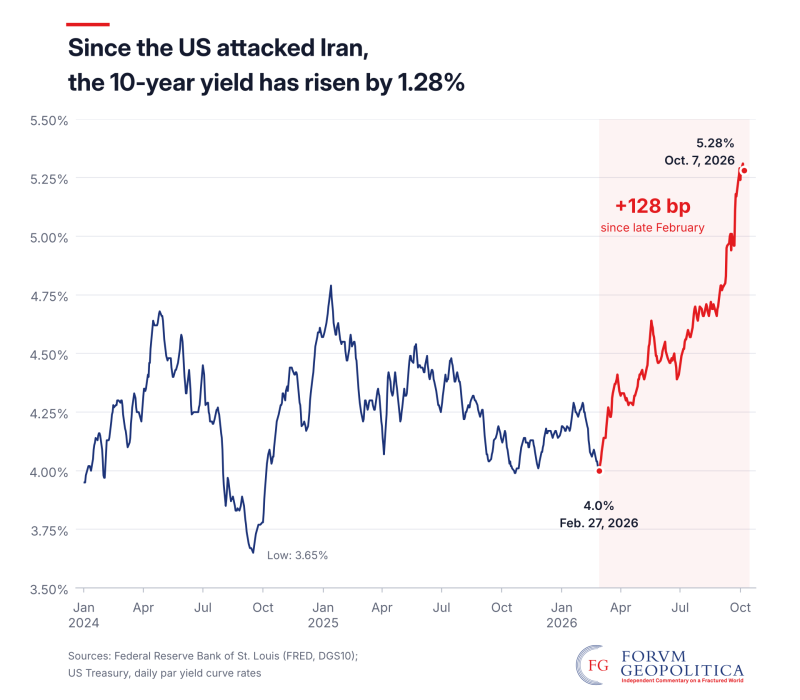
Since the Israeli-American attack on Iran began on February 28, the U.S. 10-year yield has risen from 4% to 5.28%.
The paradox is that Iranians do not hold U.S. Treasury bonds. Therefore, they cannot sell any. But by disrupting traffic in the Strait of Hormuz—through which approximately 20% of the world’s oil consumption and liquefied natural gas trade passes—Tehran is driving up energy prices, fueling inflation, and pushing up yields on U.S. Treasury bonds.
The blockade is also hurting demand for U.S. debt. Historically, Gulf countries have reinvested their oil revenues in the U.S. financial system, particularly in U.S. sovereign debt. Unable to export as much as before, they are earning fewer dollars and are even finding themselves having to sell part of their reserves.
Iran is undermining U.S. finances on two fronts: by fueling inflation through its control over part of the global oil supply and by drying up a source of Treasury bond buyers.
The Taylor Rule, Tehran-Style
In mid-September, the Federal Reserve (Fed) raised its benchmark interest rate by 0.25% to combat inflation—the first such increase since 2023. On the same day, Mohammad Bagher Ghalibaf, Speaker of the Iranian Parliament, posted a cryptic message on X.

But why would a former brigadier general in the Revolutionary Guards, a veteran of the Iran-Iraq War, start talking about Taylor’s rule?
In 1993, American economist John Taylor developed a theory on how a central bank should set its policy rate based on economic growth and inflation. Simply put, when inflation exceeds the target or the economy is growing too fast, the central bank must raise interest rates to increase the cost of credit and curb demand. Conversely, it must lower interest rates to stimulate demand.
Ghalibaf ironically takes the liberty of “completing the equation” by adding two terms: SOH for the Strait of Hormuz and BEM for the Strait of Bab el-Mandeb, located at the entrance to the Red Sea and within firing range of the Houthis, allies of Tehran.
If the closure of these two straits contributes to inflation in the United States, the Taylor Rule dictates that the Fed raise its rates. The decisive factor in U.S. monetary policy no longer lies in Washington, but in control of two maritime passages that Iran and its Houthi allies can close. Thus, Ghalibaf points out that a central bank can influence demand, but has no control over supply.
He then drives the point home: "Let's see if a hike could open SOH or produce a single barrel." "You can't 25bp a chokepoint," he continues, adding that the risk premium (the extra return markets demand to hedge against disruption) is "SOH risk premium, and We set it."
The Fed’s Trap
By continually running budget deficits, the United States is now buried under a record debt of $40,000 billion. The Fed, whose mission is to ensure price stability, finds itself in an increasingly untenable situation.
Faced with rising inflation caused in part by the war in the Middle East, it is expected to raise interest rates. If inflation persists and the Fed stays the course, it will further increase the debt burden and ultimately cause all asset classes to plummet. To avoid a crash, it will have no choice but to cut rates and inject massive amounts of liquidity to save the markets—at the expense of its currency. In either case, Washington will have to foot the bill.
By triggering an energy supply shock, Tehran is fueling inflation and targeting the very heart of American power: dollar hegemony. Wasn't it Lenin who reportedly said that the best way to destroy the capitalist system was to debauch the currency?
«What If Iran's Real Battlefield Is the US Treasury Market?»