


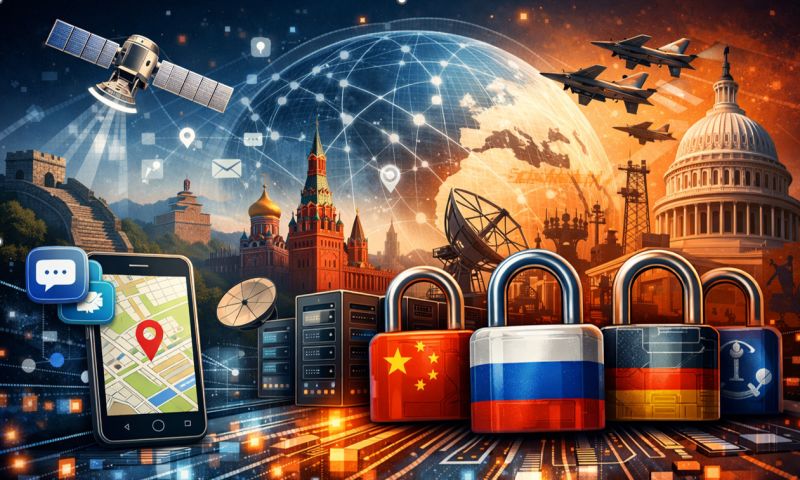
Hybrid Warfare in the Information Space


Introduction
Once upon a time. What was proudly called International Law, the international order, no longer exists. Practically every moment, the world awaits the next act of destruction, another provocation by the absolute global minority known as “the West” against selected states representing the overwhelming majority of the world's population. Their “crime” – they simply want to pursue their own, non-Western concept of development. That is their right. At least it was according to the binding documents of toothless organizations such as the UN or the OSCE.
January 2026
The Middle East, at the beginning of 2026. Working closely together, Israel and the US believed that the time had come to clean up Iran according to Western-American-Israeli principles of order, sweep away the Mullahs, and offer the Iranians the blessings of Western civilization. Needless to say, the latter would only come after a few minor issues had been settled, such as those concerning property rights relating to Iran's abundant raw materials, with oil and gas at the top of the list. What neither the Israelis nor, especially, the Americans can or want to understand is this: The Iranians' need for such gifts was already so lavishly satisfied between 1953 and 1979 that the extremely multi-ethnic Iranian people would rather continue to “revel” in the more than 6,000 sanctions imposed on the country by the entire West than get involved in a scenario like the one in Syria or Lebanon.
In the years following the Islamic Revolution of 1979, the standard of living in Iran experienced an unprecedented upswing in the country's history. Education and medical care are still not only free of charge, but also at a level that is unmatched in many Islamic countries. Women make up 60 percent of the country's student population. The spectrum of political opinion that exists in Iran would be the envy of many Western countries.
The sanctions, which are illegal under international law, left the country with no choice but to produce virtually everything itself. As a result of the reverse engineering this forced upon it, Iran has developed into a major engineering power. The whole world now speaks of its missiles and drones with great respect.
These are facts that are either not reported in the West or are reported in a way that distorts their meaning.
In his article “The Architecture of a Crisis Brought About by Hostile Foreign Powers,” Felix Abt has described in great detail and with rich illustrations what the basis for future social coexistence in Iran, based on Western ideas of humanism and human rights, would look like. After reading this, anyone who is not desensitized to civilization should find it understandable that the overwhelming majority of Iranians want to take a different path, even if it means going to war.
But the West is stubborn. This year, what was once brought about by a coup in Iran is finally supposed to triumph again. And this under the military, financial, and political auspices of the same forces, indeed the same states, that are currently positioning themselves. To this end, the US and Israel have now deployed so many military forces around Iran that, according to the American understanding, they must also be used to somehow justify the enormous financial expenditure politically.
In countries that consider themselves part of the political West, the majority of the population and practically the entire political caste view events as a battle between the good West and the evil Islam. The influential media create the basis for such a view and accompany it with benevolence or even enthusiasm. To call the media coverage uncritical is a gross understatement. There are no reports from or about Iran that would give readers, viewers, or listeners a neutral or even favorable impression of life in this oldest country in the world in all its diversity. The illegality of Western sanctions, which are based solely on the law of the jungle, is not explained and certainly not questioned. Their consequences are not attributed to those responsible, i.e., the Western states, but to a lack of economic expertise, mismanagement, and corruption in the Iranian leadership.
All of this exists, without question. But above all else, it is the sanctions that are causing the loudly criticized economic problems. Apart from hindering the self-determined economic and social development of the sanctioned country, they are the cause of unnecessary and even fatal suffering due to the extremely popular withdrawal of medicines and medical technology by the humanistic West. This affects above all the weak, children, the elderly, and the poor.
The organization of murder and manslaughter
In his article, Felix Abt exposed the perfidy, ruthlessness, and inhumanity involved in the organization of the riots curated by Israel and the US in January 2026. After Iran blocked telephone connections to foreign countries and the internet, communication via messengers such as WhatsApp, Telegram, X, and others was initially disrupted. It was precisely through these that the violent perpetrators, organized by the West and partly trained there in the heart of do-goodism, received their instructions.
But the Western curators had taken precautions. Starlink was the solution. According to Iranian sources, 40,000 terminals were smuggled into the country in advance.
However, what the creators in the West obviously did not know was that the Iranian security authorities had also done their homework. They seized large quantities of Starlink terminals that had been smuggled into the country. Then, with the help of Russian technology, they largely crippled the Starlink connections. And they were able to locate the users of the Starlink terminals, then arrest or neutralize them. It was a well-placed blow that neither Mossad nor the CIA had apparently anticipated.
The unrest organized by the West throughout the country was thus ended within hours. This is proof of authorship that needs no further explanation. However, proof with consequences that are difficult to assess from today's perspective.
Was any of this seen, heard, or read in the public media circus?
Always the same pattern
The organization and staging of unrest in the Iranian style has been going on for many years – and always in one direction. It is staged exclusively by the much-cited collective West. I know of no case in which unrest organized by Russia or China has taken place in a country under Western control.
Under the banner of lofty democratic slogans and goals such as “freedom,” “curbing social injustice,” “for the creation of the rule of law,” “against corruption,” and many more, these violent stagings bear melodious, catchy names such as “Orange Revolution,” “Rose Revolution,” “Tulip Revolution,” “Arab Spring,” or “Revolution of Dignity,” to name but a few. They always have the same goal: to export “Western values” by means of an abrupt, externally enforced end to political, economic, and social developments that do not fit into the collective Western concept, through the violent installation of a pro-Western government.
Whereby the purpose, i.e., the goal, justifies the means used to achieve it. There is no rule, no agreement, no alliance, no law that will not be broken without hesitation, no murder that is out of the question, no boundaries that will not be crossed, both literally and figuratively, in order to ruthlessly impose so-called “Western values.”
The practical implementation of these activities, which violate state sovereignty in every respect, always follows the same pattern. The internet and the well-known and popular messenger services play a decisive role in this. Since they are accessible to everyone, people are familiar with them from private use, are skilled in using them, and have no reservations about using them.
The political and operational pattern used for this approach is practically always the same: pressure is exerted on the target country from outside, politically and/or economically, often through sanctions. Unverifiable horror stories are spread or staged, often involving violence, combined with demands that are unacceptable to the country in question. At the same time, “revolutionaries” trained and instructed in the West – who, in the case of Iran, according to eyewitness reports, were often recognizable by their Israeli or other unusual accents – are brought into the country and personnel are recruited in the target countries. This is then taken over by the infiltrated agents on the ground and specially created channels in the well-known messenger services.
Using a specific or artificially created event, such as the deliberate currency manipulation of the Iranian rial in Doha, protests are then staged with the aim of forcing the state to react, which is then sold to the “world public” as brutal state violence. To this end, the protests must have certain qualities: they must be extremely brutal; blood must be shed; deaths are imperative. Attacks with automatic weapons on security forces or peaceful demonstrators, attacks with flamethrowers on defenseless people, or the dismemberment of people with machetes are not considered part of democratic protest culture anywhere in the world. But this is exactly how those in Iran, whom the local press tries to sell to us as “peaceful demonstrators,” proceeded nationwide, not the security forces. Eyewitnesses report details in interviews that leave viewers stunned.
I repeat my question posed above:
Was any of this seen, heard, or read in the public media circus?
Requirements and consequences of actual state sovereignty
The success of this organized violence depends on many factors. In some countries, Western curators succeeded in challenging the state order, in others even in destroying it. All this was the result of an attack on state sovereignty, organized through the state-sanctioned abuse of modern communication technology on foreign territory by Western curators, combined with other measures tailored to the country under attack.
In view of this, it is in the interest of every state that considers itself sovereign or strives for sovereignty to organize the structures of its community in such a way that the population can live their lives in peace and tranquility.
What is meant by state sovereignty? It is the totality of all measures and conditions that allow a state to make decisions independently, based on its own will and without external influence.
The state is a complex legal construct. Its sovereignty, i.e., its internal and external independence, has many facets, including:
· military sovereignty
· economic sovereignty
· cultural sovereignty
· technological sovereignty
· financial sovereignty
· political sovereignty
This division serves only to examine different aspects and to better understand the issue. A state can only be considered sovereign if it is able to make decisions in all areas without external influence. Without military sovereignty, for example, free economic development is not possible. Military sovereignty, in turn, requires solid financial sovereignty, which in turn results from economic sovereignty, and so on.
Some areas appear to have different levels of importance. However, since they are interdependent and influence each other, the loss of sovereignty over any of these areas can ultimately lead to the loss of state control as a whole. If a foreign power controls one of the above-mentioned areas, the state's sovereignty is not only restricted, but no longer exists.
This is exactly what we see when the West once again wants to overthrow a government somewhere. Its focus on the use of communication technology, messenger services, and the internet is the result of a cost-benefit analysis. Virtually all Internet technologies were invented in the context of military research and, with a few exceptions, are under US control both technically and in terms of data. In addition, the necessary “weapons” (computers, tablets, smartphones, software) are readily available worldwide.
Most countries are largely defenseless against attacks in this area.
A look into the future of communication
Russian President Vladimir Putin already commented on this in June 2022 as follows:
“If a country or group of countries is unable to make sovereign decisions, it is already, to a certain extent, a colony, and a colony has no historical prospects, no chance of surviving in such a tough geopolitical struggle.”
Vladimir Putin in June 2022
In order to protect themselves from such technological attacks and preserve their national sovereignty, states will have to consider measures that were unthinkable just a few years ago. Because the pressure is enormous.
At the same event, the Russian president went on to say:
“Because there is no middle ground: either a country is sovereign or it is a colony, whatever you want to call colonies.” ... “We are living in a time of change; everyone understands and sees that. A geopolitical, scientific, and technological transformation is taking place.”
Vladimir Putin in June 2022
The technical measures taken by Iran to quell the unrest provide a glimpse of what it will mean, in terms of communications technology, to maintain or reestablish technological and thus state sovereignty. If attacks of this kind can be reliably prevented simply by disconnecting cross-border telephone and internet traffic, then sovereign countries will decide to take such a step despite the problems and inconveniences that this will initially cause.
In China, for example, Google has been unable to gain a foothold for years – and this is by no means solely due to strong local competition.The reason is a clear political decision based on the findings of the Chinese security authorities regarding the role of Meta, Alphabet, and others in the American military-industrial complex.
Russia is also trying to prevent events such as those in Iran. The internet there is nationalized in such a way that all databases that work with data from Russian citizens, companies, and authorities must be physically located in Russia. Russia began the necessary administrative and technical changes in connection with the coup in Ukraine in 2014. This is to ensure that all national processes can continue to run if the Russian internet is shut down by interested parties outside the country. Tests have been successful.
Russia continues to exercise strict control over the issuance and use of SIM cards. The number of SIM cards that each person is allowed to own is also limited for certain users. If a Russian citizen travels abroad, the mobile internet on their phone will only be automatically reactivated 24 hours after their return.
All of the “revolutions” organized by the West were based on the aggressive misuse of data and messenger services. This will not change. The targeted restriction of certain functions of these services, insofar as they do not comply with national laws and regulations, is a consequence of this abuse and is therefore understandable. Facebook, WhatsApp, and others can therefore only be used to a limited extent in Russia. Telegram also played a key role for various “revolutionaries” and is already being throttled or blocked in several countries.
In sovereign states, the trend is therefore towards nationalization of key elements of telecommunications. This trend is not new. What is new is the considerable acceleration of these developments against the backdrop of the enormous geopolitical power shifts of our time.
The strategic importance of such decisions is demonstrated by the following example. Everyone uses navigation software, i.e., geolocation programs. This system, and its now ubiquitous use, also has its origins in the military. It was primarily used to guide missiles to their targets, locate the enemy, and control friendly forces. The American GPS and the Soviet Glonass were developed at around the same time, in the 1970s and 1980s. GPS was put into service in 1989, followed by the Russian Glonass in 1993.
At that time, after the collapse of the Soviet Union, the US made extraordinary efforts to make the American system palatable to Russia and thus prevent it from continuing to develop Glonass. Given Russia's weakness under Yeltsin at the time and the infiltration of all Russian authorities and hierarchies by Americans, combined with the sell-off of everything and everyone, it is remarkable that Russia did not go along with this. Had Russia decided otherwise at the time, its rise to its current greatness would have been nipped in the bud and the Russian military would have been completely emasculated. The result would have been tantamount to unconditional surrender without a fight and a surrender document. The consequences would have been catastrophic, not only for Russia.
The loss of technological sovereignty has similarly fatal consequences for every country. Even technologically advanced Germany has no sovereignty in this area. All crucial infrastructure objects and all related technologies are under American control. The eavesdropping on then-Chancellor Merkel by Danish services on behalf of the US, as well as the reaction of the then-Chancellor and the entire political class, were a remarkable declaration of bankruptcy.
Conclusion
The wonderful, convenient world of technology will no longer be quite so convenient to use in the future. Geopolitical changes will take their toll in all countries. The temptations arising from today's technological possibilities are too great. Political decisions will fuel the arms race in this area in addition to the technical possibilities.
Today's technological possibilities offer the state a degree of control over its population that has never been seen before. They form the basis for the manipulation of people as a welcome prerequisite for the manipulation of entire societies with the aim of destroying them in the interests of the “elites.” Events such as those that took place in Iran in January 2026 are, from the perspective of these “elites,” the inevitable consequence.
It will take time to restore a controllable balance between the different forces. Until then, the sovereignty of a state in this and other areas, and its actual independence from the US and others, can only be maintained or achieved by returning to its own resources and isolating itself from potential adversity.
«Hybrid Warfare in the Information Space»