


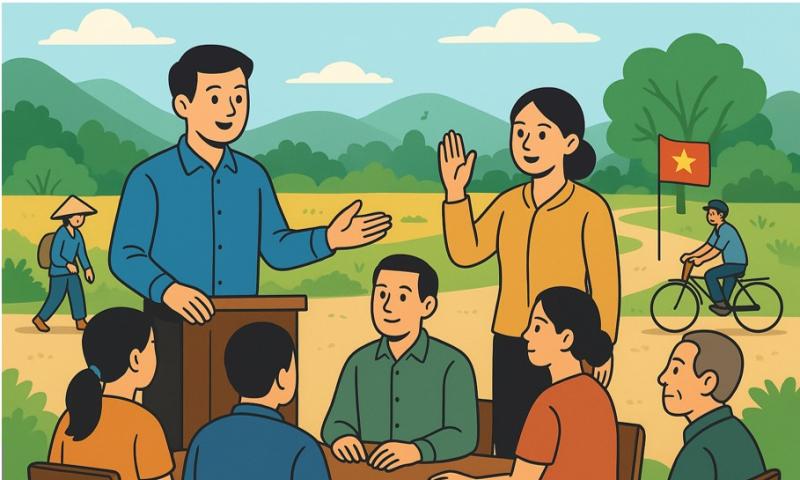
Vietnam’s Government in Transformation: Simplifying Bureaucracy and Empowering Citizens


The changes span provinces, districts, and communes, aiming to improve efficiency, streamline administration, and make governance more accessible to the people. This overview explores what is changing, why, and how it will impact citizens.
A Multi-Layered System
Historically, Vietnam’s government was complex and hierarchical:
• Communes/Wards: The local level (5,000–10,000 people), handling everyday services such as registration, permits, and basic infrastructure.
• Districts: The middle tier, overseeing budgets, IDs, land use, and family registration.
• Provinces: Regional authorities ensuring policies and laws reach local levels.
• National Government: Oversees the entire country, sets laws, and manages broad policy implementation.
Alongside this structure, organizations like the Women’s Union, Youth Union, and Fatherland Front provide citizens with a voice in civil life. The Communist Party guides overall policy, with over 5 million members shaping Vietnam’s socialist direction.
Vietnam’s Growth Trajectory
Over the past decade, Vietnam has sustained strong growth, averaging 6–7% annually, driven by a shift from agriculture to manufacturing and services, rising exports, and foreign investment. Real GDP per capita nearly doubled, improving living standards, and growth has often outpaced China’s due to Vietnam’s smaller base and rapid industrialization.
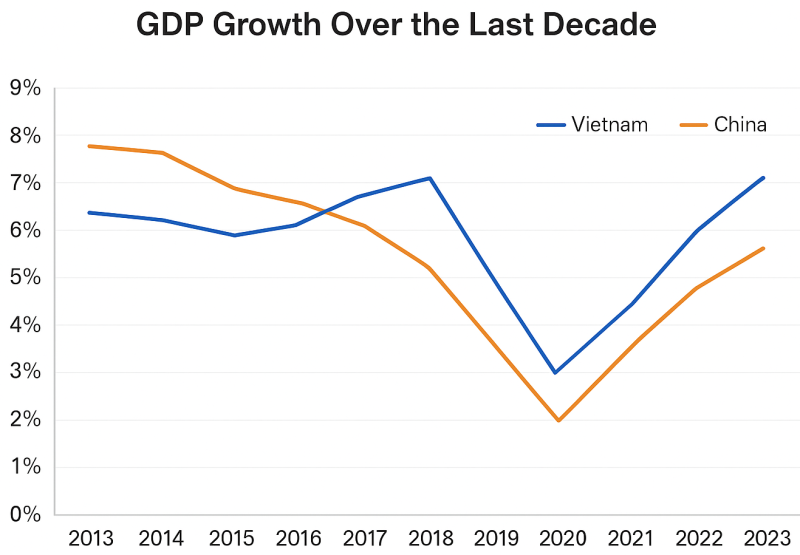
To maintain this momentum, the country will need structural reforms, higher productivity, and stronger local governance as reliance on low-cost labor and external demand becomes increasingly limiting. This sustained economic growth provides a crucial backdrop for the current government reforms, emphasizing efficiency and local empowerment as key levers to maintain development and meet the rising expectations of citizens.
Why the Old System Frustrated Citizens
The four-tier system was designed after 1975, in the postwar context. While it allowed for manageable local units, it often led to inefficiency:
• Citizens faced long waits for paperwork, as multiple layers had to approve each step.
• Simple tasks—like ID processing or marriage registration—could require multiple trips to both commune and district offices.
• Miscommunication and delays were common, frustrating citizens and slowing local development.
While the system supported social and economic progress, Vietnam’s growing population, digital infrastructure, and urbanisation exposed its limits.
The Case for Reform
Vietnam has achieved remarkable growth under the old structure, with modern infrastructure, healthcare improvements, and internet coverage. But outdated bureaucracy slowed service delivery and citizen participation.
The government recognized that a leaner, more efficient system was essential for:
• Streamlining decision-making
• Reducing duplication across layers
• Aligning governance with modern socio-economic challenges
2025: A Historic Restructuring
Provincial / Local Government Restructuring
• Reducing provincial units: From 63 provinces/cities to 34 (28 provinces + 6 centrally-governed cities) through mergers.
• Eliminating districts: The intermediate “district” level is abolished, creating a two-tier model: provinces → communes.
• Merging communes: Smaller communes and wards are consolidated, reducing the number by roughly 60–70%.
The effective date for these reforms is 1 July 2025.
Efficiency and Leaner Bureaucracy
• Provincial authorities now oversee communes directly, cutting administrative “hops” and reducing overhead costs.
• The restructuring also realigns Communist Party branches and state agencies to avoid redundancy and streamline functions.
• Merged provinces/cities reorganize personnel, assets, legal documents, and infrastructure management.
Goals
• Economic development: Larger units allow better planning, infrastructure investment, and resource allocation.
• Modern governance: Streamlined structures reduce duplication, improve digital administration, and adapt to urbanisation and globalisation.
• Political rationalisation: Fewer layers reduce bureaucratic overlap, improving state capacity and accountability.
Empowering Citizens at the Grassroots
A core aim of the reform is strengthening citizen participation at the commune level. Commune People’s Councils are directly elected by citizens every five years, giving residents a voice in local governance, budget decisions, and development priorities. While candidates are usually approved by the Communist Party, citizens now have a more direct influence over local leadership.
Grassroots Elections: Vietnam vs. China
Feature | Vietnam (Commune-Level) | China (Village-Level) |
Who votes | All eligible citizens in the commune | All eligible villagers |
What they elect | Members of the People’s Council, which oversees local administration and holds executive officials accountable | Village committees that manage local affairs and oversee village leaders |
Party involvement | Candidates must be approved by the Communist Party; non-Party candidates are rare | Candidates may be Party members or independents; elections are technically competitive, but Party influence is strong |
Scope of authority | Budget allocation, local development, social services, oversight of commune executive | Local administration, local infrastructure, dispute resolution, social welfare |
Frequency | Every five years | Typically every three years |
Takeaway: These elections provide citizens with a direct role in shaping local policies and services, reinforcing the reforms’ goal of a citizen-centered government.
Major Challenges
While ambitious, the reforms present several challenges:
• Transition costs: Merging provinces, abolishing districts, and reorganizing staff, assets, and legal documents is logistically complex.
• Local identity: Larger units may dilute community identity and alter power dynamics.
• Capacity at the commune level: Local governments must handle increased responsibilities effectively.
• Coordination: Merged units may span diverse regions, requiring careful planning and management.
• Accountability and representation: Citizens’ voices must remain strong in larger administrative units.
Legal and Policy Framework
Key documents underpinning these reforms include:
• Resolution No. 60 NQ/TW (April 2025): Approves reorganisation of administrative units and development of two-tier local government.
• Resolution No. 202/2025/QH15 (June 2025): Mandates restructuring of provincial-level units to take effect 1 July 2025.
• Decision No. 759/QD-TTg (April 2025): Provides detailed guidance on restructuring local government units.
• Conclusion No. 126 KL/TW (February 2025): Directs continued streamlining of Party and state organizations.
Self-Critique and Continuous Improvement
Vietnam has a tradition of self-reflection in governance. Past reforms, such as Đổi Mới in the 1980s, demonstrate that critical assessment and adaptation can drive progress. The current restructuring follows this philosophy: simplifying structures, improving efficiency, and empowering citizens at the grassroots level.
Looking Ahead
If implemented effectively, these reforms could:
• Accelerate decision-making at the provincial and commune levels.
• Allow more integrated infrastructure and economic planning.
• Reduce administrative costs, freeing resources for development and digital services.
• Improve the investment environment by simplifying local governance.
The long-term success will depend on careful management, adequate resourcing for communes, and integration with broader reforms in law, economy, Party governance, and digital administration. Vietnam’s government is taking a historic step: building a leaner, more responsive system where citizens play a stronger, more direct role in shaping policies and services in their daily lives.
From Bureaucracy to Empowerment: A New Era for Vietnam
Vietnam’s reforms are more than a bureaucratic overhaul—they are a blueprint for a government that listens and empowers. By streamlining administration and placing citizens at the heart of local decision-making, the country is transforming governance from a distant hierarchy into a participatory system. If successful, these changes won’t just cut red tape—they will amplify voices, strengthen communities, and prove that true progress begins at the grassroots.
«Vietnam’s Government in Transformation: Simplifying Bureaucracy and Empowering Citizens»