


War Without Peace – The U.S. Strategy Has Little to Do with Trump


Introduction
When I wrote the article “War Without Peace” in November 2022, my thoughts were focused on the war in Ukraine. I described Leo Tolstoy’s century-defining novel “War and Peace” in a single sentence: An epic in which many stories are woven together, around which a love story winds like roses around a pavilion—in the end, Natasha and Pierre find each other. A story, then, that despite the great carnage of the Napoleonic Wars, finds a romantic conclusion—a happy ending in the Russian style.
“A story isn’t truly complete until it has taken the worst possible turn”
In contrast, I recalled the Swiss writer Friedrich Dürrenmatt, who once said that a story is only truly told when it has taken the worst possible turn. In November 2022, I still harbored hopes that the conflict in Ukraine would end with a happy ending. Today I must admit that Dürrenmatt—far less romantic than Tolstoy—will likely be proven right. Not only does the war in Ukraine continue to rage, but violence and genocide now stretch across the entire Middle East. In this context, the US and Israel have miscalculated regarding Iran’s military strength, based on their incomprehensible misconception that a war can be won with air strikes alone, without a ground war. And this despite the fact that American history, in particular, shows that this has never worked. With control of the Strait of Hormuz, the Iranians hold an economic leverage that has taken all of the West’s supposed trump cards out of its hands and is likely to strengthen China and Russia rather than weaken them, as the American script had actually envisioned.
American Presidents as Prop – Trump Is No Exception
Whenever a new president has been elected since World War II, he has promised his voters greater prosperity, a better life, more peace, and more democracy. These promises have regularly gone unfulfilled, and it seems that Noam Chomsky is right: no president since World War II has been able to truly influence US foreign policy. The rich and powerful puppet masters—who are not elected but who staff key governmental and non-governmental institutions with their “envoys” and are referred to as the “deep state”—are the ones calling the shots.
JFK was an exception among presidents; he was determined to achieve his goals—against all odds. After the Bay of Pigs disaster, he fired Alan Dulles, intended to dismantle the CIA, opposed an escalation in Vietnam, ordered that the American Zionist Council (AZC)—the predecessor of AIPAC—be registered as a foreign agent, and attempted to prevent Israel from acquiring a nuclear bomb. In short: He did not follow the instructions of the deep state and was removed. Many know, or at least suspect, that this is how it happened, but even today, files that could reveal the truth are kept under lock and key. Probably not to protect individuals—they are likely all dead by now. Rather, a complete disclosure of the facts would show that the system actually operates as described. Documentary confirmation of what has just been described would likely cause lasting, perhaps even irreparable, damage to the image and credibility of the U.S. government—indeed, of the American “democratic system” as a whole. One can only speculate about the resulting consequences.
Trump, too, is in the same boat as his predecessors. He lacks the format of a JFK and will therefore not even be able to set positive tones. He will not disappoint his supporters. Where he actually differs from his predecessors is in his communication. No president has ever communicated like this. He does not see himself as a servant of the people, but wants to go down in history as the greatest, something he is unlikely to achieve. In every public appearance or tweet on True Social, he not only exposes his incompetence but also makes statements that do not stand up to even the most superficial scrutiny. His popularity stands in stark contrast to his self-absorption—he currently has an approval rating of just 38%. On top of that, the Epstein revelations and the handling of their disclosure raise questions that further undermine his credibility. (See also our article: “Epstein – ‘Concierge of Evil’ – Dangerous Questions”). Trump thus differs from his predecessors in that he acts (even) more unreliably and reveals a primitiveness and lack of complexity in his thinking that is likely unprecedented and poses a threat to the nation.
The Demise of the American Dream
At the outcome of every presidential election, the American people are presented with a new victor who claims to pursue policies that will please the majority of the population. The average American has simple desires—not specifically American ones, but desires that most people around the world likely share: a good life for themselves and their families, so they can live the American Dream. However, Americans have been taken for a ride for 75 years, and a single graph suffices as proof. In 1950, over 50% of married Americans could afford a home, fulfill the American Dream, and raise a family, with 65% of all mothers able to stay home with their children in 1950. Today, that figure is down to 15%. Despite the fact that most families today are dual-income households, only 12% of families can afford a home by the time they are 30. That says it all about the demise of the American Dream.

On the other hand, we see a concentration of wealth among the richest 1% of the population, who today hold 31.7% of the wealth, while the bottom 50% hold approximately 2.5%.
Since World War II, American presidents thus appear not to have cared about the well-being of the average citizen. There is no rational explanation for why the people still believe and trust these individuals to this day.
As an interim conclusion, we can therefore state that the influence of the US president is deliberately negligible and that the actual interests of the American people have been trampled upon by every administration—for 75 years.
Lies, Fraud, Theft, and War as Means of Maintaining Hegemony
The long-term strategy for maintaining American hegemony would be impossible to implement if every new president were free to pursue his own agenda, which might even include acting decently toward his own people and foreign countries.
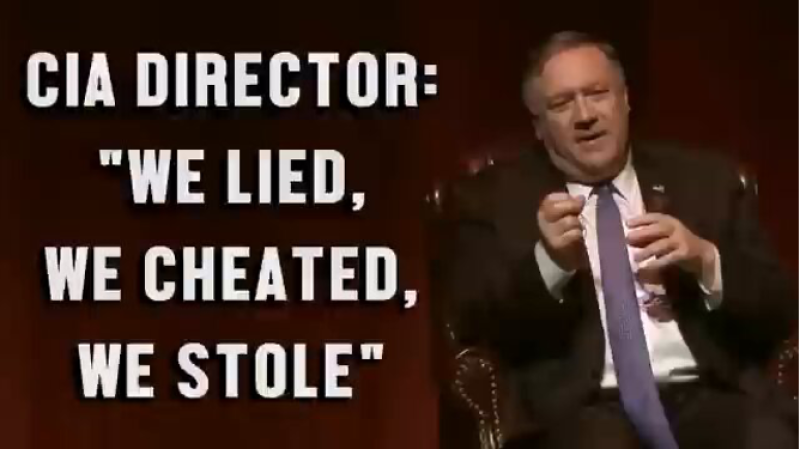
Maintaining hegemony necessarily requires, domestically, a complete disregard for the interests of one’s own population, and, in foreign policy, wars, war crimes, genocide, and treason, since American hegemony cannot be achieved through fair play, either at home or abroad. America’s industrial, financial, and other economic foundations have been eroded since 1945 by wars, corruption, and, in particular, irreversible deindustrialization. Mike Pompeo, former CIA director, confirmed this behavior when he proudly proclaimed on April 15, 2019:
«We lied, we cheated, we stole»
Mike Pompeo, 15 April 2019
The United States does not use force as a last resort, but often as a panacea—at the very latest when the opposing side does not immediately comply with the hegemon’s completely disproportionate ultimatums. The numbers speak for themselves: The Congressional Research Service has documented hundreds of instances in which U.S. armed forces have been deployed abroad since 1798, with a large portion of these occurring after 1945—251 military interventions between 1991 and 2022 alone. Other sources indicate that the US has initiated 201 out of 248 armed conflicts since World War II. A detailed—and certainly incomplete—account can be found on Wikipedia.
Most Americans are unaware of these figures; people prefer to talk about the police or security operations that are carried out solely to protect the safety of the American people. In the eyes of the general American public, the Korean War, the Vietnam War, the Gulf War, the war in Afghanistan, and the 2003 Iraq War are officially considered wars.
These astronomical figures for wars cost a staggering amount of money. So much money, in fact, that Trump was led to claim that the United States could not afford to fully fund government health and social programs such as Medicare, Medicaid, and child care because the costs of ongoing military operations were too high, citing in particular “wars” and the need for “military protection.”
Corruption at Mind-Boggling Levels
The US’ brutal and dishonest behavior toward everyone—including its own citizens—requires a very specific kind of personnel, who are apparently easy to find. These individuals operate according to the motto, “lie, cheat, and steal.” Thus, no one should be surprised that the US is one of the most corrupt countries in the world; though, of course, the US has no qualms about pointing the finger at many other countries regarding corruption and passing anti-corruption laws to divert attention from its own corruption.
Corruption is most evident in arms production. Equivalent weapons systems cost up to ten times more when they come from the US; for example, the Apache attack helicopter costs ten times more than its Russian counterpart, the Kamov KA-52, and is considered by experts to be equivalent. The result is disastrous: The US, which has the highest military spending in the world—with $1.5 trillion planned for 2027 according to the U.S. Department of Defense—has so far failed in its efforts against Iran with a budget of just over $9 billion.
“In Russia, corruption is a problem; in the US, it’s a business model”
Corruption has reached new heights during the ongoing war with Iran, with members of the Trump administration’s inner circle lining their pockets through insider trading. Here I refer to a detailed tweet by Peter Girnus, which not only documents these crimes but also notes that the authorities are doing nothing about them—a clear indication that corruption has become institutionalized.
Corruption exists everywhere—even in Switzerland, which is often considered so clean. If people are given the opportunity to steal, a significant portion of the population will be tempted by the lure of illicit money, and this happens more readily when the risk of getting caught is relatively low. In Russia, for example, corruption is a problem; in the US, it is a business model. In Russia, corruption is consistently combated and publicly exposed by the authorities. I have known Russia for 30 years and can confirm that corruption has declined dramatically, but it has not yet been eliminated.
The Russian authorities do not shy away from prosecuting even the powerful and putting them behind bars. The following case is worth mentioning. Shortly after Defense Minister Belousov took office, all of the deputies of the previous defense minister were found guilty of corruption on a significant scale. The most “notable” example is Timur Ivanov. He had already been sentenced to 13 years in prison in a separate case. That case involved the purchase of the strategically important Kerch ferries connecting to Crimea, as well as the embezzlement of funds from Interkommerz Bank. In addition, he was charged with accepting bribes totaling 1.4 billion rubles and securing a non-repayable loan for the construction of a sauna. In April 2026, another such trial against him began.
I am not aware of any case in the US where a high-ranking government official or military officer has been sentenced to a long prison term for corruption, as happens in Russia. This fact alone encourages corruption, because in the US, people do not have to fear being prosecuted.
Institutionalized corruption in the US is not only frustrating for all those who abide by the rules and laws, but ultimately accelerates the decline of the US, as these crimes drive up prices in the affected sectors—such as the defense industry. Furthermore, due to corruption in the defense industry, it is not the best weapons that are produced, but rather those manufactured by producers who most effectively bribe decision-makers. This results in many American weapons systems that, while astronomically expensive, are inferior to foreign weapons systems. Experts often cite the F-35 as an example.
Unwholesome Alliances
To achieve its goals, the US has always allied itself with shady rulers. This is a necessity, since leaders who look after the welfare of their own countries are not suitable for the US’s objectives in those nations and are replaced by the US through coups and overthrows with more suitable personnel. To cite just one example in connection with the Iran War, I mention the Shah of Persia, for whom the democratically elected President Mossadegh was sacrificed through the CIA/MI6 Operation “Ajax.” The Americans funneled billions to the Shah for the sell-off of Iranian resources and supported his hold on power through the deliberate establishment of the SAVAK secret police, which operated with a brutality on par with the Gestapo. Support for this effort came from the Mossad and former Gestapo members—an alliance that casts today’s Israeli actions in Gaza and Lebanon, along with German assistance in those efforts, in a shameful light. Most Iranians, however, continued to live in poverty. When the Shah was overthrown in 1979, they rose up not only because of poverty but also because of the country’s Westernization, which offended many devout Iranians. Since then, Iran has been one of the US’s mortal enemies.
Even as allies, the Americans are completely unreliable and treacherous. Take Saddam Hussein, for example, who was nurtured and supported by the US and supplied with loans and weapons to go to war against Iran in 1980, only to be removed from power once he was no longer of use to the US.
The most repugnant alliance, however, that the US has entered into is the one with Israel. Since the declaration of the State of Israel in 1948—in defiance of UN Resolution 181 of 1947, which called for a two-state solution—the US has supported Israel despite its illegal wars, expulsions, murders, and acts of genocide. The murder of Palestinians did not take place “behind the scenes” for the wider global public, even during the period from 1948 to 2023. Yet the genocide has been impossible for anyone to overlook since at least October 2023, and this with the most active complicity of the US. In the Western media, this genocide—which in no way falls short of the Nazis’ atrocities—does not exist; a sign that the Zionists completely control the Western press—including the Swiss press—through payment or blackmail.
I cannot imagine that this will not have devastating consequences for the US and the entire Western media in the medium and long term. In any case, our blog has already received information that a Swiss weekly magazine is receiving direct instructions from Israeli government agencies and dutifully promoting the genocide and the “Greater Israel” project—my contempt knows no bounds, and we will report on this in detail soon.
Despite Everything—that's Not Enough
Despite all the efforts of the US—its complete disregard for the interests of its own people, its alliance with genocidal psychopaths in Israel, the murder of millions of civilians around the world, and its perpetual state of war—the outlook for maintaining its hegemonic status is not looking good.
The US appears to have made a major strategic blunder. The Americans have already lost the war against Iran, because the US is incapable of sustainably weakening Iran from the air, let alone bringing it to its knees. Arrogance, hubris, and naivety, as well as the belief in Israeli assurances that Iran could be easily defeated, led to the ignoring of warning voices within the Pentagon that assessed Iran’s capabilities more realistically. Professor Mersheimer spoke about this in detail on Judge Napolitano: According to him, the Chairman of the Joint Chiefs of Staff, General Dan Caine, warned Trump against this adventure; however, Trump followed Netanyahu and Pete Hegseth, neither of whom has any useful military training. Mersheimer continued: never has a war been won from the air—and this time is no exception.
The US blockade is neither sustainable nor effective, nor can it be, given the vast territory that needs to be monitored and the fact that US ships are practically lost in it. Dozens of Iranian ships managed to get through despite the blockade—according to Larry Johnson. On top of that, the US is harming its allies with this action. On the other hand, Iran’s long-term control of this strait appears relatively easy to enforce, both militarily and, not least, legally. An ironic outcome of this war, considering that Hormuz was freely and openly accessible to all until the US-Iranian incursion.
The current de facto ceasefire is limited to Iran and the US. However, it is already being violated by the US naval blockade, since a blockade is considered an act of war. Israel—to no one’s surprise—is not observing the ceasefire in the West Bank, Gaza, or Lebanon. In their own view, they are not required to do so. As early as August 2025, Smotrich announced:
"International law does not apply to the Jews... and that is the difference between the chosen people and the others."
Bezalel Smotrich, Israeli Minister of Defense

Thus, there is no ceasefire at all. War is raging; only the Iranian and American weapons are currently silent.
Conclusion
The US, which has firmly held the reins of hegemony since 1945, finds itself unable to maintain its interpretation of its hegemonic status—one not justified by any mandate—in a peaceful manner through fair competition with the rest of the world. The current herald of the hegemon, who came to power with promises of peace, is employing means that until recently would have been—and still should be—considered unacceptable and despicable. The deep state thus appears to have hoisted the right man onto the throne in Washington at the right time. A man whose mind is so dominated by his pathological narcissism that he is incapable of self-reflection. It began with the blackmailing of competitors (China) and allies (Europe) through tariffs intended to compensate for the US’s lack of competitiveness; he then sought to extort an entire country (Greenland) from Europe. He then kidnapped President Maduro in Venezuela to gain access to the world’s largest proven oil reserves, only to ultimately join forces with the psychopaths in Tel Aviv in an attack on a civilization that has not attacked any other country for longer than the US has existed as a nation.
If he were to succeed in this, future history books—which, as is well known, are written by the victors—might treat such actions leniently, even though they differ in no way from the actions of the Nazis. As always in world history, parties not directly involved stand by and watch the cruel events unfold, and then, once the winner is foreseeable, will side with them. This is already evident among the Gulf states, whose recipe for success has always been opportunism. The spineless German Chancellor Merz, who initially applauded the war against Iran, is already speaking of strategic American mistakes and the necessity of making peace with the Russians even if Ukraine has to cede territory. He senses that the wind is shifting, and with it, the flag of the fickle chancellor shifts as well.
China, along with its ally Russia—the ultimate target of the US—is demonstrating through its reserved approach that it will not abandon Iran. Based on the information available to me, I cannot confirm with certainty that Chinese and Russian support includes arms shipments and military satellite intelligence, but it appears to be the case. Since I consider both the Russians and the Chinese to be loyal allies of Iran, and since Persia is of vital importance to both, I assume that these two giant empires will consistently support Iran, which ultimately does not rule out a direct armed conflict between China and Russia on one side and the US on the other. It appears that China and Russia believe Iran can prevail on its own in this conflict in order to prevent a direct conflict with the US. By calling for a ceasefire, the US seems to be stalling for time to bring more military supplies into the Middle East, which, according to Flightradar data, is indeed happening around the clock.
“War without peace does indeed seem to be the order of the day.”
We are thus looking at a self-assured Iran that sees no reason to deviate from the demands of its 10-point plan, which Trump initially viewed favorably, during negotiations; an America that may feel compelled to prove to the world that it is the strongest; and a China and Russia that both appear determined not to abandon Iran under any circumstances. Truly a Gordian knot that is more likely to explode than to be untangled by deft diplomatic fingers. War without peace seems to be the order of the day.
«War Without Peace – The U.S. Strategy Has Little to Do with Trump»